

Case Background
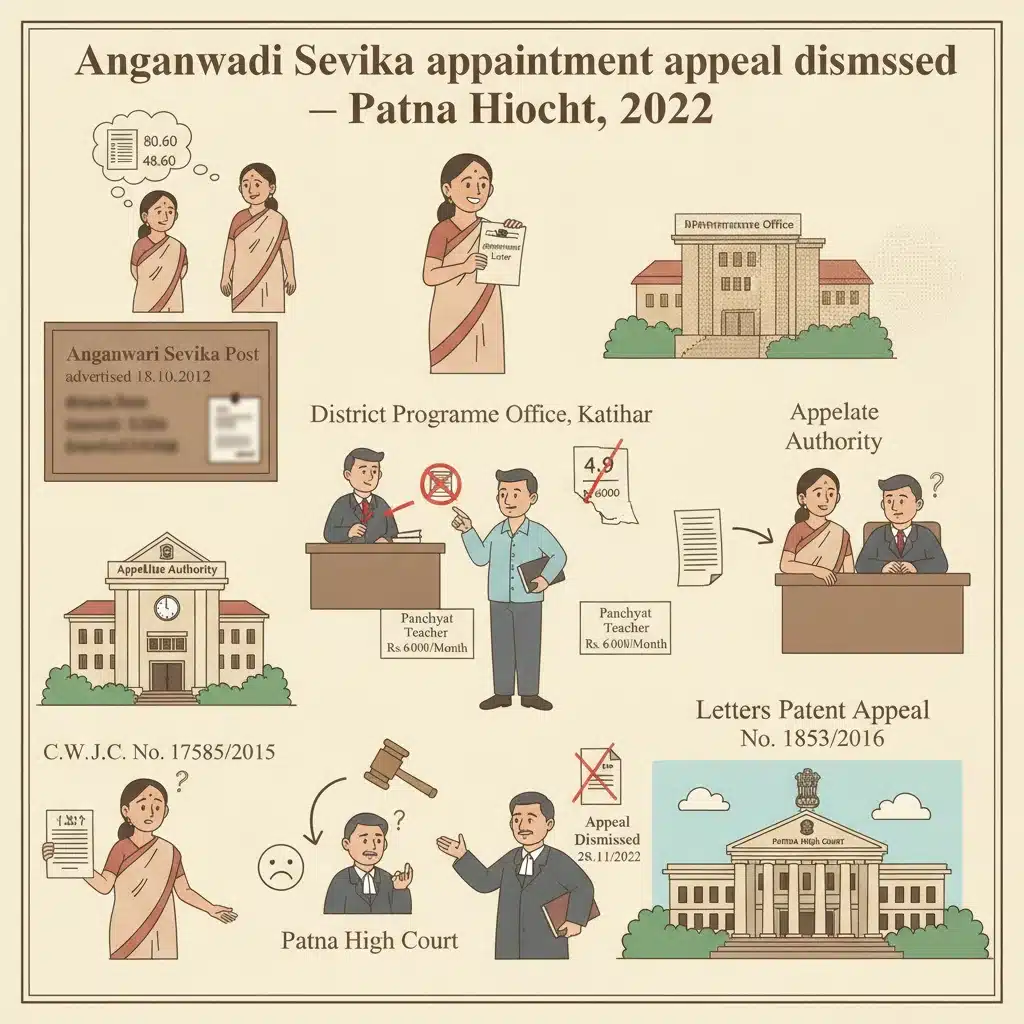
This case arises from recruitment to the post of Anganwari Sevika pursuant to an advertisement dated 18.10.2012.
The appellant and the private respondent were both candidates for the same Anganwari Sevika post. The appellant secured 80.60 marks, while the private respondent secured 48.60 marks.
On the basis of her higher marks, the appellant was appointed as Anganwari Sevika on 02.07.2013.
Feeling aggrieved by this appointment, the private respondent filed a representation before the District Programme Officer. She requested that the appellant’s appointment be cancelled and that she herself be appointed. This representation was rejected.
The private respondent then filed an appeal before the Appellate Authority. On 30.07.2015, the Appellate Authority allowed the appeal and set aside the appellant’s appointment.
Against this, the appellant filed Civil Writ Jurisdiction Case No. 17585 of 2015 under Article 226 of the Constitution of India before the Patna High Court. On 23.08.2016, a learned Single Judge dismissed the writ petition and affirmed the Appellate Authority’s order.
The appellant then filed the present Letters Patent Appeal (L.P.A. No. 1853 of 2016) before a Division Bench of the Patna High Court challenging the judgment of the Single Judge.
What the Court Examined and Decided
The Division Bench, consisting of Hon’ble Mr. Justice P. B. Bajanthri and Hon’ble Mr. Justice Purnendu Singh, heard the appeal and delivered an oral judgment on 28.11.2022.
The core dispute was whether the appellant’s appointment as Anganwari Sevika could stand in view of a specific eligibility condition in the government guidelines.
The State government had issued guidelines in the year 2011 regarding selection and appointment of Anganwari Sevika. These guidelines included an amended clause 4.9. As per the reading of the Court, this clause made a candidate ineligible if his or her parent was working and drawing a sum of Rs. 6,000 per month.
In this case, it was not disputed that the appellant’s father was a Panchayat Teacher and was drawing Rs. 6,000 per month. Because of this fact, the authorities treated the appellant as ineligible under the guidelines.
On behalf of the appellant, senior counsel argued that both the Appellate Authority and the learned Single Judge had committed an error in not appreciating the case on merits. The appellant accepted that her father was a Panchayat Teacher earning Rs. 6,000 per month, but she argued that this should not be a hurdle.
The appellant relied on a previous decision of the Patna High Court in C.W.J.C. No. 13210 of 2014. In that case, the Court had set aside amended guideline 4.9, holding that such a clause violated Articles 14 and 16 of the Constitution of India. Based on this, the appellant contended that the disqualification relating to her father’s income could not be used against her.
The appellant also submitted that she had validly participated in the Aam Sabha process of selection, and this was another aspect not properly appreciated by the Appellate Authority or the Single Judge.
In response, counsel for the State and for the private respondent argued that there was no infirmity in the orders of the Appellate Authority or the Single Judge. They pointed out that the 2011 guidelines, read together with the amended clause, clearly barred candidates whose parents were working and earning Rs. 6,000 per month from being selected as Anganwari Sevika.
They further submitted that the earlier decision in C.W.J.C. No. 13210 of 2014 was not applicable to the present case. The crucial distinction, according to them, was that the appellant in this case had never challenged the specific guideline which made her ineligible. Therefore, she could not claim the benefit of that earlier decision.
The Division Bench then identified the core issue: whether the appellant had challenged clause 4.9 of the guidelines, and if not, whether she could still claim relief on the basis of the decision in C.W.J.C. No. 13210 of 2014.
The Court noted several undisputed facts. First, both the appellant and the private respondent were candidates in response to the advertisement dated 18.10.2012. Second, while the appellant was more meritorious in terms of marks, her father was a Panchayat Teacher drawing Rs. 6,000 per month. Third, the guidelines treated such a situation as a disqualification for appointment as Anganwari Sevika.
The Court observed that, in light of these guidelines, the appellant had been made ineligible because of her father’s income. Crucially, the appellant had never directly challenged the clause of the guidelines that brought about this ineligibility.
The Court accepted that the appellant had participated in the Aam Sabha during the selection process. However, it treated the failure of the Appellate Authority and the Single Judge to notice this participation as only a minor error, which did not change the legal position. Even if that aspect had been considered, the appellant remained ineligible because of the unchallenged guideline regarding her father’s income.
Because the appellant had not attacked the very clause which rendered her ineligible, the Bench held that she could not rely on the earlier judgment in C.W.J.C. No. 13210 of 2014. That order, though it had set aside amended guideline 4.9 in another matter, did not automatically grant relief to a person who had not himself or herself questioned the validity of the clause in their own proceedings.
In simple terms, the Court’s view was that a candidate must specifically challenge the rule that disqualifies them if they want the Court to ignore or strike down that rule. Since the appellant had not done so, the authorities were entitled to treat her as ineligible under the existing guidelines.
After hearing both sides and examining the record, the Division Bench concluded that the appellant had failed to make out any case for interference. The finding of the Appellate Authority that she was ineligible due to her father’s income was in accordance with the guidelines, and the Single Judge had rightly upheld it.
Accordingly, the Letters Patent Appeal was dismissed. The Court did not grant any further relief to the appellant, and the cancellation of her appointment as Anganwari Sevika remained in force.
Why This Judgment Matters
This judgment has important practical consequences for Anganwadi recruitment and similar government schemes in Bihar.
First, it shows that even a more meritorious candidate can lose an appointment if a specific eligibility rule disqualifies them. In this case, the appellant’s higher marks could not save her appointment because the guideline about parental income was still in force and unchallenged.
Second, it underlines that people affected by a rule must directly challenge that rule if they believe it is illegal or unconstitutional. Merely relying on another case where a similar clause was struck down will not be enough unless the same issue is properly raised in their own case.
Third, the judgment confirms that authorities and courts will strictly follow recruitment guidelines unless they are specifically set aside. For candidates in Anganwari or other welfare posts, understanding these conditions is crucial before and after applying.
For villagers and applicants in Bihar, especially women aspiring to become Anganwari Sevika, this decision is a reminder to carefully check all eligibility criteria, including conditions relating to family income or employment, and to seek timely legal advice if such criteria are to be questioned.
Legal Issues and Answers
-
Issue: Could the appellant, whose father was a Panchayat Teacher earning Rs. 6,000 per month, claim entitlement to the Anganwari Sevika post despite the guideline disqualifying such candidates?
Answer: No. The Court held that the guideline made her ineligible, and since she had not challenged that specific clause, she could not claim appointment on par with the decision in C.W.J.C. No. 13210 of 2014. -
Issue: Did the appellant’s higher marks and participation in the Aam Sabha process justify interference with the Appellate Authority’s order?
Answer: No. The Court treated the oversight about her participation in Aam Sabha as a minor error which did not affect the outcome, because her basic ineligibility under the guidelines remained.
Cases Cited by the Court
- The Court referred to C.W.J.C. No. 13210 of 2014, where amended guideline 4.9 had been set aside. However, it held that this decision did not assist the appellant because she had not challenged the relevant clause herself.
Case Details
Case Number: Letters Patent Appeal No. 1853 of 2016 in Civil Writ Jurisdiction Case No. 17585 of 2015
Case Title: Anjum Ara v. The State of Bihar & Ors.
Coram: Hon’ble Mr. Justice P. B. Bajanthri and Hon’ble Mr. Justice Purnendu Singh
Date of Judgment: 28.11.2022
Citation: 2022(4) PLJR 757
Advocates:
- For the appellant: Mr. Shivendra Kishore, Sr. Advocate; Mr. Nafisuzzoha, Advocate
- For the State: Mr. Sunil Kumar Mandal, SC-3; Ms. Neelam Kumari, AC to SC-3; Mr. Bipin Kumar, AC to SC-3; Mr. Arjun Prasad, AC to SC-3
- For the private respondent: Mr. Rajendra Naraian, Sr. Advocate; Mr. Sanjeev Kumar Singh, Advocate
Nature of the case: Letters Patent Appeal against dismissal of writ petition challenging cancellation of Anganwari Sevika appointment
Link to full judgment: Patna High Court Judgment
If you found this explanation helpful and wish to stay informed about how legal developments may affect your rights in Bihar, you may consider following Samvida Law Associates for more updates.




