

Case Background
The case arises from Madhepura P.S. Case No. 879 of 2021, registered on 12.11.2021 for offences under Sections 392 and 397 of the Indian Penal Code and Section 27 of the Arms Act against unknown persons.
According to the written report, the informant was robbed of Rs. 23,570/- by two persons riding a motorcycle. Later, during investigation, the name of the present appellant surfaced in the confessional statement of a co-accused. The prosecution case also states that the appellant himself confessed before the police about his involvement.
However, the judgment records that nothing incriminating was recovered from the appellant. Despite this, he was treated as a child in conflict with law and was kept in an Observation Home from 27.03.2023.
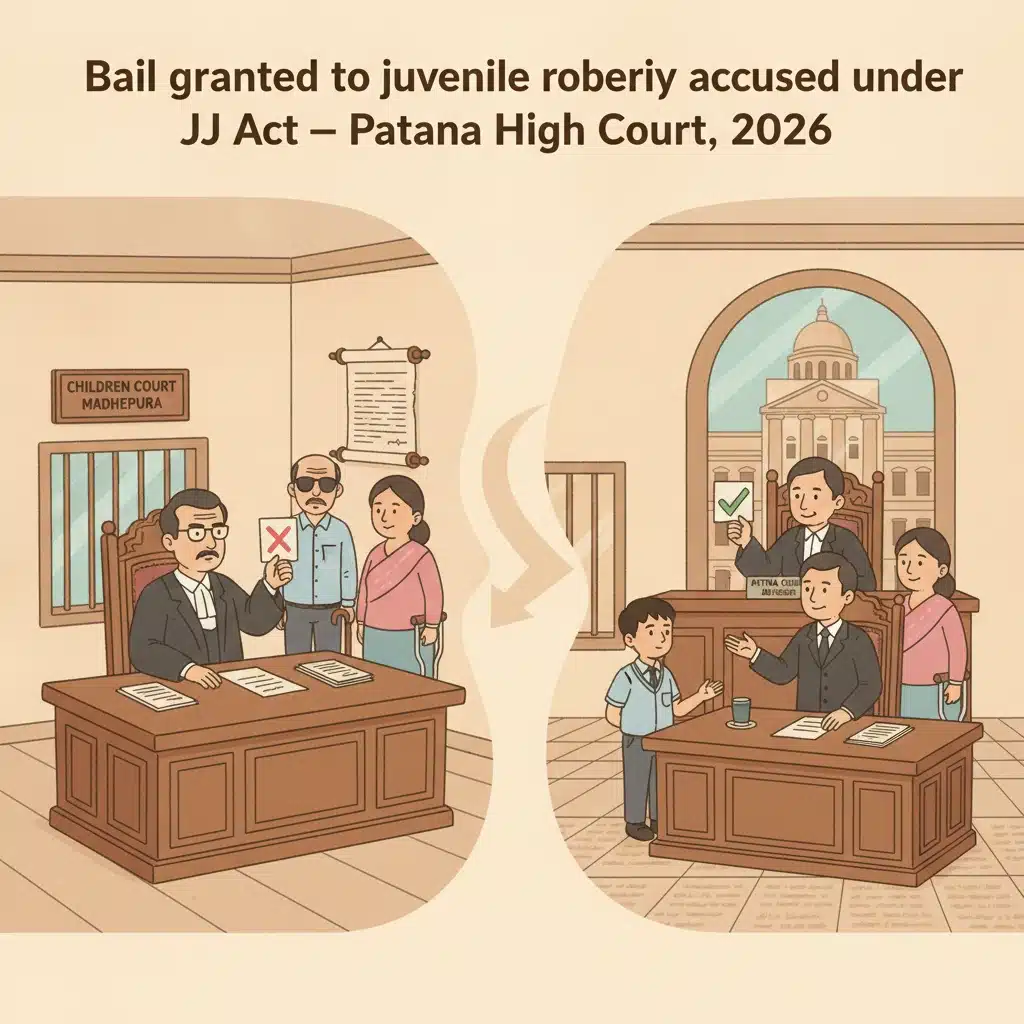
In Children Case No. 23 of 2024, the appellant moved Bail Petition No. 1590 of 2025 before the Children Court (1st Additional Sessions Judge, Madhepura-cum-Special Judge, Children Court and SC/ST (Prevention of Atrocities) Act). On 26.06.2025, the Children Court rejected his regular bail under Section 12 of the Juvenile Justice (Care and Protection of Children) Act, 2015 (J.J. Act).
Aggrieved, the appellant filed Criminal Revision No. 1031 of 2025, which came before the Patna High Court as Criminal Appeal (SJ) No. 623 of 2026. This appeal challenged only the bail rejection order, not the entire criminal case.
What the Court Examined and Decided
The Patna High Court, presided over by Hon’ble Mr. Justice Jitendra Kumar, heard the appellant through counsel and the State through the Additional Public Prosecutor.
Counsel for the appellant argued that the juvenile was innocent and had been falsely implicated, not only in this case but also in several others. The judgment notes that, according to the defence, the appellant had been implicated in eight other cases. In six of those he had already been acquitted, and in two he was on bail, with one of those cases pending in addition to the present one.
The defence highlighted the appellant’s socio-economic background. He belongs to an extremely poor family, living in a thatched house. His father, though educated up to M.A., is blind due to an accident. His mother is physically challenged, and his sister is already married. The entire family depends on the appellant for support.
The appellant had been a student of Class 11 at B.N.M.V. College, Madhepura. The Social Investigation Report described him as of good conduct, religious in nature, and cordial in his behaviour with family members and other people. Importantly, the report stated that he had not been used by any gang or criminal.
It was further argued that the Children Court’s finding that the appellant was in contact with anti-social elements had no basis in the record, especially when the Social Investigation Report did not support such a conclusion. The appellant had been remanded in this case from another pending case and had been in the Observation Home since March 2023, causing disruption to his studies and hardship to his family.
The State opposed bail, with the learned APP submitting that there was no illegality or infirmity in the Children Court’s order.
Before applying the facts, the Patna High Court undertook a detailed examination of Section 12 of the J.J. Act, 2015, which governs bail for children in conflict with law. The Court reproduced Section 12 and emphasised that:
• Any person who is apparently a child and alleged to have committed a bailable or non-bailable offence must be released on bail with or without surety or placed under supervision or in the care of a fit person.
• Bail can be refused only if there are reasonable grounds to believe that release is likely to bring the child into association with any known criminal, or expose the child to moral, physical or psychological danger, or if release would defeat the ends of justice.
The Court stressed that Section 12 overrides the usual provisions of the Code of Criminal Procedure. It held that, under the J.J. Act, bail to a juvenile is the rule and refusal is the exception.
To support this understanding, the Court cited several decisions:
• The Supreme Court in Juvenile in Conflict with Law v. State of Rajasthan, 2024 SCC OnLine SC 5297, which held that a juvenile must necessarily be released on bail unless the proviso to Section 12(1) applies and a clear finding is recorded.
• The Supreme Court in Re: Exploitation of Children in Orphanages in the State of T.N. v. Union of India, (2020) 14 SCC 327, which clarified that bail may be denied only on the three specific grounds mentioned in the proviso and that children cannot be kept in jail or police lock-up.
• High Court decisions from Bombay, Karnataka, Allahabad, Punjab and Haryana, Rajasthan, and Uttarakhand, all reinforcing that the seriousness of the offence, the age of the juvenile, or the gravity of charges are not independent grounds to deny bail under Section 12. Instead, the decision must be rooted in actual material showing the risk of association with criminals, exposure to danger, or that release would defeat the ends of justice.
The Patna High Court also quoted the preamble and Section 3 of the J.J. Act to underline that the law is child-centred and aims at reform, rehabilitation, and social reintegration, not punishment. Concepts like “best interest of the child”, “principle of safety”, “positive measures”, “family responsibility”, “institutionalisation as a measure of last resort”, and “repatriation and restoration” were highlighted.
From these provisions and precedents, the Court summarised the legal position:
• Section 12 applies to all juveniles, including those aged 16–18 alleged to have committed heinous offences.
• The nature and seriousness of the offence are not relevant criteria for bail under Section 12.
• “Ends of justice” in this context means the welfare, protection, development, and rehabilitation of the child, not the punitive aims of general criminal law.
• The family is the primary institution for the child’s care and rehabilitation; institutionalisation is a last resort.
• Denial of bail must be reasoned and based on material, especially the Social Investigation Report.
Turning to the present case, the High Court examined the Children Court’s reasons. The lower court had rejected bail mainly because the appellant allegedly had association with anti-social elements and had eight criminal antecedents.
The High Court found that this finding about association with criminals was not supported by facts. On the contrary, the Social Investigation Report described the child as of good behaviour, not used by any gang or criminal, and facing cases due to alleged false implication by hostile co-villagers. The report also showed that the entire family was dependent on him.
The Court noted that in such circumstances, keeping the child in the Observation Home was harming his best interests. He was unable to continue his education and could not support his physically challenged parents. Detention, therefore, was not helping his protection, development, or rehabilitation.
Applying Section 12 and the principles of the J.J. Act, the Court concluded that none of the three statutory grounds for denying bail were made out:
• There was no material to show that his release would bring him into association with known criminals.
• There was no material suggesting that he would be exposed to moral, physical or psychological danger if released to his family.
• Considering the aim of the J.J. Act, his continued detention would in fact go against the ends of justice, not his release.
Accordingly, the Patna High Court allowed the appeal. It set aside the impugned order dated 26.06.2025 and directed that the appellant be released on bail on furnishing a bail bond of Rs. 10,000/-.
Release was made subject to an undertaking by his father, through affidavit, that he would keep vigil over the child’s habits, would not allow him to come in contact with criminal persons, would take care of his developmental needs, and would ensure his appearance in court as and when required.
Going further, the Court recognised the family’s “stark poverty”. It directed the District Magistrate, Madhepura, to take welfare measures in favour of the appellant and his parents, if permissible under government schemes. Examples mentioned include providing a pucca house and grant of grains or any other welfare scheme benefits.
The Court also directed the Secretary, District Legal Services Authority (DLSA), Madhepura, to collaborate with the District Magistrate in these benevolent steps. The purpose, as recorded, was to ensure that the appellant is properly reformed and rehabilitated and that his family is prevented from being ruined.
Why This Judgment Matters
This judgment is important for families of children in conflict with law across Bihar and beyond. It clearly explains that under the Juvenile Justice Act, a child must normally be released on bail, regardless of how serious the alleged offence is.
Court or Board cannot refuse bail just because of the type of charge or the number of cases. They must look at concrete material, especially the Social Investigation Report, to decide whether release will truly harm the child’s welfare or associate him with criminals.
For poor families, this decision shows that the Patna High Court expects authorities not only to follow the law on juvenile bail but also to connect deserving children and their families with government welfare schemes.
For practitioners and lay persons, the judgment reinforces that “ends of justice” under the J.J. Act means what is best for the child’s growth and rehabilitation, not simply punishment.
Legal Issues and Answers
- Issue: Whether a juvenile accused of robbery could be denied bail under Section 12 of the J.J. Act, 2015 solely on the basis of alleged criminal antecedents and a general observation of association with anti-social elements.
Answer: No. The Patna High Court held that bail to a juvenile is the rule, and refusal is permissible only if one of the three specific grounds in the proviso to Section 12(1) is supported by material. In this case, the Social Investigation Report showed good conduct and no association with criminals, so bail could not be denied. - Issue: How should “ends of justice” be understood while deciding bail for a child in conflict with law under Section 12.
Answer: The Court held that “ends of justice” in the J.J. Act is child-centric and tied to the child’s protection, development, and rehabilitation. Detention may defeat the ends of justice if it harms the child’s education, family support, or prospects of reform, as happened here. - Issue: What role does the Social Investigation Report play in deciding juvenile bail.
Answer: The Court stated that denial of bail must be reasoned and based on relevant facts, with the Social Investigation Report being one of the most important materials. Here, that report supported the child’s bail and contradicted the Children Court’s view about association with anti-social elements.
Cases Cited by the Court
- Juvenile in Conflict with Law v. State of Rajasthan, 2024 SCC OnLine SC 5297
- Re: Exploitation of Children in Orphanages in the State of T.N. v. Union of India and Others, (2020) 14 SCC 327
- XYZ v. State of Maharashtra, 2023 SCC OnLine Bom 2790
- XXX (accused before the J.J. Board) v. State and Others, MANU/KA/3957/2024 (Karnataka High Court)
- Radhika (Juvenile) v. State of U.P., 2019 SCC OnLine All 4911
- Vishvas v. State of Punjab, MANU/PH/0067/2021
- Gau v. State of Rajasthan, 2025 SCC OnLine Raj 2526
- X (Juvenile in conflict with law) v. State of Uttarakhand, 2025 SCC OnLine Utt 157
- Lalu Kumar @ Lal Babu v. State of Bihar, 2019 (6) BLJ 2016
- Abhishek v. State, 205 CriLJ (NOC) 115 (Delhi)
- Manoj v. State (NCT of Delhi), 2006 CriLJ 4759
- Biswajit Kumar Pandey @ Lalu Kumar v. State of Bihar (cited as “supra”)
- Nitish Kumar v. State of Bihar (cited as “supra”)
- Chandan Kumar Paswan v. State of Bihar (cited as “supra”)
- Rakesh Rai v. State of Bihar (cited as “supra”)
- Avnish Kumar v. State of Bihar (cited as “supra”)
Case Details
Case Number: Criminal Appeal (SJ) No. 623 of 2026 in Criminal Revision No. 1031 of 2025; arising out of Madhepura P.S. Case No. 879 of 2021.
Case Title: Bittu Kumar @ Bittu Yadav v. The State of Bihar & Anr.
Coram: Hon’ble Mr. Justice Jitendra Kumar
Advocates: Mr. Diwakar Prasad Singh, Advocate for the appellant; Ms. Usha Kumari 1, APP for the State.
Nature of the Case: Criminal appeal (against rejection of regular bail) in a juvenile matter under the Juvenile Justice (Care and Protection of Children) Act, 2015, arising from a robbery case under the IPC and Arms Act.
Date of Judgment: 02.07.2026
Trial Court Order Challenged: Order dated 26.06.2025 of the 1st Additional Sessions Judge, Madhepura-cum-Special Judge, Children Court and SC/ST (Prevention of Atrocities) Act in Children Case No. 23 of 2024, rejecting Bail Petition No. 1590 of 2025.
Link to Judgment: https://patnahighcourt.gov.in/viewjudgment/MjQjNjIzIzIwMjYjMSNO-k–am1–r–ak1–QGHa4UY=
If you found this explanation helpful and wish to stay informed about
how legal developments may affect your rights in Bihar,
you may consider following Samvida Law Associates for more updates.




