

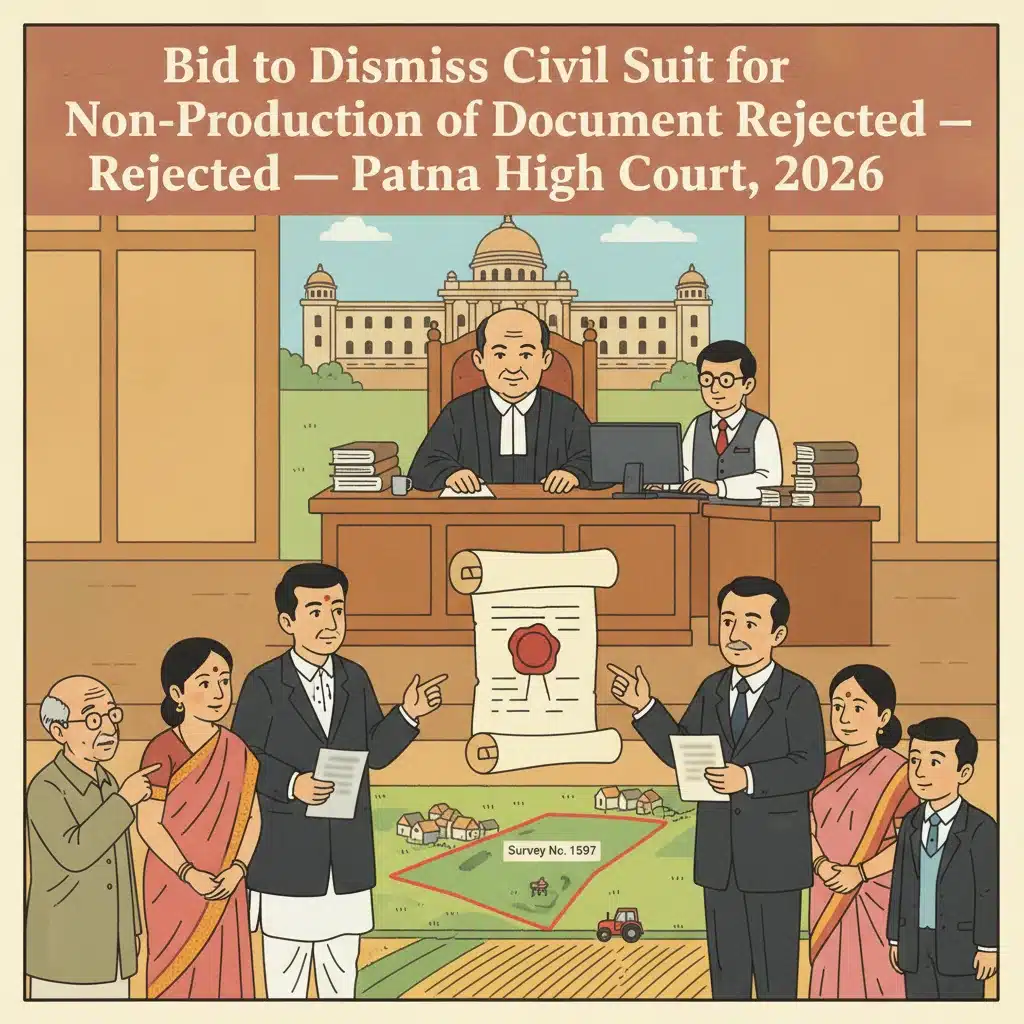
Case Background
The dispute arises out of a land transaction at village Manik Pur, P.S. Gopalganj, District Gopalganj. The land is part of Survey No. 1597, measuring 3 katha 10 dhur.
According to the plaintiff in the title suit, the land originally belonged to one Ram Nirekhan Singh of village Bhikha Chapra. He is said to have transferred this land to Babu Madan Gopal Prasad for valid consideration.
Later, Madan Gopal Prasad filed Partition Suit No. 182 of 1970 before the Sub Judge, Chapra, against his brothers and mother. In that suit, the joint family properties, including Survey No. 1597, were partitioned on the basis of a compromise.
Under this compromise, as pleaded by the plaintiff, the northern portion of Survey No. 1597, measuring 1 katha 5 dhur, went to the share of Madan Gopal Prasad. The southern portion, measuring 2 katha 5 dhur, went to his brother Dwarika Prasad. The remaining brothers and the mother did not get any share in this particular land.
The present dispute started when, on 01.01.2016, the plaintiff came to know that two family members (arrayed as defendant nos. 1 and 2) had executed documents in favour of another relative (arrayed as defendant no. 3) regarding the same land.
The plaintiff made enquiries in the Registry Office at Gopalganj. On 04.01.2016 he obtained a certified copy of the sale deed dated 28.12.2015 said to be executed by defendant nos. 1 and 2 in favour of defendant no. 3.
After seeing the document, the plaintiff alleged that the sale deed was forged and fabricated. He said it was created by committing forgery and was not binding on him.
On this basis, he filed Title Suit No. 305 of 2016 in the civil court, Gopalganj. He sought a declaration that the sale deed in favour of defendant no. 3 is forged, void, fabricated and not binding on him, along with other related reliefs.
Defendant no. 3, the purchaser of the land, appeared in the title suit. He filed a written statement contesting the case.
His stand was that during his lifetime, Madan Gopal Prasad had already partitioned his properties among his four sons. Each son, according to him, had come into possession of his share and was dealing with it independently.
Defendant no. 3 further claimed that the disputed land, along with other properties, had fallen to the share of Most. Sangeeta Prasad (arrayed as one of the defendants). She allegedly needed money for the marriage of her daughter and for higher education of her son, Shivam Kumar (defendant no. 2). Therefore, she sold the land to defendant no. 3 for valid consideration and delivered possession.
He denied other allegations in the plaint and prayed for dismissal of the suit with costs.
After filing his written statement, defendant no. 3 moved an application dated 11.04.2022 under Section 151 of the Code of Civil Procedure (CPC). In this petition, he requested the trial court to direct the plaintiff to produce the compromise decree passed in Partition Suit No. 182 of 1970, which had been referred to in the plaint.
As per the petitioner’s argument before the High Court, the trial court had issued directions to the plaintiff to produce the compromise decree. Several adjournments and opportunities were given but, according to him, the plaintiff failed to obey the court’s direction.
On this basis, defendant no. 3 prayed before the trial court that the title suit itself be dismissed for non-compliance with the court’s order to produce the document.
The trial court, by order dated 28.02.2023 in Title Suit No. 305 of 2016, rejected this petition of defendant no. 3.
Aggrieved by the rejection, defendant no. 3 filed Civil Miscellaneous Jurisdiction No. 776 of 2023 before the Patna High Court, seeking to quash the trial court’s order. This civil miscellaneous application led to the present judgment.
What the Court Examined and Decided
The Patna High Court, through Hon’ble Mr. Justice S. B. Pd. Singh, heard learned counsel for both sides. The central question was narrow: can a civil suit, already admitted, be dismissed at an initial stage merely because the plaintiff has not yet produced a particular document referred to in the plaint, despite a direction of the court?
On behalf of the petitioner (defendant no. 3), it was argued that the plaintiff had been directed to produce the compromise decree of Partition Suit No. 182 of 1970. Despite several chances, he did not bring it on record. Therefore, relying on Order XI Rules 15 and 21 read with Section 151 CPC, it was contended that non-compliance with the court’s direction must result in dismissal of the suit for want of prosecution.
In simple words, the petitioner wanted the High Court to hold that if a party does not produce a directed document, the case should be thrown out.
For the respondent-plaintiff, it was submitted that no such drastic consequence is provided in law for mere non-production of a document. The plaintiff’s counsel stated that despite due diligence and best efforts, the plaintiff had not yet been able to obtain a certified copy of the compromise decree from the Civil Court at Chapra.
He informed the Court that an application for obtaining the certified copy had already been filed there, and a certified copy of the suit register was annexed to show that the partition suit and compromise did exist. It was also highlighted that in the written statement, defendant no. 3 had not specifically denied the averment regarding the compromise decree.
The plaintiff assured that he was making earnest efforts to secure the certified copy and would produce it before the trial court immediately after obtaining it from Chapra.
To decide the legal question, the Patna High Court examined the relevant provisions of the CPC. It first noted that the title suit had already been admitted and the defendant’s written statement had been filed. This meant that the court had already applied its judicial mind at the stage of admission. Therefore, the compromise decree could not be treated as the basis of admitting the suit.
The Court then discussed Order VII Rule 14 of the CPC, which deals with production of documents on which the plaintiff sues or relies. Sub-rule (1) requires that where the plaintiff sues upon a document or relies upon a document in his possession or power, he must list and file it with the plaint.
Sub-rule (2) is important where the document is not in the plaintiff’s possession or power. In that situation, the plaintiff must state, wherever possible, in whose possession or power the document is.
Sub-rule (3) provides that if such a document is not produced or listed when it should have been, it cannot be received in evidence at the hearing without the leave of the court.
The High Court emphasised that, under Rule 14(2), the law itself recognises that sometimes a plaintiff may not have a document in his possession or power. In such cases, he only needs to state whose custody it is in. The plaintiff in this case had asserted that he was trying to obtain a certified copy of the compromise decree and had attached a copy of the relevant suit register.
The Court also referred to Order XIII Rule 1 CPC, which states that parties must produce, on or before the settlement of issues, all documentary evidence in original where copies were filed with the plaint or written statement. The Court receives such documents if they are accompanied by an accurate list.
This provision shows that the appropriate time for producing original documents is up to the settlement of issues. In the present case, issues had not yet been framed, and the suit had not reached its first hearing.
The petitioner had heavily relied on Order XI Rules 15 and 21 CPC. Order XI deals with discovery and inspection of documents and answering interrogatories. Rule 21 allows the court to dismiss the suit (or strike out the defence) if a party wilfully disobeys an order for discovery or inspection.
However, the High Court examined these rules closely. It noted that, for Rule 21 to apply, the party must first have followed the process under Rule 15. Rule 15 requires that a party give notice to the other side to produce documents referred to in their pleadings or affidavits. The manner of giving notice is set out in Rule 16, which requires a notice in a prescribed form.
In this case, the High Court recorded that there was “no whisper” of any such notice from the petitioner-defendant to the plaintiff. Since this pre-condition under Rule 15 had not been followed, the penalty provided under Rule 21 could not apply.
Therefore, the Court held that the provision had been misconstrued by the petitioner. Simply put, because no formal notice to produce under Order XI had been served, the extreme step of dismissing the suit under Rule 21 was not available.
The High Court then gave an important clarification. It observed that if the plaintiff’s case is ultimately based upon the alleged compromise decree of Partition Suit No. 182 of 1970, and if he finally fails to produce that decree, his suit may be dismissed on merits, even with exemplary costs, after appreciation of evidence during trial.
But this stage had not yet arrived. At present, the suit had not reached first hearing, issues were not framed, and evidence had not started. Therefore, dismissal merely for non-production of the compromise decree at this preliminary stage was not justified.
In conclusion, the Court found no illegality, impropriety or infirmity in the trial court’s order dated 28.02.2023 rejecting the petitioner’s application under Section 151 CPC. The High Court affirmed that order and dismissed Civil Miscellaneous No. 776 of 2023.
Why This Judgment Matters
This judgment is important for ordinary litigants involved in civil suits, particularly land and property disputes.
First, it clarifies that a civil suit cannot usually be thrown out at the beginning just because one key document has not yet been produced, especially when the party is still trying to obtain it from another court or office.
Second, it explains that the strict penalty of dismissal under Order XI Rule 21 CPC applies only when proper notice for discovery or inspection has been given and then deliberately disobeyed. It cannot be used casually as a shortcut to end a case.
Third, the judgment reminds plaintiffs that, although a suit will not be dismissed at the threshold for non-production, they must ultimately produce the documents on which their case rests. If they fail even by the trial stage, their case can be dismissed on merits, possibly with heavy costs.
For buyers, sellers and family members in land disputes, the ruling shows that disputes about forgery or validity of documents will ordinarily be decided after full trial and evidence, not on technical objections alone.
Legal Issues and Answers
- Issue: Can a title suit already admitted be dismissed at an early stage for non-production of a compromise decree referred to in the plaint, by invoking Order XI Rule 21 read with Section 151 CPC?
Answer: No. In the absence of proper notice under Order XI Rule 15, the penalty in Rule 21 does not apply, and the suit cannot be dismissed merely for non-production of the document at this stage. - Issue: What is the consequence if the plaintiff ultimately fails to produce a crucial document like the compromise decree during trial?
Answer: The suit may then be dismissed on merits, even with exemplary costs, after appreciation of evidence, but not before the trial has properly commenced.
Cases Cited by the Court
- The judgment does not mention or rely upon any other reported cases. The Court’s reasoning is based on the provisions of the Code of Civil Procedure alone.
Case Details
Case Number: Civil Miscellaneous Jurisdiction No. 776 of 2023
Title of the Case: Madhuri Kumari v. Daya Shankar Prasad @ Manu Lal & Ors.
Court: High Court of Judicature at Patna, Civil Miscellaneous Jurisdiction
Date of Judgment: 19.06.2026
Coram: Hon’ble Mr. Justice S. B. Pd. Singh
Citation: 2026 (5) PLJR 222
Advocates:
- For the Petitioner: Mr. Y. V. Giri, Senior Advocate; Mr. Mahesh Narayan Prabhat, Senior Advocate; Mr. Praveen Prabhakar
- For the Respondents: Md. Waliur Rahman; Mr. Arbind Kumar Singh
Nature of the Case: Civil miscellaneous application seeking quashing of a trial court order rejecting an application under Section 151 CPC in a pending title suit (Title Suit No. 305 of 2016)
Link: https://patnahighcourt.gov.in/viewjudgment/NDQjNzc2IzIwMjMjMSNO-87umqRBGXI4=
If you found this explanation helpful and wish to stay informed about
how legal developments may affect your rights in Bihar,
you may consider following Samvida Law Associates for more updates.




