

Case Background
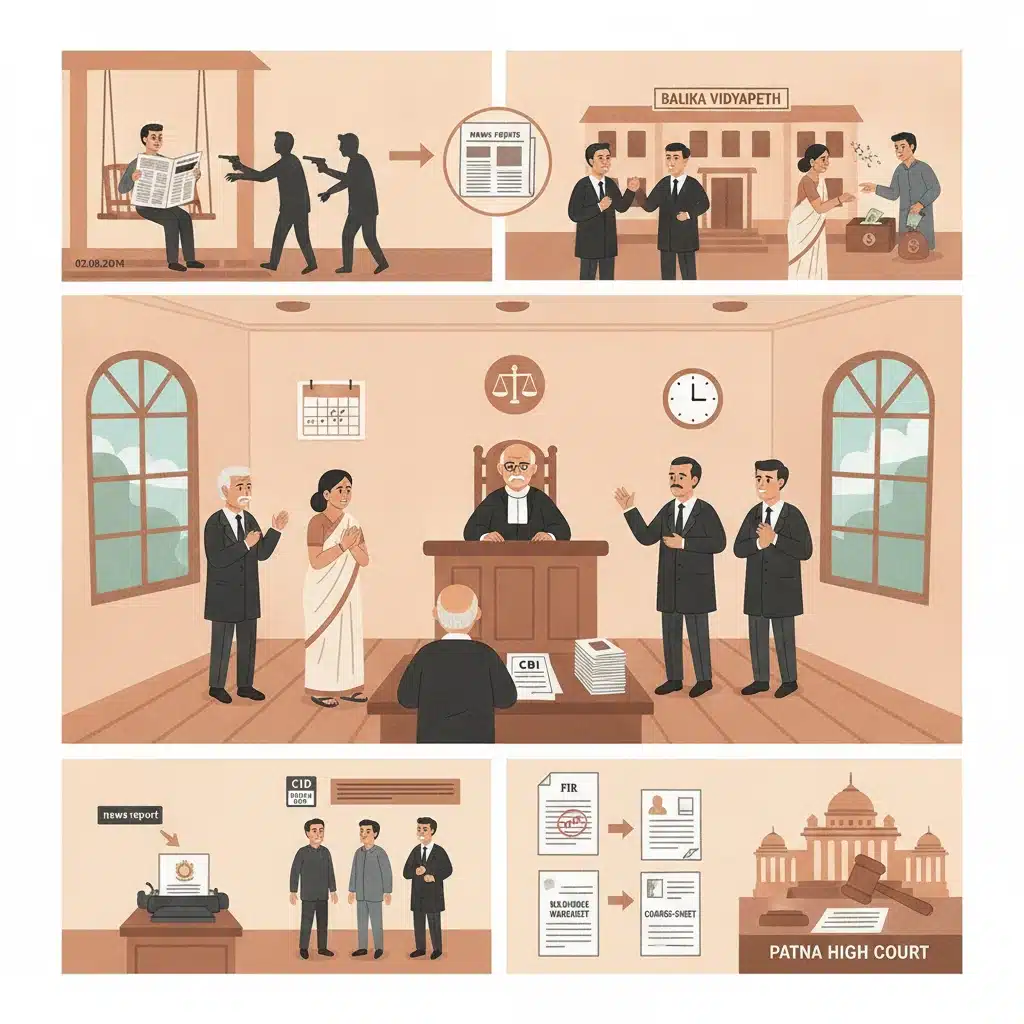
The case arises from the murder of the petitioner’s husband on 02.08.2014 at about 6:45 a.m. in Lakhisarai. He was sitting in the verandah of his house reading a newspaper when he was shot. The petitioner, his wife, heard the gunshot and rushed out.
She saw her husband with a bullet injury on his head, blood oozing from his left eye. She states that a young man holding a pistol was running towards the main gate and another person was waiting outside on a black motorcycle. She claims to have identified both men.
According to the petitioner, her husband was Secretary of Balika Vidyapeeth. In 2009, a trust dispute arose when, as alleged by her, a private group took over the trust of Balika Vidyapeeth with the help of some of the private respondents and others. Her husband was removed, and litigation and complaints followed over control of the institution and its income.
The petitioner alleges that school income was being siphoned into a personal bank account in the name of certain persons, that a new Principal was brought in to strengthen this control, and that her husband was protesting these acts. She further states that their house had earlier been attacked and fired upon, and that he had complained to authorities.
She says her husband regularly received threats asking him to leave Lakhisarai, and that he feared for his life. She points out that he had succeeded before the Patna High Court regarding his claim as Secretary, and the State Government had recognised the committee formed by him. He had also lodged a case against the personal bank account where school money was being deposited, and the accused were, according to her, likely to be convicted.
The petitioner alleges that to grab the land and properties of Balika Vidyapeeth, a conspiracy was hatched and her husband was murdered. On 04.07.2014, a CBSE team was to visit to examine his complaints about irregularities. She claims he was killed to stop this scrutiny.
On her fardbeyan, Lakhisarai P.S. Case No. 443 of 2014 was registered under Sections 302, 34, 120B of the Indian Penal Code and Section 27 of the Arms Act. Three persons were arrested during investigation and put to Test Identification Parade, in which the petitioner identified the shooter.
About two and half months later, the investigation was transferred to the Criminal Investigation Department (CID), Bihar. Dy. S.P., CID, Uday Prakash Singh, took over on 23.10.2014 under Memo No. 3442/CR. Within seven days, he filed charge-sheet No. 596 dated 30.10.2014 against Dr. Praveen Kumar Sinha, and charge-sheet No. 655 dated 06.11.2014 against two persons named Raushan Kumar.
Investigation against other accused, including private respondents 6 to 8, was kept pending. On the I.O.’s request, the Chief Judicial Magistrate (CJM), Lakhisarai, had already issued non-bailable warrants against four accused persons, including respondent no. 8. On 31.10.2014, despite there being a charge-sheet only against Dr. Praveen Kumar Sinha, the CJM (Incharge) took cognizance and, on a prima facie view, issued non-bailable warrants against the remaining accused, including the private respondents.
Since no charge-sheet had been filed against them, the private respondents approached the Patna High Court challenging the cognizance order and warrants. The High Court set aside the order against them, holding that the case should proceed after a charge-sheet, if any, was filed against them.
What the Court Examined and Decided
After the cognizance order was set aside, the private respondents sought anticipatory bail in separate criminal miscellaneous cases. A learned Judge of the Patna High Court granted them pre-arrest bail. The petitioner challenged this before the Supreme Court, leading to Criminal Appeal Nos. 682–684 of 2016.
The Supreme Court, by order dated 22.07.2016, noted the seriousness of the allegations. It observed that the private respondents were specifically named in the FIR and, according to the materials pointed out, two of them had been doubted by the deceased himself during his lifetime. Holding that they did not deserve anticipatory bail at that stage, the Supreme Court set aside the High Court’s orders and directed the private respondents to surrender at the concerned police station within four weeks.
Following this, on 12.08.2016, the Superintendent of Police (Crime), CID, wrote a letter (Annexure D) to the I.O. He directed that if the private respondents surrendered within four weeks, their statements were to be recorded and they should then be forwarded to judicial custody.
However, just seven days later, on 19.08.2016, the same officer issued another letter (Memo No. 1976, Annexure D/1). This time he instructed that if the private respondents surrendered, their statements be recorded and, if they did not surrender, the department be informed. Crucially, he added that a decision on the accusations against them was yet to be taken, deleting the earlier direction to send them to judicial custody.
The petitioner attacked this sudden change as an attempt to favour the accused, especially because the investigation had been pending since October 2014 and there was no case diary explanation why, even by August 2016, no firm view on their role had been taken.
The Court notes that, after this second letter, the private respondents appeared at the police station on 20.08.2016 and 21.08.2016, just as the Supreme Court’s four-week limit was expiring. Their statements were recorded, and they were released by the I.O. on personal recognizance (PR) bonds, instead of being arrested or produced in court.
Later, while examining the case diary, the Patna High Court found that after these PR bonds were executed, the investigation essentially stopped. The case diary was blank from 2016 to May 2019, and even thereafter only formal, insignificant entries were made. The Court observed that for about two and a half years nobody looked into the diary, and from 2019 to 2021 there was no meaningful step by the I.O., as if the investigation had been dumped.
The petitioner argued that the CID had failed to investigate the conspiracy angle at all. She pointed out that the same Dy.S.P., CID, who had submitted the charge-sheet against one of the accused, later admitted before the trial court in that case that he had not investigated the allegation of criminal conspiracy. According to her, this led to the acquittal of that accused and created a real fear that the same would happen regarding respondents 6 to 8 if the probe was not entrusted to an independent agency.
The Court called for a response from the CID. The Additional Director General, CID, appeared in person with records. He accepted that the investigation had not progressed since 2016 and admitted that the letters, particularly Annexure D/1, “prima facie should not have gone to the I.O.” He stated that after he took charge in September 2021, he reviewed the case in July 2022 and found sufficient material on record to proceed against private respondents 6 to 8.
The ADG, CID, clearly stated before the Court that once the Supreme Court had cancelled their anticipatory bail and directed them to surrender at the police station, and since there were adequate materials against them, the I.O. “could not have released them from the police station on their personal bond.” He assured the Court that he would seek explanations from the concerned officers and take the matter to its logical end.
By the time of the final hearing, learned Government Pleader informed the Court that a non-bailable warrant had been obtained against respondents 6, 7 and 8, and that steps under Section 82 CrPC (proclamation) were being initiated as they were evading arrest. Show cause notices had been issued to the then S.P. (Crime) and the I.Os. regarding the 2016 letters.
The private respondents, in their defence, claimed that they had complied with the Supreme Court’s order by surrendering at the police station. They pointed out that the petitioner’s miscellaneous petition before the Supreme Court had been dismissed as infructuous on this ground. They also narrated how the earlier cognizance order had been set aside as premature.
However, during arguments before the Patna High Court, counsel for respondent no. 6 candidly stated that he would not attempt to legally justify the I.O.’s action in releasing the accused on PR bonds after the cancellation of their anticipatory bail by the Supreme Court, and did not rely upon Section 437(2) CrPC to support it. Counsel for respondents 7 and 8 endorsed this stand and also did not justify the CID’s action.
Counsel for respondents 7 and 8 did not dispute that the CID had failed to investigate the conspiracy angle and had kept the investigation pending for eight years without justification. They expressly stated that they had no objection if the investigation was handed over to the CBI. Respondent no. 6 alone opposed transfer to the CBI, relying on the Supreme Court decision in M.C. Abraham, which cautions courts against directing arrest and interfering with investigation.
The High Court carefully distinguished this reliance. It held that it had not directed the CID to arrest any accused. Instead, it had only recorded the ADG, CID’s own stand that sufficient material existed against the private respondents and that they should not have been released on PR bonds. The Court noted it was simply observing the conduct of the agency and the serious delay, not issuing a mandatory arrest order.
The Court then turned to the broader legal principles. Referring to Supreme Court judgments in Amar Nath Chaubey, State of West Bengal v. Committee for Protection of Democratic Rights, and K.V. Rajendran, it reiterated that while investigation is primarily the job of the police, the constitutional courts have a duty to intervene in rare and exceptional cases where investigation is not fair, appears biased, or is not carried out at all. Fair investigation is part of the right to life under Article 21, and where the local agency fails, courts can direct transfer to an independent agency like the CBI.
Applying these principles, the Patna High Court found that the CID’s conduct in this case showed a clear failure of its statutory duty. The investigation was kept pending for more than eight years; the case diary remained untouched for long stretches; and no steps were taken to meaningfully probe the allegations of conspiracy either before or after the private respondents were released on PR bonds. The ADG, CID’s own admissions further supported this conclusion.
The Court emphasised that the petitioner, as widow of the deceased, had been seeking justice all these years and had a legitimate grievance that influential accused persons appeared to have kept the investigation stalled. Given the cloud over the impartiality and effectiveness of the CID investigation, the Court held that transfer of the case to an independent agency was necessary to restore confidence and to do justice.
Accordingly, the Patna High Court ordered that the investigation of Lakhisarai P.S. Case No. 443 of 2014 be transferred to the Central Bureau of Investigation (CBI), which had already been added as respondent no. 9. The CID was directed to hand over all documents and materials to the CBI within two weeks. The Director, CBI, was asked to assign competent investigating officers to conduct proper, fair, impartial and independent investigation and to act expeditiously, keeping in mind the already long delay.
The Court clarified that it was not expressing any opinion on the merits of the allegations against any accused. It also recorded that an accused has no right to choose the investigating agency. The writ petition, along with interlocutory applications, was disposed of with these directions. The ADG, CID, was left free, and indeed expected, to pursue departmental action against the officers who had mishandled the investigation.
Why This Judgment Matters
This judgment is important for families of crime victims who feel that the police are not doing their job. The Patna High Court closely examined the case diary, the conduct of the CID and the unexplained eight-year delay.
It recognised that a fair and timely investigation is part of the fundamental right to life. Where the local agency fails, and especially where influential persons are involved, the Court can step in and hand the case to an independent body like the CBI.
The judgment also sends a message to investigating officers. Releasing accused persons on PR bonds in the face of a Supreme Court order cancelling their anticipatory bail, and then doing nothing further in the case, will not be tolerated. Senior officers can be called to court, and their decisions scrutinised.
For ordinary citizens, the decision shows that if there is strong, provable material that the police have neglected or biased an investigation, constitutional courts can order corrective steps, including transfer of the case. However, such transfer is reserved for rare cases where the record itself shows serious lapses.
Legal Issues and Answers
- Issue: Whether the prolonged, incomplete and allegedly biased investigation by Bihar CID into a murder and conspiracy case justified transfer of the probe to the CBI.
Answer: Yes. The Court held that, given the eight-year delay, blank case diary, failure to examine the conspiracy angle, release of accused on PR bonds despite cancellation of anticipatory bail by the Supreme Court, and the ADG, CID’s admission of lapses, the case fell within the rare and exceptional category warranting transfer to the CBI. - Issue: Whether the High Court had directed arrest of the private respondents in violation of principles laid down in M.C. Abraham.
Answer: No. The Court clarified that it had not issued any independent direction to arrest the accused. It had merely recorded the ADG, CID’s stand and expected lawful steps during investigation. Therefore, the decision in M.C. Abraham was found inapplicable. - Issue: Whether an accused has a right to insist that investigation remain with a particular agency and oppose transfer to CBI.
Answer: No. The Court held that an accused has no right to choose the investigating agency. In suitable cases, constitutional courts may direct transfer of investigation to another agency, including the CBI.
Cases Cited by the Court
- Amar Nath Chaubey v. Union of India and others, (2021) 11 SCC 804
- State of West Bengal and others v. Committee for Protection of Democratic Rights, West Bengal and others, (2010) 3 SCC 571
- K.V. Rajendran v. Superintendent of Police, CBCID South Zone, Chennai and others, (2013) 12 SCC 480
- Manohar Lal Sharma v. Union of India, (2014) 2 SCC 532
- M.C. Abraham and another v. State of Maharashtra and others, (2003) 2 SCC 649
- Minor Irrigation & Rural Engg. Services, U.P. v. Sahngoo Ram Arya, (2002) 5 SCC 521
- Sakiri Vasu v. State of U.P., (2008) 2 SCC 409
- Ashok Kumar Todi v. Kishwar Jahan, (2011) 3 SCC 758
Case Details
Case Number: Criminal Writ Jurisdiction Case No. 130 of 2017 (arising out of Lakhisarai P.S. Case No. 443 of 2014)
Case Title: Usha Sharma v. The State of Bihar & Others
Citation: 2022 (4) PLJR 462
Court: High Court of Judicature at Patna
Coram: Hon’ble Mr. Justice Rajeev Ranjan Prasad
Date of Judgment: 12-12-2022
Advocates:
- For the petitioner: Mr. Amit Narayan, Advocate; Mr. Abhigyan Kumar, Advocate; Mr. Jeetendra Narayan, Advocate
- For the State of Bihar: Mr. Md. Nadeem Seraj, GP-5
- For respondent no. 6: Mr. A.K. Thakur, Advocate; Dr. Anjani Prasad Singh, Advocate
- For respondents no. 7 & 8: Mr. Ramakant Sharma, Senior Advocate; Mr. Sanjeev Kumar, Advocate
Respondents: State of Bihar through Home Secretary; Director General of Police, Bihar; Additional Director General, CID, Bihar; Superintendent of Police, CID, Bihar; Superintendent of Police, Lakhisarai; private respondents 6 to 8; and Central Bureau of Investigation through its Director.
Nature of the Case: Criminal writ petition challenging the conduct of investigation by Bihar CID in a murder and conspiracy case, seeking arrest of certain accused and transfer of investigation; with connected application for modification of interim order.
Final Outcome: Investigation of Lakhisarai P.S. Case No. 443 of 2014 directed to be transferred from CID, Bihar to CBI. CID directed to hand over all records to CBI within two weeks. ADG, CID to examine conduct of concerned officers and fix responsibility. No opinion expressed on merits of allegations.
Link to Judgment: Full text of Patna High Court judgment
If you found this explanation helpful and wish to stay informed about
how legal developments may affect your rights in Bihar,
you may consider following Samvida Law Associates for more updates.




