

Case Background
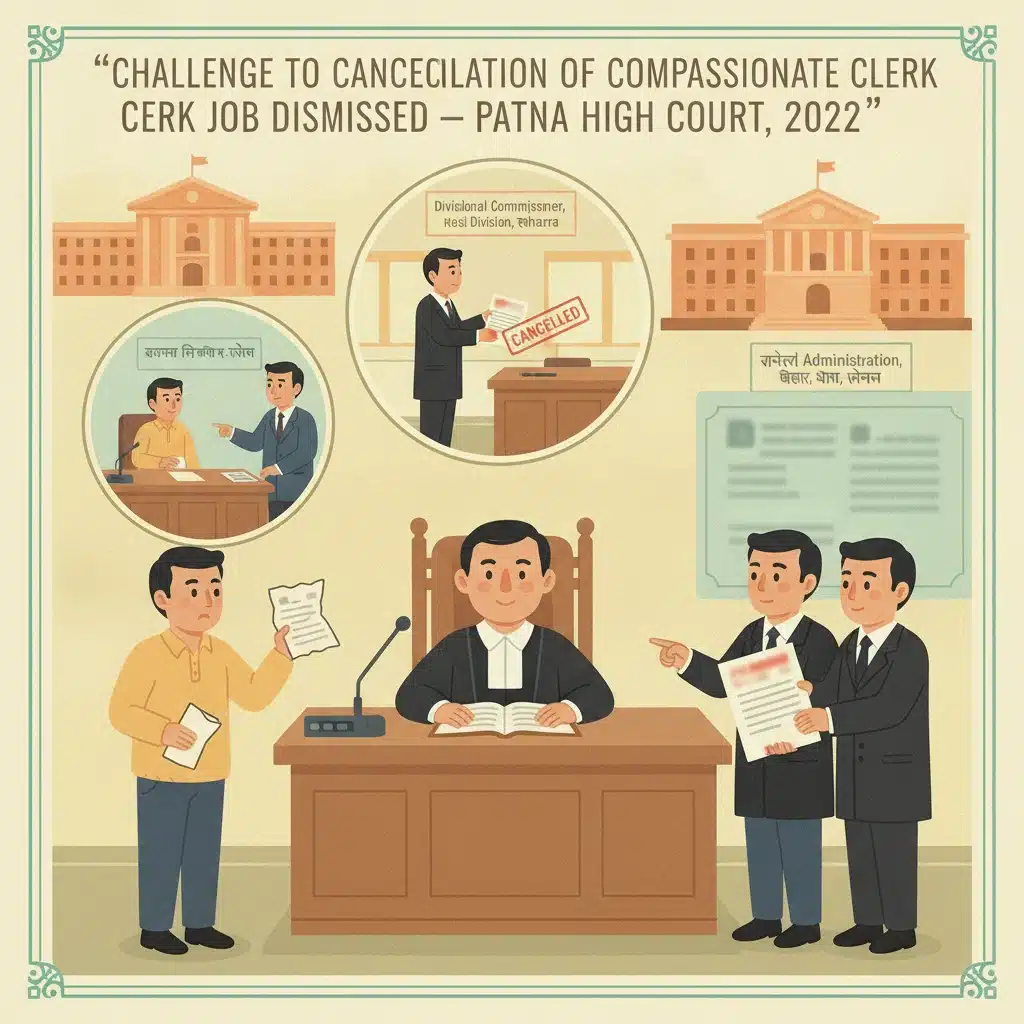
The petitioner had applied for compassionate appointment after the death of his family member in government service. His case was placed before the Central Compassionate Committee.
In its meeting dated 09.12.2010, the Central Compassionate Committee recommended his appointment on a Group ‘Ga’ post, subject to availability of vacancies. This recommendation was in his favour and recognised his entitlement to compassionate appointment.
On the basis of this recommendation, the Office of the Divisional Commissioner, Kosi Division, Saharsa, appointed him as a “Clerk-cum-Typist”. This was a Group ‘Ga’ post in the secretarial establishment of the State.
However, the General Administration Department of the Government of Bihar is the competent authority for appointments on compassionate grounds in the secretarial services. The Divisional Commissioner was not the competent appointing authority for such a post.
Realising this defect, the Divisional Commissioner’s office issued an order dated 24.05.2014 (Memo No. 1034/Saharsa) cancelling the petitioner’s clerk-cum-typist appointment with immediate effect.
Subsequently, on 23.01.2015, the Joint Secretary, General Administration Department, issued Memo No. 37 appointing the petitioner afresh on compassionate grounds to the post of Peon, Group ‘Gha’, on the pay scale applicable to that post.
The office order dated 23.01.2015 itself records that the petitioner had applied for appointment against a Group ‘Gha’ post. It also notes that the petitioner had been recommended for appointment as a Lower Division Clerk (a Group ‘Ga’ post), but nevertheless he was appointed as Peon.
The petitioner accepted this new appointment and worked under it. He did not immediately challenge either the cancellation order dated 24.05.2014 or the fresh appointment order dated 23.01.2015.
Almost three years later, in 2018, he filed the present writ petition under Article 226 of the Constitution, seeking quashing of the cancellation order and restoration of his earlier appointment as clerk-cum-typist.
What the Court Examined and Decided
The Patna High Court first recorded the relief sought. The petitioner wanted a writ of certiorari to set aside Memo No. 1034/Saharsa dated 24.05.2014 issued by the Secretary to the Commissioner, Kosi Division, Saharsa. By that memo, his appointment as typist-cum-clerk was cancelled. He also questioned the consequential office order dated 23.01.2015 by which he was given a fresh temporary appointment as Peon, Group ‘Gha’, by the Joint Secretary, General Administration Department, without any show cause notice.
The petitioner’s main argument, advanced by his senior counsel, was that his compassionate appointment had been recommended by the Central Compassionate Committee headed by the Principal Secretary, General Administration Department. Since the Principal Secretary was part of the recommending body, he argued there was no justification for cancelling his clerk-cum-typist appointment without giving him an opportunity of hearing or show cause. On this basis, he alleged violation of principles of natural justice and claimed the cancellation order was illegal.
The State’s counsel placed emphasis on the subsequent events. He drew the Court’s attention to the office order dated 23.01.2015 issued by the competent authority, the General Administration Department. That order referred to an application made by the petitioner himself for appointment on a Group ‘Gha’ post, that is, the peon’s post.
Importantly, the petitioner’s application for a Group ‘Gha’ post was made even before the cancellation order dated 24.05.2014. This showed, according to the State, that the petitioner had willingly sought appointment as a Peon. Further, between the cancellation order and the fresh appointment order, the petitioner did not object or protest. He only accepted the fresh appointment without any grievance.
After getting the new Peon post on 23.01.2015, the petitioner continued in service and did not complain for nearly three years. Only in 2018 did he approach the Court challenging the earlier cancellation of his clerk-cum-typist appointment. The State therefore argued that he was barred by delay, laches, and acquiescence, and could not be allowed to challenge what he had already accepted.
The Court considered these rival stands. It first addressed the basic legality of the clerk-cum-typist appointment made by the Divisional Commissioner. The Court held clearly that this appointment was unsustainable, because it had been made by an “incompetent Authority”. The competent authority for such appointments in secretarial services was the General Administration Department, not the Divisional Commissioner.
The Court stated that this crucial fact was not in dispute. Therefore, the petitioner’s argument that his appointment stood on the firm footing of a recommendation by a competent authority (the Principal Secretary heading the Central Compassionate Committee) did not help him. A recommendation, even if made by competent officials, has to be implemented through an order issued by a legally competent appointing authority.
In simple terms, the Court held that a valid recommendation cannot cure the defect of an appointment order issued by an authority that has no legal power to appoint. The appointment remained illegal, regardless of the recommendation behind it.
On the issue of natural justice, the Court explained that even if no prior hearing was given before cancelling the clerk-cum-typist appointment, that argument had lost force in the specific facts of this case. The petitioner himself had applied for appointment on a Group ‘Gha’ post, and thereafter the authorities proceeded to cancel the earlier illegal appointment and issue a fresh appointment order through the competent authority.
Thus, the cancellation and subsequent regular appointment as Peon were steps taken in continuation of the petitioner’s own request. In this situation, the Court found that the plea of violation of natural justice was “of no avail”.
The Court then emphasised the petitioner’s conduct after 24.05.2014. Following cancellation of his clerk-cum-typist job, he did not raise any immediate protest. Instead, he accepted the fresh appointment dated 23.01.2015 as Peon. For almost four years after this, he did not approach the authorities or the Court to challenge either the cancellation or the lower post.
On these facts, the Court held that no case was made out for interfering with the cancellation order dated 24.05.2014, particularly in writ jurisdiction which is discretionary and equitable in nature. The Court highlighted that the petitioner had voluntarily accepted the benefit of the new appointment and allowed years to pass before taking legal action.
At the same time, the Court did note an important aspect favourable to the petitioner. It recorded that the office order dated 23.01.2015 itself acknowledged that, as per the Central Compassionate Committee recommendation, the petitioner was entitled to compassionate appointment as a “Lower Division Clerk” (a Group ‘Ga’ post). However, the record did not show why, despite this acknowledgement, he was not appointed to that post and was instead placed as Peon in Group ‘Gha’.
The Court expressly stated that it was not clear from the record whether there were any justifiable reasons for not granting him the Lower Division Clerk post. It also mentioned that the petitioner had not approached the authorities seeking any specific relief on this issue of proper post or upgradation.
Finally, the Court considered the principles of delay, laches, acquiescence and waiver. For this, it relied on the Supreme Court judgment in Union of India and Others vs. N. Murugesan and Others, reported in (2022) 2 SCC 25. The Supreme Court had explained that when a person, by his conduct, accepts a particular position and allows time to pass, he may be treated as having waived his right to challenge that position.
The Patna High Court quoted paragraph 22 of the Supreme Court decision, which stresses that courts should look at both the length of delay and the nature of acts done during that period. When a party’s behavior shows that he has accepted a situation and put the other side in a particular position, it may be unjust to later allow him to challenge that situation.
Applying this principle, the High Court found that the petitioner had clearly accepted the cancellation of his clerk-cum-typist appointment and the subsequent Peon appointment. He enjoyed the benefit of the 23.01.2015 order, which he could not have obtained without cancellation of the earlier illegal appointment. While taking advantage of this, he did not challenge the cancellation for nearly four years.
The Court held that he could not “accept and reject the same thing”. He could not both enjoy the fruits of the new appointment and at the same time attack the very order of cancellation that made this new appointment possible. His conduct amounted to delay, laches and acquiescence.
On this basis, the Court concluded that no equitable relief could be granted in writ jurisdiction. The writ application was accordingly disposed of, effectively dismissing his challenge.
Why This Judgment Matters
This judgment is important for families seeking compassionate appointments in Bihar and similar government jobs elsewhere. It shows that even if you feel wronged about the post given to you, your own actions after the appointment matter a lot.
If a person accepts a post, works on it, and waits for several years without protest, the court may treat that as acceptance of the situation. Later challenges can be dismissed for delay and acquiescence, even if there were some irregularities earlier.
The judgment also clarifies that a recommendation for compassionate appointment does not by itself create a valid appointment. The actual appointment order must come from the authority legally empowered to appoint. If an incompetent officer issues the appointment, it can be cancelled.
For government employees and their families, the decision underlines the need to act promptly. If someone feels that a wrong or lower post has been given on compassionate grounds, they should raise the issue quickly with the department or the court, rather than silently accepting and then challenging much later.
Legal Issues and Answers
Issue: Whether the petitioner’s initial compassionate appointment as clerk-cum-typist could be cancelled when it was made by an authority not competent to appoint.
Answer: Yes. The Patna High Court held that the initial appointment was unsustainable because it was issued by an incompetent authority, and cancellation of such an appointment was justified.
Issue: Whether the cancellation order dated 24.05.2014 was vitiated for not granting the petitioner an opportunity of hearing (violation of natural justice).
Answer: No. In the facts of the case, the Court held that the plea of violation of natural justice had no merit, as the petitioner himself applied for a Group ‘Gha’ post and then accepted the fresh appointment issued by the competent authority.
Issue: Whether the petitioner could, after accepting a fresh appointment as Peon and waiting nearly four years, challenge the earlier cancellation of his clerk-cum-typist post.
Answer: No. Relying on the Supreme Court judgment in Union of India and Others vs. N. Murugesan and Others, the Court held that the claim was barred by delay, laches, and acquiescence, and no equitable writ relief could be granted.
Cases Cited by the Court
- Union of India and Others vs. N. Murugesan and Others, (2022) 2 SCC 25
Case Details
Case Number: Civil Writ Jurisdiction Case No. 16681 of 2018
Case Title: Nirmal Kumar Singh vs. The State of Bihar & Others
Court: High Court of Judicature at Patna
Coram: Hon’ble Mr. Justice Madhuresh Prasad
Date of Judgment: 01.11.2022
Citation: 2022 (4) PLJR 940
Advocates for Petitioner: Mr. Ashok Kumar Sinha, Senior Advocate; Mr. Bijendra Kumar Singh, Advocate; Mr. Rajeev Kumar, Advocate; Mr. Divyani Verma, Advocate
Advocate for Respondents (State of Bihar and others): Mr. Harshvardhan Shivsundaram, AC to SC 8
Nature of Case: Writ petition under civil writ jurisdiction challenging cancellation of compassionate appointment and consequential fresh appointment.
Link to Full Judgment: Click here to read the official Patna High Court judgment
If you found this explanation helpful and wish to stay informed about
how legal developments may affect your rights in Bihar,
you may consider following Samvida Law Associates for more updates.




