

Case Background
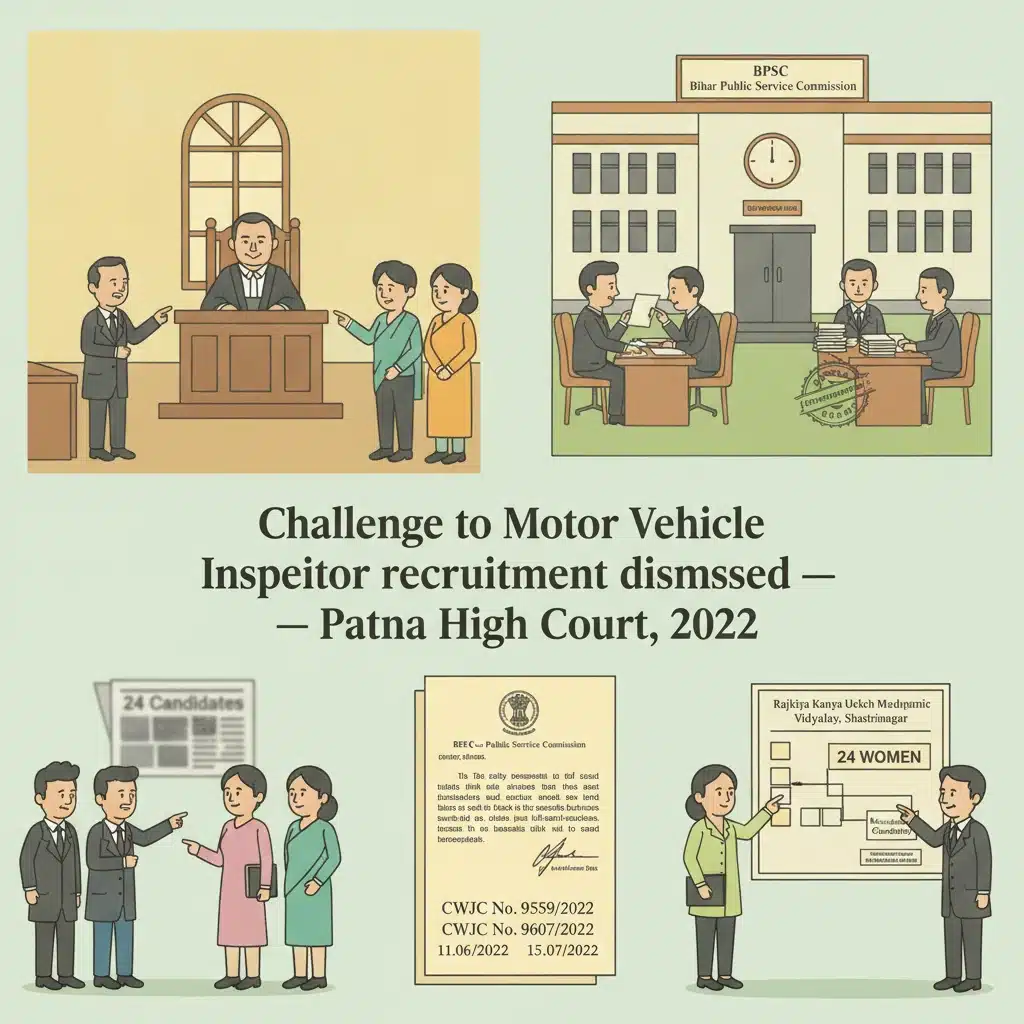
The dispute arose from Advertisement No. 6 of 2020 for recruitment to the post of Motor Vehicle Inspector in Bihar. The petitioners in both writ petitions had applied under this advertisement.
They participated in the selection process and took the written examination conducted by the Bihar Public Service Commission (BPSC). After evaluation, BPSC declared the result of the written examination on 11.06.2022.
The names of the petitioners did not appear in the list of successful candidates. They were therefore not included in the further stages of the recruitment process.
Subsequently, a newspaper carried a report stating that 24 candidates, who had appeared from one room in a particular examination centre, had all been declared successful. On reading this news, the petitioners approached the Patna High Court under its civil writ jurisdiction.
In Civil Writ Jurisdiction Case No. 9559 of 2022, the petitioners sought quashing of the entire result dated 11.06.2022. In Civil Writ Jurisdiction Case No. 9607 of 2022, the petitioner restricted his grievance only to alleged irregularities in the selection process and specifically stated that he was not pressing any challenge to Advertisement No. 6 of 2020 itself. This clarification was earlier recorded by the Court in an order dated 15.07.2022.
In view of these allegations, the Court called upon the State authorities and BPSC to file a counter affidavit, which was placed on record. The matter was finally heard through video conferencing on 02.09.2022.
What the Court Examined and Decided
Justice Madhuresh Prasad heard detailed submissions from learned senior counsel for the petitioners, counsel for the State of Bihar, and counsel for the Bihar Public Service Commission.
The petitioners’ core allegation was that the selection process had been manipulated to favour 24 candidates. According to them, all 24 candidates were seated in one room at a specific examination centre and every one of them emerged successful.
The petitioners said they learnt of this fact only through a newspaper report. Relying on this, they alleged “mass level illegality and fraud” in the selection process, allegedly in connivance with officials. They described these 24 candidates as “chosen persons”, asserting that their centre and room allocation were fixed in advance to favour them.
On this basis, the petitioners asked the Court to quash the result of the written examination declared on 11.06.2022. They sought interference with the entire selection process for Motor Vehicle Inspectors under Advertisement No. 6 of 2020.
To support their challenge, learned senior counsel for the petitioners relied on the Supreme Court judgment in Nidhi Kaim & Another v. State of Madhya Pradesh & Others, reported in (2017) 4 SCC 1, and referred specifically to paragraphs 81, 86, 89, 94, 95 and 96 of that decision. They attempted to draw a parallel between alleged irregularities in the present recruitment and the fraud examined in that case.
On behalf of BPSC, learned counsel opposed the petitions at the threshold. He submitted that the petitioners had not even qualified in the written examination. Only after the result was out and the newspaper report appeared did they raise any objection.
It was emphasized that, prior to publication of the news article, the petitioners had never complained about any illegality in the conduct of the exam or the selection process. One of the petitioners, Petitioner No. 2 in CWJC No. 9559 of 2022, had himself appeared from the same examination centre — Rajkiya Kanya Uchch Madhyamic Vidyalay, Shastrinagar — where the 24 candidates were seated. Despite being physically present at that centre, he raised no objection at the time of the examination or immediately thereafter.
BPSC’s counsel argued that the petitions were based purely on the newspaper report, which was both belated and unreliable as a foundation for such a serious challenge. Since the petitioners had participated in the examination and been declared unsuccessful, they were now, according to BPSC, making baseless allegations only because they were aggrieved by their own failure.
The counter affidavit filed by the authorities provided a detailed explanation about the 24 candidates. BPSC stated that:
First, all 24 candidates were female. For this reason, their centre was fixed at Rajkiya Kanya Uchch Madhyamic Vidyalay, Shastrinagar, which is a girls’ school. This was done for their convenience.
Second, from that centre, a total of 64 candidates were declared successful, including these 24 female candidates. Thus, the 24 candidates formed only a part of the overall successful candidates from that centre.
Third, the female candidates had been grouped together in one room in the centre because they were women candidates, not because of any favouritism. Their success, the Commission said, was on the basis of merit and marks obtained by them in the written examination.
BPSC further pointed out that these 24 women candidates were beneficiaries of the horizontal reservation policy for female candidates. Their grouping in one centre and one room was described as a fortuitous circumstance, arising out of administrative convenience and reservation policy, and not as a sign of illegal favour.
On these facts, the Commission maintained that the petitioners’ suspicion was unfounded. The mere fact that 24 candidates from one room had qualified could not, without more, be a valid ground to set aside an entire recruitment process.
The Court examined the rival submissions and the contents of the counter affidavit. It first addressed the reliance placed on the Supreme Court decision in Nidhi Kaim. Justice Madhuresh Prasad acknowledged that the legal principles laid down by the Supreme Court are binding. However, he clarified that such propositions apply only in the backdrop of the specific facts considered by the Supreme Court in that case.
In contrast, the present case stood on a very different factual footing. Here, the allegations were described by the Court as “presumptuous”. The challenge was built solely on an inference drawn from a single circumstance — that 24 candidates from one room had all passed — and on a newspaper report highlighting that fact.
The Court found the explanation given by BPSC in its counter affidavit to be convincing. The allocation of all women candidates to a girls’ school centre and to one room, coupled with the horizontal reservation policy, was accepted as a bona fide administrative arrangement. The Court held that this explanation revealed a legitimate, merit-based selection process and not a manipulated one.
Importantly, the Court noted that the writ petitions rested “merely on a newspaper report/article”. There was no independent material produced by the petitioners to substantiate their allegations of fraud or mass irregularity. Given that the petitioners raised no contemporaneous objection, and one of them had written the exam in the same centre, the Court was not persuaded to treat the newspaper article as sufficient proof.
On this basis, the Court distinguished the facts of the present case from those in Nidhi Kaim. It held that the Supreme Court decision had “no applicability” here, because there was no comparable evidence of systemic fraud or large-scale illegality in the recruitment process.
Concluding the analysis, Justice Madhuresh Prasad stated that the petitions were founded on presumptions and did not make out any case for interference with the result of the selection process. The selection, as defended by the Commission, manifested a bona fide exercise, and the Court was “inclined to accept the stand of the Commission”.
Ultimately, the Court held that the writ petitions were “devoid of merit” and dismissed them. As a result, the written examination result declared on 11.06.2022 and the ongoing recruitment of Motor Vehicle Inspectors under Advertisement No. 6 of 2020 remained undisturbed.
Why This Judgment Matters
This judgment is significant for candidates in government recruitment examinations in Bihar and beyond. It shows that courts will not lightly cancel an entire selection process based on suspicion alone.
The Patna High Court made it clear that newspaper reports, without supporting evidence, cannot be the sole ground for alleging fraud in recruitment. Candidates who take part in an exam and then challenge the process only after failing must show concrete material, not just media articles.
The decision also underlines that administrative decisions like grouping female candidates in one centre, or implementing horizontal reservation, will be respected when they are reasonably explained and supported by records.
For genuine aspirants, the case highlights the importance of raising objections at the earliest possible stage if they notice irregularities, and of collecting solid proof before approaching the Court.
Legal Issues and Answers
-
Issue: Whether the Patna High Court should quash the result of the Motor Vehicle Inspector written examination dated 11.06.2022 on the allegation that 24 candidates from one room in a particular centre all qualified, allegedly indicating mass fraud and favouritism.
Answer: No. The Court accepted the Bihar Public Service Commission’s explanation that all 24 were female candidates allotted to a girls’ school centre for convenience and benefited from horizontal reservation. The challenge was based only on a newspaper report and presumptions, without reliable evidence of illegality, and therefore did not justify interfering with the selection process.
Cases Cited by the Court
- Nidhi Kaim & Another v. State of Madhya Pradesh & Others, (2017) 4 Supreme Court Cases 1 – cited by the petitioners; held by the Patna High Court to be distinguishable on facts.
Case Details
Case Numbers: Civil Writ Jurisdiction Case No. 9559 of 2022; Civil Writ Jurisdiction Case No. 9607 of 2022
Case Title: Mayank Mayur & Another v. The State of Bihar & Others (with) Niraj Kumar v. The State of Bihar & Others
Coram: Hon’ble Mr Justice Madhuresh Prasad
Citation: 2022 (4) PLJR 765
Advocates:
In CWJC No. 9559 of 2022 – For the petitioners: Mr Y. V. Giri, Senior Advocate with Mr Pranav Kumar, Mr Ashish Giri, Ms Shrishti Singh, Advocates. For the respondents: Mr Anil Kumar Singh, GP XXVI; Mr Sanjay Pandey, Advocate.
In CWJC No. 9607 of 2022 – For the petitioner: Mr Pankaj Kumar Singh, Mr Bipin Kumar, Advocates. For the respondents: Mr Sheo Shankar Prasad, SC VIII; Mr Sanjay Pandey, Mr Zaki Haider, Advocates.
Date of Judgment: 02.09.2022
Court: High Court of Judicature at Patna
Nature of the Case: Writ petitions under civil writ jurisdiction challenging result of recruitment examination for Motor Vehicle Inspectors conducted by Bihar Public Service Commission.
Link to Judgment: Click here to access the official Patna High Court judgment
If you found this explanation helpful and wish to stay informed about how legal developments may affect your rights in Bihar, you may consider following Samvida Law Associates for more updates.




