

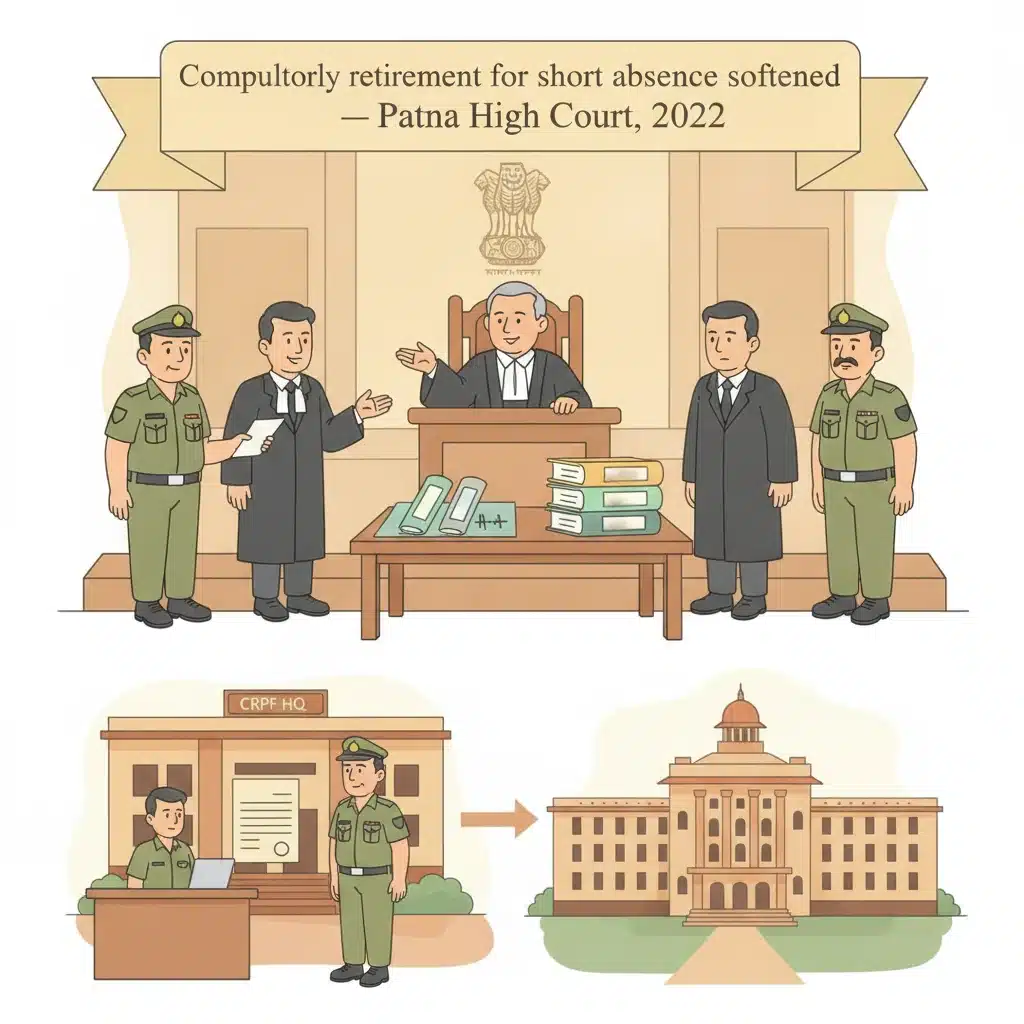
Case Background
The petitioner was a member of the Central Reserve Police Force (CRPF). He joined service as a Constable on 08.07.1991.
After nearly nineteen years of service, he was promoted to the post of Head Constable on 15.05.2010.
Later, the authorities accused him of remaining unauthorisedly absent from duty. The main allegation was that he had remained absent for 13 days. The department also took into account a previous incident where he had been unauthorisedly absent for 36 days.
For these acts, he was charge-sheeted on 17.09.2011. The departmental proceedings ended with the imposition of the penalty of compulsory retirement on 20.03.2012.
The petitioner challenged this order before the higher departmental authorities. His appeal was dismissed by the Deputy Inspector General, CRPF, Agartala Range, Tripura on 12.07.2012. His revision was then rejected by the Inspector General, CRPF, Bihar Sector, Patna on 10.01.2013.
Having failed in appeal and revision, he approached the Patna High Court in Civil Writ Jurisdiction Case No. 10065 of 2013, seeking to quash the orders at all three stages.
What the Court Examined and Decided
The Patna High Court, through Hon’ble Mr. Justice P. B. Bajanthri, heard the matter on 31.08.2022.
The petitioner’s main prayer was to quash three orders: the compulsory retirement order passed by the Commandant, 190 Battalion, CRPF; the appellate order passed by the DIG, CRPF, Agartala Range, Tripura; and the revisional order passed by the IG, CRPF, Bihar Sector, Patna.
He also requested that any other suitable relief be granted as the Court found just and proper.
On the petitioner’s side, learned counsel argued that the punishment of compulsory retirement was too harsh and disproportionate to the charge. The absence alleged was for a period of 13 days, even though it was read together with an earlier absence of 36 days. According to the petitioner, such misconduct, while wrong, did not justify ending his entire career through compulsory retirement.
He sought conversion of the major penalty of compulsory retirement into some lesser penalty. Along with this, he prayed for reinstatement in service and grant of all service and monetary benefits that would follow from such modification of punishment.
On the other side, learned counsel for the respondents defended the orders. They submitted that the petitioner had committed misconduct by remaining unauthorisedly absent for 13 days, and had also previously remained unauthorisedly absent for 36 days. Given this repeated conduct, they argued that the disciplinary, appellate and revisional authorities had rightly imposed and upheld the penalty of compulsory retirement. Therefore, they said, there was no infirmity in the orders and no interference by the High Court was called for.
The Court noted the undisputed facts: the petitioner had joined service on 08.07.1991 as a constable, was promoted to Head Constable on 15.05.2010, and for his unauthorised absence of 13 days read with past unauthorised absence of 36 days, he was awarded compulsory retirement on 20.03.2012. This punishment was thereafter affirmed by the appellate and revisional authorities.
The core question before the Patna High Court was whether such a major penalty was proportionate to the misconduct proved.
For this, the Court examined the length of service and nature of misconduct. It observed that the petitioner had served from 1991 until the order of compulsory retirement in 2012, i.e., around 21 years. Against this background, the Court considered whether compulsory retirement for 13 days of absence, combined with the past 36 days of absence, was justified.
The Court found that, in these circumstances, the penalty of compulsory retirement was “too harsh”. To support its view, the Court referred to recent decisions of the Hon’ble Supreme Court.
First, it cited the case of Amrendra Kumar Pandey vs. Union of India & Ors., reported in 2022 Live Law (SC) 600. In that case, the Supreme Court compared the facts with another case (Satgur Singh) and explained when severe punishment can or cannot be justified.
The Supreme Court had noted that in Satgur Singh’s case, the employee had failed to give any explanation for absence on seven different occasions, and had suffered imprisonment. On those specific facts, the Court there had upheld the order of discharge.
However, in Amrendra Kumar Pandey, the Supreme Court held that, considering the nature of misconduct and the material on record, the ends of justice would be met by setting aside the order of discharge and treating the employee as being in service till he completed the qualifying service for pension. The Court stressed that there was nothing on record to show that the misconduct was so unacceptable that the authority had no option but to discharge him to prevent indiscipline.
The Patna High Court quoted this reasoning to emphasise that not every case of absence from duty should automatically result in the most extreme penalties, especially where there is no material to show that the misconduct was of such a grave nature that only removal or discharge would maintain discipline.
Secondly, the Patna High Court relied on another decision of the Supreme Court in Union of India & Anr. vs. R. K. Sharma (Civil Appeal No. 4059 of 2015). In that case, the Supreme Court examined a situation where an employee had been dismissed for absence.
The Supreme Court held that, having regard to the period of absence, the punishment of dismissal from service was too harsh, disproportionate and not in line with the nature of the charge proved. It stated that justice would have been adequately served by imposing some lesser but still major penalty.
The Supreme Court further explained that, because a long time had passed since the original charge memo and the dismissal order, it would not be proper to send the matter back to the disciplinary authority. Instead, using its powers under Article 142 of the Constitution and applying the doctrine of proportionality, the Supreme Court itself modified the punishment. It underlined that punishment in service law must not be disproportionate to the misconduct.
Drawing guidance from these Supreme Court rulings, the Patna High Court assessed the petitioner’s case. It considered his long tenure since 1991 and the nature of his misconduct, namely unauthorised absence for 13 days read with an earlier 36 days of absence.
The Court concluded that imposing compulsory retirement for this misconduct was indeed too harsh. The principle that punishment must be proportionate, as set out by the Supreme Court, applied squarely.
Therefore, the Court decided to interfere with the orders of the disciplinary, appellate and revisional authorities. It set aside all three orders, which were annexed as Annexures 5, 6 and 8 to the writ petition.
At the same time, the Court did not itself choose a particular lesser penalty. Instead, it remanded the matter to the disciplinary authority with a specific direction: the authority must impose a lesser penalty and extend all monetary and service benefits to the petitioner.
The Court fixed a time limit. It directed that this exercise must be completed within three months from the date of receipt of the Court’s order.
With these directions, the Patna High Court allowed the writ petition.
Why This Judgment Matters
This judgment is important for government and paramilitary employees, especially those facing departmental action for unauthorised absence.
The Patna High Court has clearly recognised that even in disciplined forces like the CRPF, punishment must match the gravity of the misconduct. Long years of service and the actual period of absence cannot be ignored.
For employees, this decision shows that if a penalty like compulsory retirement or dismissal feels too severe when compared to the actual misconduct, courts can examine it and provide relief, as long as the record supports such interference.
For departments, the judgment is a reminder to follow the doctrine of proportionality when deciding punishments. Simply because absence is proved does not mean the harshest penalty is always justified.
In practical terms, the petitioner in this case has been given a chance to receive a lesser punishment and regain service and monetary benefits, subject to the fresh order of the disciplinary authority.
Legal Issues and Answers
Issue: Whether the penalty of compulsory retirement imposed on a CRPF Head Constable for 13 days of unauthorised absence, read with a past absence of 36 days, was disproportionate and required interference by the Court.
Answer: Yes. The Patna High Court held that, considering the petitioner’s length of service and the nature of misconduct, compulsory retirement was too harsh. The Court set aside the disciplinary, appellate and revisional orders and directed the disciplinary authority to impose a lesser penalty and grant all service and monetary benefits within three months.
Cases Cited by the Court
- Amrendra Kumar Pandey vs. Union of India & Ors., reported in 2022 Live Law (SC) 600.
- Union of India & Anr. vs. R. K. Sharma, Civil Appeal No. 4059 of 2015.
Case Details
Case Number: Civil Writ Jurisdiction Case No. 10065 of 2013
Case Title: Constable No. 911120653 Hawaldar, G.D. Datta Singh @ Dhatta Singh vs. The Union of India & Ors.
Citation: 2022 (4) PLJR 377
Court: High Court of Judicature at Patna
Coram: Hon’ble Mr. Justice P. B. Bajanthri
Date of Judgment: 31.08.2022
Advocates for Petitioner: Mr. Akshay Ashish, Advocate; Mr. Ramanuj Tiwary, Advocate
Advocates for Respondents: Mr. Awadhesh Kumar Pandey, Sr. Panel Counsel; Mr. R.K. Sharma, CGC
Respondents: Union of India through Home Secretary, Government of India, New Delhi; Inspector General, CRPF, Bihar Sector, Patna; Deputy Inspector General Administration, Bihar Sector, Patna; DIG, CRPF, Muzaffarpur Range, Bihar; DIG, CRPF, Agartala Range, Tripura; Commandant, 190 Battalion, CRPF, Chatra, Jharkhand
Nature of the Case: Writ petition (service matter challenging disciplinary, appellate and revisional orders imposing compulsory retirement)
Link to Judgment: Patna High Court Judgment
If you found this explanation helpful and wish to stay informed about
how legal developments may affect your rights in Bihar,
you may consider following Samvida Law Associates for more updates.




