

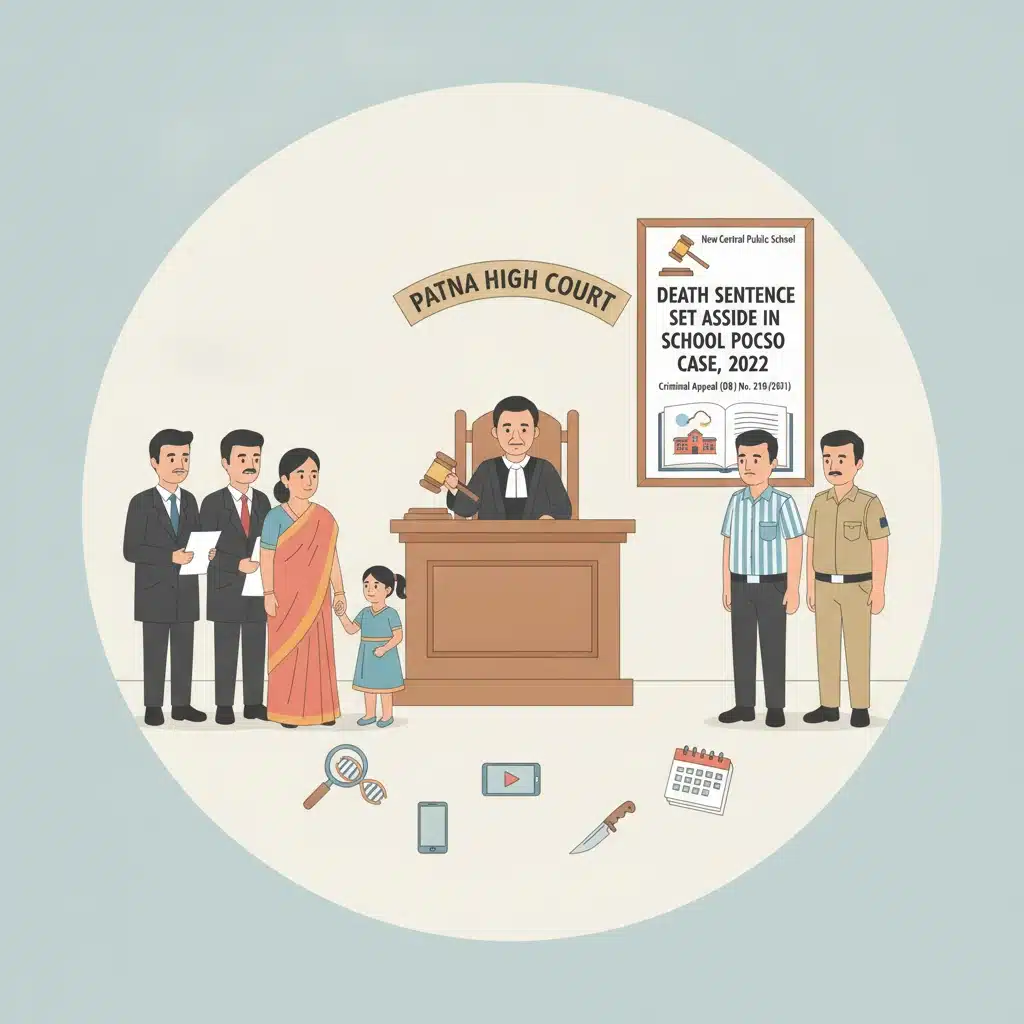
Case Background
The case arose from Mahila P.S. Case No. 136 of 2018, registered on 19.09.2018 at Phulwarisharif Mahila Police Station, Patna. The informant was the mother of the victim girl, who alleged sexual exploitation of her daughter by the school principal of New Central Public School, Phulwarisharif, with the help of a teacher.
According to the written complaint, the victim (referred to as ‘X’) was said to be about 11 years old and studying in Class V. The principal, Arvind Kumar @ Raj Singhania, allegedly called her from the classroom to his adjacent bedroom under the pretext of checking her handwriting. There he was said to have repeatedly raped her, made videos, and blackmailed her by threatening to make the video viral and to kill her brother while showing a knife. It was also alleged that a teacher, Abhishek Kumar, used to send the girl to the principal’s room.
The mother noticed stoppage of the girl’s menstruation and vomiting. On conducting a pregnancy test at home with a kit, the test reportedly turned positive. She then went to Phulwarisharif Police Station and was sent to Mahila Police Station, where she submitted a written complaint. On this basis, FIR was registered under Sections 376, 376(b), 120B, 504, 506, 354(D) IPC and Sections 4, 6, 12 of the POCSO Act.
Investigation followed. The Investigating Officer (PW 5) submitted charge-sheet against both accused, and cognizance was taken. The case was committed to the court of the Additional Sessions Judge VI-cum-Special Judge, POCSO, Patna as Special POCSO Case No. 186 of 2018.
The trial court convicted both accused under Section 376(DB) IPC (gang rape on woman under 12 years) and Section 6 POCSO read with Section 120B IPC. Arvind Kumar was additionally convicted under Section 506 IPC and awarded death penalty, plus fine. Abhishek Kumar was sentenced to life imprisonment and fine. The trial court made a reference under Section 366 Cr.P.C. (Death Reference No. 3 of 2021) to the Patna High Court for confirmation of death sentence. Both convicts filed criminal appeals (Criminal Appeal (DB) No. 218 of 2021 by Arvind Kumar; Criminal Appeal (DB) No. 285 of 2021 by Abhishek Kumar).
What the Court Examined and Decided
A Division Bench of the Patna High Court, comprising Hon’ble Mr. Justice Ashwani Kumar Singh and Hon’ble Mr. Justice Rajeev Ranjan Prasad (authoring Judge), heard the death reference and the two connected criminal appeals together. The Court appointed senior counsel and an advocate as Amicus Curiae to assist.
The prosecution examined six witnesses, including the victim (PW 2), her parents (PW 3 and PW 4), her maternal uncle (PW 1), the Investigating Officer (PW 5), and a doctor from the medical board (PW 6). Several documents were produced, including the FIR, seizure list, medical reports, birth certificate (Exhibit 8), and DNA/Forensic report (Exhibit 9). The defence examined four witnesses and produced admission forms of a school and photocopies of Aadhaar cards.
The victim (PW 2) stated that she was studying in New Central Public School and that the principal, Arvind Kumar, called her to his room on the pretext of checking handwriting and there committed rape on her 5–6 times. She told her mother that “Principal Sir Raj Singhania @ Arvind Kumar” had done wrong acts with her. About Abhishek Kumar, she only stated that on one occasion, “Arvind Sir ne mujhe Principal Sir ke room me writing check karne bheja tha” (Arvind Sir sent me to the principal’s room for writing check). She did not say that Abhishek repeatedly sent her, that he guarded the door, or that he participated in the assault.
The mother (PW 3) and father (PW 4) supported the prosecution story. PW 3 said both the principal and Abhishek Kumar were involved: the teacher would send the girl to the principal’s room and stand guard outside, and the principal would rape her inside. She also deposed about the pregnancy test and the report to the police. PW 4 confirmed that his daughter was a student of the school and that the principal raped her. He mentioned a prior loan transaction of Rs. 1 lakh between his wife and Arvind Kumar, which the defence tried to use as a ground for false implication.
The Investigating Officer (PW 5) deposed that she visited the school with the victim and seized three mobile phones, a school register and a knife, and prepared seizure list (Exhibit 4). She collected blood samples of the accused and serum of chorionic villi of the foetus, and sent them for DNA testing (Exhibits 5 and 5/1). In cross-examination, she admitted serious lapses: no documentary proof was taken to show the victim studied in the school; no neighbours of the school were examined; the number and description of school rooms were not recorded; seizure witnesses’ statements were not recorded; and there was no supervision note by senior police officers. She also did not secure school admission records for proof of age and admitted that no age-related document was produced before her at the time of FIR.
The doctor (PW 6) from Gardanibagh Hospital was part of the medical board that examined the victim on 20.09.2018. She found the pregnancy test positive, with last menstruation on 08.08.2018, but no signs of violence on the private parts. Vaginal swab was sent for testing. For age determination, the victim was sent to PMCH for radiology and other tests. On the basis of radiological, pathological and ultrasound reports, the victim’s age was assessed between 13–14 years (Exhibit 7). PW 6 also observed, from dentition, that the victim had 14 teeth each in upper and lower jaws, a feature she associated with being “major”. She clarified that without ossification test, she could not give final opinion. She further stated that no DNA test had been done for paternity (parental finding) and she had not received any such report.
On the defence side, DW 1 and DW 2 (brother and father of accused Arvind respectively) claimed the girl actually studied in a different school with a similar name at Anisabad, run by another person, and produced admission forms (Exhibits A, B, B/1, C) showing the victim’s date of birth as 12.07.2000 and class VIII in 2017–18. The prosecution challenged these documents as forged, pointing out absence of school seal or headmaster’s signature. DW 3 (sister of Abhishek) and DW 4 (a parent of another student) also tried to show confusion of schools and denied the victim’s presence in the accused’s school.
The trial court, relying primarily on the oral statements of PW 1–PW 4 and the birth certificate (Exhibit 8, issued by the Registrar, Department of Planning and Development, Nalanda), held the victim’s age to be 11 years and convicted both accused for gang rape of a child under 12 years under Section 376(DB) IPC, as well as for aggravated penetrative sexual assault under Section 6 POCSO read with Section 120B IPC. It also found Arvind Kumar guilty of criminal intimidation under Section 506 IPC for threatening the victim with a knife. Death penalty was imposed on Arvind Kumar.
Before the High Court, the main points argued by the defence were: (1) the prosecution had not legally proved that the victim was below 12 years of age; (2) evidence against Abhishek Kumar did not show common intention or participation in rape; (3) birth certificate (Exhibit 8) was marked as exhibit after closure of prosecution evidence and without a proper witness proving its contents; (4) the medical assessment (Exhibit 7) showed the victim to be 13–14 years; and (5) age-related incriminating material was not put to the accused in their Section 313 Cr.P.C. statements.
The Amicus Curiae supported the prosecution on some points but agreed that age determination had procedural defects and that conviction of Abhishek Kumar for gang rape could not stand because the victim herself spoke of only a single sending to the room and no participatory role.
The High Court carefully examined the testimony of the victim. It noted that she was the only eye-witness and, as a “sterling witness”, her version carried great weight. She clearly implicated Arvind Kumar as the person who repeatedly raped her in his room. However, regarding Abhishek Kumar, she described only one instance of being sent to the principal’s room and did not speak about any repeated sending, guarding of the door, or knowledge on his part that rape would occur.
On this basis, the Court held it would be unsafe to conclude that there was a pre-concert or common intention between Abhishek Kumar and Arvind Kumar to commit rape. Since Abhishek had not committed any act falling within clauses (a)–(d) of Section 375 IPC (the definition of rape), and common intention for gang rape under Section 376(DB) was not proved beyond reasonable doubt, he could not be held guilty under Section 376(DB) or under Section 6 POCSO (which requires commission of penetrative sexual assault). He was given benefit of doubt and acquitted, with a direction for his release if not wanted in any other case.
On the age issue, the Court analysed the oral evidence, the birth certificate (Exhibit 8), and the medical report (Exhibit 7). PW 1, PW 2 and PW 4 all said the victim was about 11 years, and the defence did not cross-examine them on age. But the defence did question PW 3 (mother), PW 5 (IO) and PW 6 (doctor), produced photocopies of Aadhaar cards, and even filed an application under Section 7A of the Juvenile Justice Act seeking determination of the victim’s age. The trial court did not finally decide that application and later allowed Exhibit 8 to be marked, despite objections and without calling any witness to prove the certificate.
Relying on precedent including State of Bihar v. Durgawati Devi, the High Court reiterated that merely marking a document as an exhibit does not prove its contents. As no witness was examined to prove the date of birth in Exhibit 8, and the document was introduced after closure of evidence, the Court held it could not be safely relied upon. Additionally, the victim’s age, as per medical report (13–14 years), and non-compliance with the procedure for age determination under the Juvenile Justice Act and POCSO framework, created reasonable doubt.
The Court also noticed that in the accused’s statements under Section 313 Cr.P.C., no question was put to them regarding Exhibit 8 or other age-related incriminating material. Citing Supreme Court rulings, the Bench held that circumstances not put to the accused under Section 313 cannot be used against them. In such a situation, accepting the prosecution’s claim that the victim was below 12 years would not be a “prudent and safe approach”. The benefit of doubt on age had to go to Arvind Kumar.
However, the Court found that the core allegation of rape was firmly established against Arvind Kumar. The victim’s detailed and consistent account, supported by pregnancy and medical evidence, clearly brought his act within the definition of rape in Section 375 IPC. She narrated multiple instances of sexual assault in his room. The High Court therefore held him guilty of rape under Section 376 IPC, criminal intimidation under Section 506 IPC, and aggravated penetrative sexual assault under Section 6 POCSO.
Because of Section 42 POCSO (alternate punishment), where both IPC and POCSO apply, the Court is to impose the greater punishment. The Bench therefore sentenced Arvind Kumar to rigorous imprisonment for life with a fine of Rs. 1,00,000 under Section 376 IPC. His conviction under Section 6 POCSO was maintained, but no separate sentence was awarded under that section. His conviction and sentence of two years’ rigorous imprisonment and Rs. 5,000 fine under Section 506 IPC were also upheld, with all sentences to run concurrently.
On sentencing, the Court considered that this case, though grave, did not involve kidnapping and murder like some other “rarest of rare” cases. It noted submissions that Arvind Kumar was about 32–33 years old, educated, allegedly without prior criminal antecedents, and that there was no material to show that reformation was impossible. Following principles from judgments like Bachan Singh v. State of Punjab, Md. Mannan v. State of Bihar, and decisions where death sentences were converted to life imprisonment, the Bench concluded that death penalty was not justified.
Consequently, the criminal appeals were allowed to the extent indicated: Abhishek Kumar was acquitted; Arvind Kumar’s conviction was altered from Section 376(DB) to Section 376 IPC with modified sentence; and Death Reference No. 3 of 2021 for confirmation of death penalty was rejected.
Why This Judgment Matters
This judgment is important for several reasons. First, it shows that even in extremely serious sexual offence cases, courts insist that legal procedures be followed strictly. The Patna High Court held that for imposing the harsher provision of gang rape on a child under 12, the prosecution must clearly and legally prove both the child’s age and the common intention of all accused. Mere suspicion or incomplete paperwork is not enough.
Second, the decision explains that the testimony of the victim, when trustworthy, is enough to convict the main offender. The Bench relied on the girl’s own words to uphold rape charges against the principal, despite various lapses in investigation. This reassures survivors that their voice can be decisive.
Third, the case underlines the duty of police and prosecution to properly prove age of child victims using school records, birth certificates, and medical evidence in accordance with the Juvenile Justice and POCSO frameworks. If this is not done, harsher punishment slabs linked to age (like “below 12 years”) may not stand on appeal.
Finally, on sentencing, the Court reaffirmed that death penalty is reserved for the rarest of rare cases and that possibilities of reform and rehabilitation must be considered. Even where the trial court had imposed death, the High Court closely reviewed mitigating factors and reduced the sentence to life imprisonment.
Legal Issues and Answers
Issue: Whether the prosecution proved beyond reasonable doubt that the victim was below 12 years, justifying conviction under Section 376(DB) IPC (gang rape on woman under twelve years).
Answer: No. The High Court found that the age was not proved in accordance with law, the birth certificate (Exhibit 8) was not properly proved, the medical report suggested age 13–14 years, and age-related material was not put to the accused under Section 313 Cr.P.C. Hence benefit of doubt went to the accused.
Issue: Whether the evidence established common intention or participation of Abhishek Kumar sufficient for his conviction for gang rape under Section 376(DB) and under Section 6 POCSO.
Answer: No. The victim’s testimony spoke of only one instance of being sent by Abhishek to the principal’s room and did not show that he knew rape would occur or that he guarded the room. There was no proof of pre-concert of mind or penetrative sexual assault by him. He was acquitted with benefit of doubt.
Issue: Whether the conviction and death sentence of Arvind Kumar under Section 376(DB) IPC should be upheld.
Answer: Partly. While his guilt for rape and aggravated penetrative sexual assault was upheld, the specific conviction under Section 376(DB) IPC failed due to lack of legal proof that the victim was under 12 years. His conviction was modified to Section 376 IPC read with Section 6 POCSO and Section 506 IPC, and the death penalty was converted to life imprisonment with fine.
Cases Cited by the Court
- The judgment refers to several decisions for legal principles, including:
- State of Bihar v. Durgawati Devi, 2021 (4) PLJR 516 (on proof of documents).
- Jairnail Singh v. State of Haryana, (2013) 7 SCC 263 (age determination using Juvenile Justice Rules).
- Laxmibai v. Bhagwanthuva, AIR 2013 SC 1204; (2013) 4 SCC 97 (effect of non cross-examination).
- Mudassani v. M. Sarojana, AIR 2016 SC 2250, and Karnidan Sarda v. Sailja K. Mitra, AIR 1940 Pat 683 (cross-examination principles).
- Noor Aga v. State of Punjab, 2008 (16) SCC 417 (presumptions and foundational facts).
- State of Bihar v. Bachesh Kumar Singh, 2021 (3) PLJR 297 (Section 313 Cr.P.C.).
- Bachan Singh v. State of Punjab, (1980) 2 SCC 684 and Md. Mannan v. State of Bihar, (2019) 16 SCC 584 (death penalty principles).
- State of Bihar v. Rohan Bind, 2018 (4) BLJ 219 (PHC) and State of Bihar v. Hari Krishna Sada, 2018 (4) BLJ 302 (PHC) (sentencing in child rape-murder cases).
- Pappu v. State of Uttar Pradesh, 2022 (2) BLJ 231 (SC) (commutation of death sentence).
- Jagat Prasad v. State of Bihar & Anr., 2022 (1) PLJR 568 (SC) (Section 313 Cr.P.C. obligations, as discussed by the Division Bench).
Case Details
Case Number: Death Reference No. 3 of 2021 with Criminal Appeal (DB) No. 218 of 2021 and Criminal Appeal (DB) No. 285 of 2021, arising out of Mahila P.S. Case No. 136 of 2018, District Patna.
Case Title: The State of Bihar v. Arvind Kumar @ Raj Singhania (Death Reference No. 3 of 2021); Arvind Kumar @ Raj Singhania v. The State of Bihar (Criminal Appeal (DB) No. 218 of 2021); Abhishek Kumar v. The State of Bihar (Criminal Appeal (DB) No. 285 of 2021).
Coram: Hon’ble Mr. Justice Ashwani Kumar Singh and Hon’ble Mr. Justice Rajeev Ranjan Prasad.
Citation: 2022 (4) PLJR 387.
Advocates:
- In Death Reference No. 3 of 2021:
- For the Petitioner/State: Mr. Xxxxxx.
- For the Respondent: Mr. Rajesh Singh, Amicus Curiae; Ms. Surya Nilambari, Amicus Curiae.
- In Criminal Appeal (DB) No. 218 of 2021 (Arvind Kumar @ Raj Singhania):
- For the Appellant: Mr. Baxi S.R.P. Sinha, Senior Advocate; Mr. Prem Ranjan Kumar, Advocate; Mr. Rupesh Kumar, Advocate; Mr. Mrigendra Pratap Singh, Advocate; Mr. Brajesh Kumar, Advocate.
- For the Respondent/State: Mr. Ajay Mishra, APP.
- In Criminal Appeal (DB) No. 285 of 2021 (Abhishek Kumar):
- For the Appellant: Mr. Baxi S.R.P. Sinha, Senior Advocate; Mr. Prem Ranjan Kumar, Advocate; Mr. Rupesh Kumar, Advocate; Mr. Mrigendra Pratap Singh, Advocate; Mr. Brajesh Kumar, Advocate.
- For the Respondent/State: Mr. Ajay Mishra, A.P.P.
Nature of the Case: Death reference under Section 366 Cr.P.C. arising from conviction in a Special POCSO case, heard along with criminal appeals against conviction and sentence.
Link to Judgment: Patna High Court Judgment (Death Reference No. 3 of 2021 and connected appeals)
If you found this explanation helpful and wish to stay informed about
how legal developments may affect your rights in Bihar,
you may consider following Samvida Law Associates for more updates.




