

Case Background
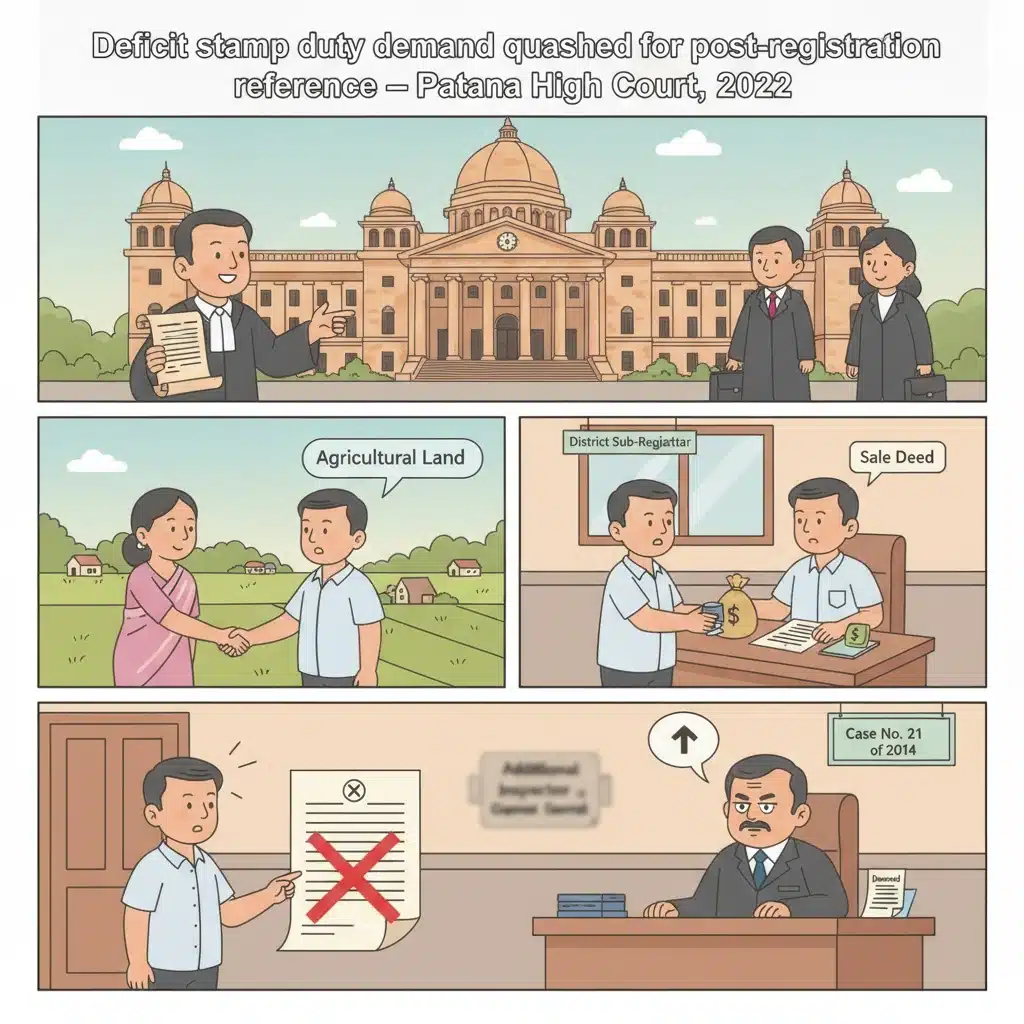
The petitioner agreed to purchase land in Mauza Govindpur Selhauri, P.S. Naubatpur, District Patna. The land related to Thana No. 155 (computer code 036), Khata No. 316, Khesra survey plot Nos. 1164, 1165, 1166, 1167 and 1168, with a total area of 1 acre 56 decimals, said to be about 50 kathas.
The vendors had advertised this land for sale. The agreed rate was Rs. 12,000 per katha. According to the petitioner, the vendors jointly received Rs. 2,00,000 as earnest money and executed a deed of baibeyana (agreement to sell) on 10.03.2012 in his favour.
Out of the total agreed sale consideration of Rs. 6,00,000, the petitioner paid Rs. 4,85,000. At that stage, the vendors allegedly refused to execute and register the sale deed. This led the petitioner to file Title Suit No. 119 of 2012 seeking specific performance of contract against the vendors.
On 23.10.2013, during the pendency of the title suit, the parties filed a joint compromise petition. Following this compromise, a sale deed was presented for registration on 28.10.2013 in favour of the petitioner for the same land and for the same sale consideration of Rs. 6,00,000.
In the sale deed, the land was described as agricultural land. The petitioner paid stamp duty of Rs. 48,000 as per the valuation then considered applicable. The District Sub‑Registrar, Bikram, registered the sale deed on 28.10.2013.
Despite the registration, the matter later took a different turn. The District Sub‑Registrar, Bikram, treated the land as “progressive” or developing land attracting higher valuation. He purported to make a reference under Section 47A(1) of the Indian Stamp Act, 1899 to the Additional Inspector General of Registration, Patna (respondent no. 4).
On the basis of this reference, Case No. 21 of 2014 was initiated before respondent no. 4. A notice dated 09.09.2014 was issued to the petitioner. The petitioner appeared and asserted that the land was agricultural and that the Sub‑Registrar’s higher valuation was arbitrary and unsupported by reasons.
However, on 29.05.2015, respondent no. 4 passed an ex parte order in Case No. 21 of 2014. He accepted the Sub‑Registrar’s reference, valued the property at Rs. 2,49,60,000, and directed payment of deficit stamp duty of Rs. 19,48,800 along with a fine of Rs. 1,94,880. He further stipulated that if payment was not made within 60 days, interest at 5% per month would be levied on the deficit amount.
Thereafter, by letter dated 04.06.2015, respondent no. 4 raised a total demand of Rs. 21,43,680 on the petitioner. Challenging the order dated 29.05.2015 and the subsequent demand letter, the petitioner approached the Patna High Court in CWJC No. 1281 of 2019.
What the Court Examined and Decided
The Patna High Court, through Hon’ble Mr. Justice Mohit Kumar Shah, closely examined the legality of the reference made by the District Sub‑Registrar and the ex parte order passed by the Additional Inspector General of Registration.
First, the Court reproduced Section 47A(1) of the Indian Stamp Act, 1899 as amended by the Indian Stamp (Bihar Amendment) Act, 2013. This provision allows a registering officer, while registering an instrument of conveyance, exchange, gift, partition or settlement, to refer the document to the Collector for determination of proper market value and duty if the classification, measurement or stated value appears to be wrong or lower than the guideline register.
A key element of Section 47A(1) is timing. The registering officer must make such a reference “before registering” the instrument. The Court stressed that this language is clear and mandatory.
On the admitted facts, the petitioner’s sale deed was registered by the Sub‑Registrar, Bikram, on 28.10.2013. The Sub‑Registrar made his reference to respondent no. 4 only on 01.09.2014, almost eleven months after the registration.
The Court held that a reference under Section 47A(1) made after registration is contrary to the statute. The provision empowers the registering officer to act only before registration. Once registration is done, that route is closed.
The Court then considered what the law permits after registration. Section 47A(3) of the Indian Stamp Act, 1899 allows the Collector to act suo motu within two years from the date of registration of an instrument not already referred under sub‑section (1). The Collector may call for the instrument, examine its correctness regarding market value and duty, and if he finds undervaluation, determine the proper value and additional duty following the procedure of sub‑section (2).
The Court pointed out that in the present case, there was no such suo motu proceeding initiated by the Collector or the Assistant Inspector General under Section 47A(3). Instead, the Sub‑Registrar himself made a delayed reference under Section 47A(1) after registration, which the statute does not allow.
On this basis alone, the Court found the reference to be illegal and held that the consequent order dated 29.05.2015 was unsustainable.
To reinforce this conclusion, the Court relied on a previous judgment of a coordinate Bench in Shahnaz Begam vs. The State of Bihar & Ors., 2018(2) PLJR 293. In that case also, the registering authority had made a reference after registration. The coordinate Bench had categorically held that such a reference was against Section 47A(1) and had quashed the resulting order.
The Patna High Court extracted paragraphs 6 to 9 of Shahnaz Begam, where it was clearly laid down that:
- a reference under Section 47A(1) can be made only before registration;
- post‑registration action, if any, has to be under Section 47A(3) by the Collector acting suo motu within two years; and
- a reference made after registration is against statutory provisions and cannot be sustained.
Finding the present case “squarely covered” by Shahnaz Begam, and noting that the State’s counsel could not controvert this, the Court held the reference and the order based on it to be in clear contravention of Section 47A(1).
The Court then examined a second, independent illegality. It noted that the Assistant Inspector General, Registration, Patna, had passed the impugned ex parte order dated 29.05.2015 without complying with the Bihar Stamp (Prevention of Under Valuation of Instruments) Rules, 1995 (the Rules, 1995).
Under Rule 5 of the Rules, 1995, the District Sub‑Registrar has to prepare a guidelines register of estimated minimum value after classifying rural and urban lands. Rule 6, as amended by the Amendment Rules, 2013, lays down the process of fixation of estimated minimum market value by the District Valuation Committee under the guidance of the Central Valuation Committee.
In the petitioner’s case, there was no recommendation of the District Valuation Committee for the relevant period. Annexure‑7 to the writ petition showed that the District Valuation Committee decided the nature and extent of “progressive land” at Govindpur Selhauri only on 30.09.2014.
However, the petitioner had presented the document for registration much earlier, on 28.10.2013. Before 30.09.2014, the only notified rate was Rs. 65,000 per decimal for agricultural land at Thana Govindpur Selhauri for the period 01.04.2011 to March 2012. There was no prescribed rate for 01.04.2012 to 31.03.2013 and 01.04.2013 to 31.03.2014.
Despite the absence of any duly fixed estimated minimum market value for the relevant period and category, the Assistant Inspector General treated the land as “progressive” and fixed an extremely high valuation of Rs. 2,49,60,000. The Court found that he did this without calling for a report from the concerned Circle Officer regarding the nature or category of the land, and without following Rules 5 and 6 of the Rules, 1995.
The Court observed that this very issue had been considered earlier in Prashant Kumar Mahensaria vs. The State of Bihar & Ors., 2019 (3) PLJR 1094. There, the Court had quashed a similar order where minimum valuation registers did not properly categorise land, the authority had not relied on relevant Circle Officer reports, and no proper enquiry had been conducted. The Court in that case held that in the absence of proper fixation of estimated minimum market value and proper categorisation, and in the absence of a reasoned enquiry, a demand for deficit stamp duty could not stand.
Referring to paragraphs 5 to 9 of Prashant Kumar Mahensaria, the Patna High Court in the present case held that the same defects existed here. There was no valid guideline rate for the petitioner’s agricultural land at the time of presentation; the District Valuation Committee’s later decisions could not be applied retrospectively; and no proper enquiry or categorisation was carried out before imposing the huge deficit duty.
Therefore, apart from the illegality of the post‑registration reference, the Court found that the valuation and demand themselves were arbitrary and contrary to the Rules, 1995.
Having considered both grounds, the Court concluded that the impugned order dated 29.05.2015 passed by the Assistant Inspector General of Registration, Patna, was illegal and contrary to law. It accordingly quashed the order.
The Court also declared all consequential actions taken by the respondent authorities on the basis of the impugned order, including the demand letter dated 04.06.2015, to be null and void. The writ petition was allowed.
Why This Judgment Matters
This judgment is important for land buyers and sellers across Bihar, especially small buyers of agricultural land. It confirms that once a sale deed is registered, the Sub‑Registrar cannot later send the document for higher valuation under Section 47A(1).
If the government suspects undervaluation after registration, the law requires the Collector to act on his own within two years, following the proper procedure. The Court shows that shortcuts by registration officials will not be tolerated.
The ruling also protects citizens from arbitrary stamp duty demands based on vague labels like “progressive land” without proper guideline rates, committee recommendations or enquiries. Authorities must strictly follow the Bihar Stamp Rules, 1995 when fixing minimum market value.
For people in Bihar who face sudden, large demands for deficit stamp duty years after their sale deed is registered, this Patna High Court decision provides a clear basis to challenge illegal references and unsupported valuations.
Legal Issues and Answers
- Issue: Can the District Sub‑Registrar refer a registered sale deed to the Collector/Additional Inspector General under Section 47A(1) of the Indian Stamp Act, 1899 for revaluation and deficit stamp duty?
Answer: No. The Patna High Court held that a reference under Section 47A(1) can be made only before registering the instrument. A reference made about eleven months after registration was illegal and contrary to the Act. - Issue: Was the valuation of the petitioner’s land as “progressive land” and the resulting deficit stamp duty demand valid when no proper guideline rate or committee recommendation existed for the relevant period?
Answer: No. The Court held that, in the absence of estimated minimum market value fixed on the recommendation of the District Valuation Committee, and without enquiry or Circle Officer’s report on the nature of land, the authority’s order was arbitrary, violated Rules 5 and 6 of the Bihar Stamp (Prevention of Under Valuation of Instruments) Rules, 1995, and had to be quashed. - Issue: What is the effect of these findings on the demand for deficit stamp duty and penalty against the petitioner?
Answer: The Court quashed the impugned order dated 29.05.2015 and declared all consequential actions, including the demand of Rs. 21,43,680, null and void. The writ petition was allowed.
Cases Cited by the Court
- Shahnaz Begam vs. The State of Bihar & Ors., 2018(2) PLJR 293.
- Prashant Kumar Mahensaria vs. The State of Bihar & Ors., 2019 (3) PLJR 1094.
Case Details
Case Number: Civil Writ Jurisdiction Case No. 1281 of 2019
Case Title: Raj Kumar Sharma vs. The State of Bihar & Ors.
Citation: 2022 (4) PLJR 698
Court: High Court of Judicature at Patna
Coram: Hon’ble Mr. Justice Mohit Kumar Shah
Date of Judgment: 02.08.2022
Advocates:
- For the petitioner: Ms. Prakritita Sharma, Advocate
- For the respondents: Mr. Rishi Raj Sinha, SC‑19; Mr. Saurabh Kumar, AC to SC‑19
Respondents: State of Bihar through the Principal Secretary, Revenue and Land Reforms, and registration authorities including the Inspector General of Registration, the Collector‑cum‑District Magistrate Patna, the Additional Inspector General of Registration, and the District Sub‑Registrar, Bikram.
Nature of the Case: Writ petition (civil) challenging an ex parte order determining alleged deficit stamp duty and penalty, and the resulting demand notice.
Statute and Rules Involved: Section 47A of the Indian Stamp Act, 1899 (as amended by the Indian Stamp (Bihar Amendment) Act, 2013); Bihar Stamp (Prevention of Under Valuation of Instruments) Rules, 1995, including Rules 5 and 6.
Link to the Judgment: Click here to view the full judgment of the Patna High Court
If you found this explanation helpful and wish to stay informed about how legal developments may affect your rights in Bihar, you may consider following Samvida Law Associates for more updates.