

Case Background
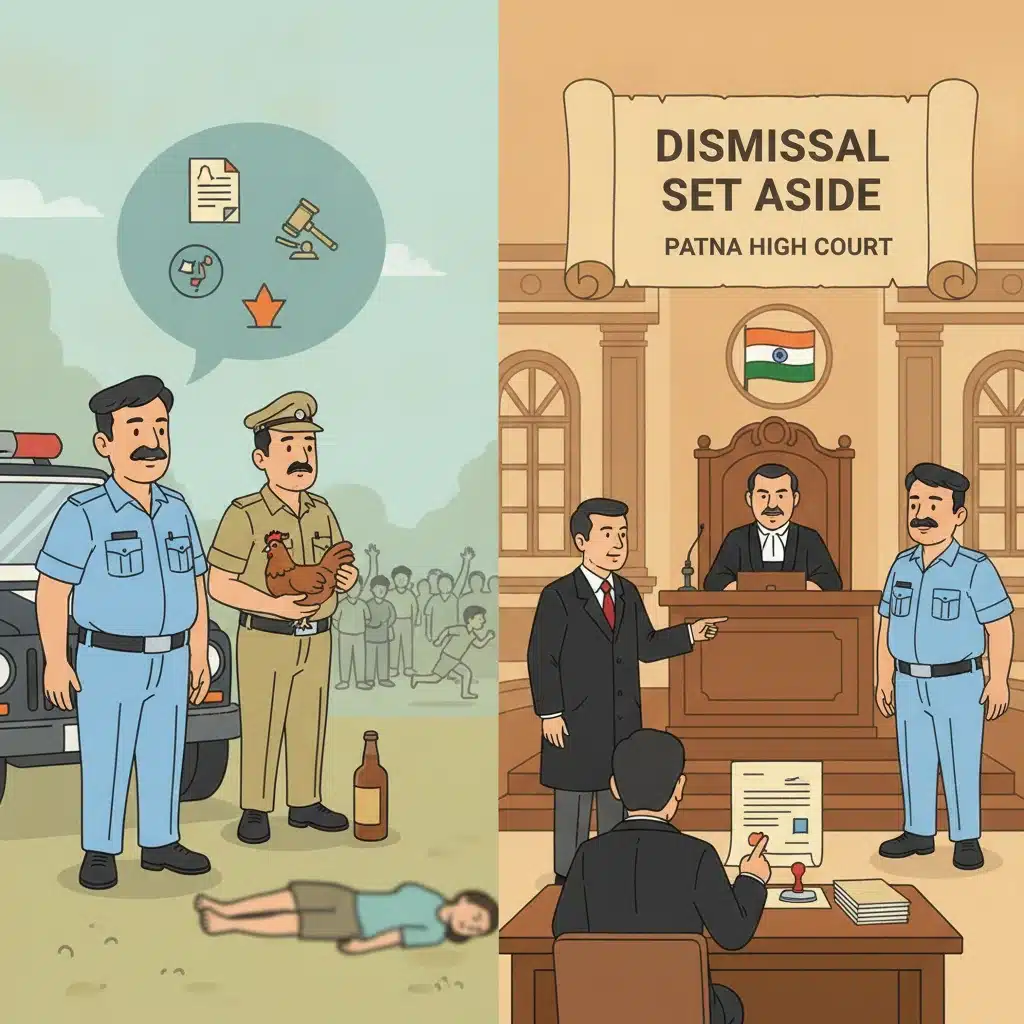
The case arose from an incident on 6 April 2018. At that time, the petitioner was working as an Assistant Sub-Inspector of Police at Mohammadpur Police Station in Gopalganj district.
On that morning, he went out on patrolling duty in a police jeep along with other police personnel. During this patrolling, the jeep met with an accident. A woman was injured in the accident, taken to hospital and later died.
After the accident, local people became angry. According to the petitioner, they caught hold of him and a Homeguard, while the driver ran away. The petitioner says that these agitated locals planted a bottle of liquor and a live chicken in the back of the jeep to falsely implicate them.
A report about the incident was sent by the Sub-Divisional Police Officer, Sadar, Gopalganj to the Superintendent of Police, Gopalganj. Blood and urine samples of the police personnel, including the petitioner, were sent to the Regional Forensic Science Laboratory, Muzaffarpur for analysis.
On 6 April 2018, the Superintendent of Police, Gopalganj ordered a departmental proceeding against the petitioner. A memo of charge was served on him on 23 May 2018. The petitioner submitted a detailed written defence on 5 November 2019 denying the charges.
The enquiry officer conducted the departmental enquiry and submitted his report on 3 December 2020, holding the petitioner guilty. A second show cause notice dated 4 December 2020, along with a copy of the enquiry report, was issued to the petitioner. He replied to this second show cause on 6 December 2020.
On 10 December 2020, the Deputy Inspector General of Police, Saran Range, Chapra, passed an order dismissing the petitioner from service with immediate effect. The petitioner filed an appeal before the Additional Director General of Police (Law and Order), Bihar, Patna.
The appellate authority rejected the appeal by order dated 24 April 2021. This rejection was communicated to the petitioner by the Superintendent of Police, Saran through District Order No.1047/2021 dated 19 May 2021.
Aggrieved, the petitioner approached the Patna High Court in Civil Writ Jurisdiction Case No. 897 of 2022. He challenged both the dismissal order dated 10 December 2020 and the appellate order dated 24 April 2021, and sought reinstatement with consequential benefits.
What the Court Examined and Decided
The matter was heard by Hon’ble Mr. Justice Partha Sarthy. The Court heard Mrs. Nivedita Nirvikar, Senior Advocate for the petitioner, and Mr. Md. N.H. Khan, Standing Counsel for the State.
The petitioner’s main argument was that the departmental enquiry was a “no evidence” enquiry. According to him, the respondents failed to lead any oral or documentary evidence to actually prove the charges.
The petitioner pointed out that the enquiry report itself showed that only two witnesses were examined: ASI Randhir Kumar Singh and ASI Harendra Kumar. Their role was only to prove that certain office memos dated 6 April 2018 were issued from the office of the Superintendent of Police, Gopalganj and the SDPO, Sadar, Gopalganj.
Neither of these witnesses spoke about the contents of those memos. They did not say anything about the accident, the alleged recovery of liquor, or the petitioner being drunk on duty.
The petitioner argued that there was no witness who stated that liquor was recovered from the jeep, or that the Forensic Science Laboratory report showed alcohol in his blood or urine. No such documents were proved in accordance with law.
He therefore contended that the enquiry officer wrongly held him guilty without any legally acceptable evidence. He relied on the Supreme Court judgment in Roop Singh Negi v. Punjab National Bank, (2009) 2 SCC 570, which stresses that documents in a departmental enquiry must be proved through witnesses and cannot be treated as evidence merely because they exist.
On the other hand, the State’s counsel defended the dismissal. He submitted that while returning from patrolling duty, the police jeep in which the petitioner was present along with other police personnel hit a lady, who later died.
He stated that, in the enquiry, the petitioner was found guilty. During investigation, the urine and blood samples of the police personnel were sent to the Forensic Science Laboratory, and alcohol was found in all the samples. This, he said, confirmed that the petitioner and others were in a drunken condition while on patrolling duty.
He argued that the petitioner was given adequate opportunity at every stage of the departmental proceeding. After considering the enquiry report and the petitioner’s reply to the second show cause notice, the competent authority passed the dismissal order.
He further submitted that the scope of judicial review in a writ petition under Article 226 of the Constitution against orders passed in departmental proceedings is very limited. Since no illegality or irregularity in the conduct of the enquiry had been shown, the Court should not interfere.
The Court then examined the material on record, especially the enquiry report, which had been filed as Annexure-5 to the writ application.
On going through the enquiry report, the Court noted that only two witnesses were examined. ASI Randhir Kumar Singh stated that he was posted in the office of the Superintendent of Police, Gopalganj, and that Memo dated 6 April 2018 (marked Exhibit I) had been issued from that office.
ASI Harendra Kumar stated that he was posted in the office of the SDPO, Sadar, Gopalganj, and that Office Memo No.629 dated 6 April 2018 (marked Exhibit II) had been issued from that office.
The Court pointed out that the enquiry report did not contain any statement of these witnesses regarding what was written in those memos. Nor did it show what exactly the respondents wanted to prove through these memos.
Beyond proving that these memos were issued and bore the signatures or initials of the concerned authorities, no other witness was examined. No other document was proved in support of the charges against the petitioner.
However, in the part of the enquiry report dealing with the enquiry officer’s “opinion”, the officer narrated several facts: that the petitioner was present during the accident; that a 25-year-old woman died; that there was disturbance by local people; that a criminal case, Mohammadpur P.S. Case No.43 of 2018 under Sections 279 and 304A of the Indian Penal Code, was registered; that a half-filled liquor bottle was recovered from the jeep; that blood samples were sent to the Forensic Science Laboratory; and that the FSL report was received in the criminal case.
On the basis of these statements, the enquiry officer concluded that the charges against the petitioner had been proved. But the Court underlined that none of these facts had been proved in the departmental enquiry through witnesses or properly exhibited documents.
The Court then reiterated an important principle: a departmental proceeding is a quasi-judicial proceeding. The enquiry officer performs a quasi-judicial function. The presenting officer must lead both oral and documentary evidence in the enquiry. Documents have to be proved by witnesses. The charges must be established on the basis of the evidence led in the enquiry itself.
Referring to the contents of the enquiry report, the Court held that no such evidence had been brought on record. Only the issuance of two office memos and the signatures or initials on them were proved, nothing more.
The Court then quoted paragraphs 14 and 15 of the Supreme Court judgment in Roop Singh Negi v. Punjab National Bank and others, (2009) 2 SCC 570. In that case, the Supreme Court held that documents collected during investigation cannot automatically be treated as evidence in a departmental proceeding unless proved by witnesses. It also held that even an FIR or a confession before the police cannot by itself be treated as evidence in the departmental enquiry.
The Court also cited a Division Bench judgment of the Patna High Court in Devendra Prasad v. The State of Bihar & Ors. (LPA No.1302 of 2017, judgment dated 19 October 2023). That decision, following Roop Singh Negi, held that documents in departmental enquiries must be proved by examining witnesses and that mere suspicion cannot replace legal proof.
After considering the law and the facts, the Court concluded that the present case was indeed a case of “no evidence” against the petitioner. There was nothing on record in the enquiry to legally establish that the petitioner had committed the misconduct alleged.
In these circumstances, the Court held that neither the dismissal order dated 10 December 2020 (Saran Range Order No.186/2020 contained in Memo No.3134 issued by the DIG, Saran Range, Chapra) nor the appellate order communicated through Saran District Order No.1047/2021, Memo No.3435 dated 20 May 2021 (issued by the Superintendent of Police, Saran) could be sustained. Both were set aside.
However, the Court did not give the petitioner a clean chit on the facts. Instead, considering the nature of the allegations and the material available, it gave liberty to the respondents to proceed against the petitioner afresh from the stage of commencement of the enquiry. In other words, the department can restart the enquiry, but it must be conducted properly and based on evidence.
With these observations and directions, the writ application was allowed.
Why This Judgment Matters
This judgment is significant for government employees, especially police personnel in Bihar and elsewhere, who face departmental action.
The Patna High Court has made it clear that a person cannot be dismissed from service merely on the basis of office memos, investigation papers, or assumptions. The department must bring proper evidence in the enquiry itself.
For employees, this means that if no witnesses are examined about the real facts and documents are not proved, serious punishments like dismissal can be challenged. The Court will not accept an enquiry report built only on suspicion or unproved documents.
For departments, the judgment is a reminder that disciplinary proceedings are not a formality. They are quasi-judicial processes. Presenting officers must lead evidence, examine witnesses, and prove documents if they want the punishment to survive in court.
The Court has also balanced interests by allowing the department to restart the enquiry. This ensures that if there is real misconduct, it can still be examined, but only through a fair and lawful process.
Legal Issues and Answers
- Issue: Whether the petitioner’s dismissal from service in the departmental proceeding could be sustained when no real evidence was led to prove the charges.
Answer: No. The Patna High Court held that the enquiry was a case of “no evidence” as only issuance of two memos and signatures were proved, and no witness or document established the alleged misconduct. The dismissal and appellate orders were therefore set aside, with liberty to the department to recommence the enquiry.
Cases Cited by the Court
- Roop Singh Negi v. Punjab National Bank and others, (2009) 2 SCC 570.
- Devendra Prasad v. The State of Bihar & Ors., LPA No.1302 of 2017, judgment dated 19.10.2023 (Patna High Court).
Case Details
Case Number: Civil Writ Jurisdiction Case No.897 of 2022
Case Title: Ajay Kumar Singh v. The State of Bihar & Ors.
Citation: 2026 (5) PLJR 179
Court: High Court of Judicature at Patna
Coram: Hon’ble Mr. Justice Partha Sarthy
Date of Judgment: 22.06.2026
Nature of the Case: Writ petition under Article 226 of the Constitution challenging dismissal from service and appellate order in departmental proceedings.
Advocates for Petitioner: Mrs. Nivedita Nirvikar, Senior Advocate; Mr. Shashank Shekhar, Advocate; Mr. Krishna Ranjan, Advocate.
Advocates for Respondents: Mr. Md. N.H. Khan, Standing Counsel-1; Ms. Babita Kumari, Assistant Counsel to SC-1.
Link to Judgment: https://patnahighcourt.gov.in/viewjudgment/MTUjODk3IzIwMjIjMSNO-aWVu–am1–oTE9qE=
If you found this explanation helpful and wish to stay informed about
how legal developments may affect your rights in Bihar,
you may consider following Samvida Law Associates for more updates.




