

Case Background
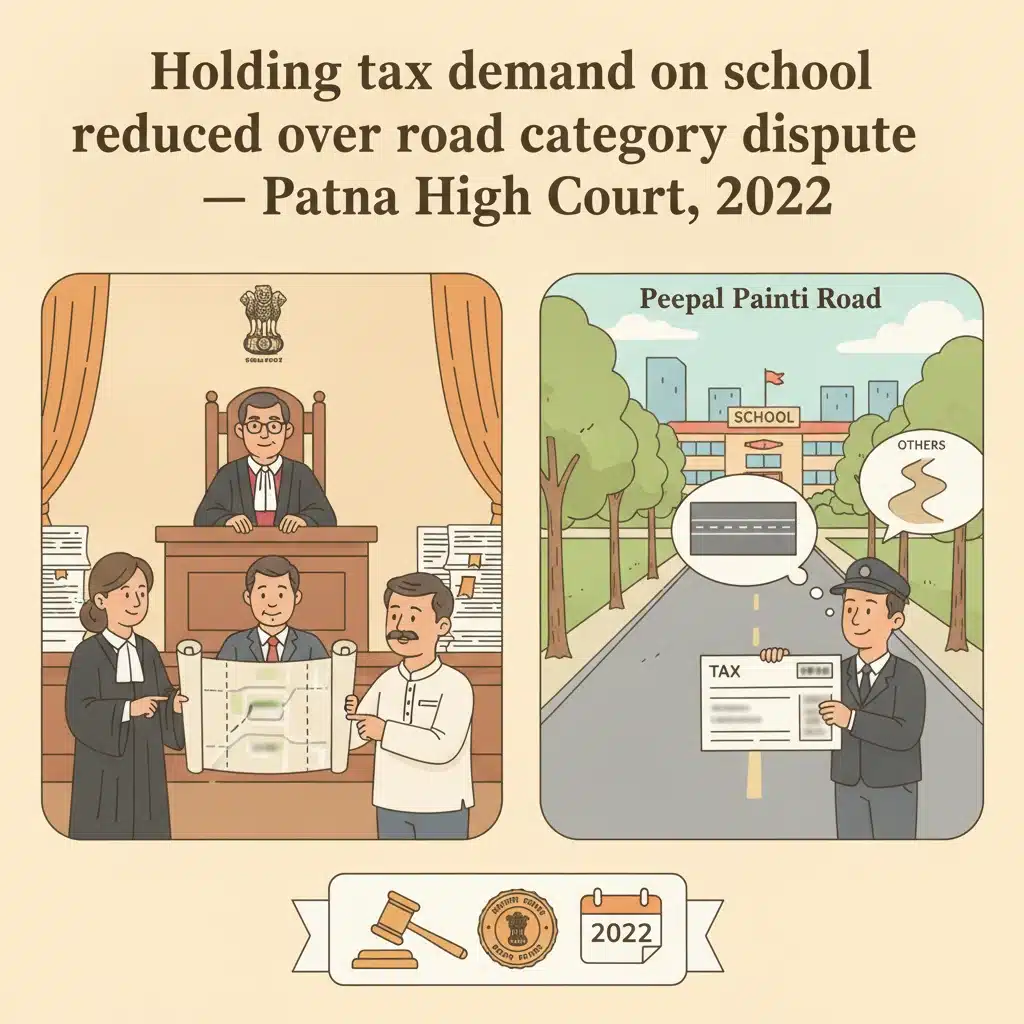
The case concerns an educational institution in Munger which runs a school claimed to be charitable and not for profit. The school building is located on Peepal Painti Road, Munger.
The Munger Municipal Corporation assessed this property for holding tax under Section 127 of the Bihar Municipal Act, 2007. It treated Peepal Painti Road as a “principal main road” and applied the higher tax rate used for such roads.
On this basis, the Corporation raised a demand for arrears and current holding tax. By communication dated 21.06.2011, the Municipal Commissioner quantified total outstanding dues at Rs. 9,93,578/- for the financial years 1997-98 to 2010-11.
The school disagreed with this demand. It objected on two main grounds: first, that as a charitable institution and as a religious residence for religious women of the Catholic Church, it was exempt under Section 124(2) of the 2007 Act; second, that there was no notification under Section 127 declaring Peepal Painti Road to be a “principal main road”, so higher rates could not be applied.
Under these circumstances, the school filed an objection on 29.07.2011. It requested that Peepal Painti Road be treated as falling in the “Others” category of roads, not as a principal main road. It also asked for the calculation details of the demand. The Corporation supplied a detailed calculation under letter dated 04.08.2011.
During the pendency of later court proceedings, the Corporation, by order dated 04.04.2018, admitted the school to “concession” on holding tax instead of full exemption. Because of this, the school’s counsel chose not to press the exemption claim in the present writ case, and the Patna High Court expressly refrained from deciding that issue.
The Municipal Commissioner, however, rejected the school’s review petition against the demand by order dated 15.04.2017. He affirmed the assessment based on treating the premises as located on a principal main road.
The school then filed an appeal under Section 143 of the Bihar Municipal Act, 2007 before the District Judge. This appeal, registered as M.T.A. No. 01 of 2017/C.I.S. No. 1 of 2017, was dismissed on 10.02.2020 by the learned Additional District Judge-II, Munger.
Aggrieved, the school approached the Patna High Court in CWJC No. 3015 of 2021. It sought quashing of both the appellate order dated 10.02.2020 and the review order dated 15.04.2017, and challenged the holding tax demand as illegal to the extent it relied on the “principal main road” category.
What the Court Examined and Decided
Before the Patna High Court, the school narrowed its case. Through its counsel, it no longer argued exemption on the ground of being a charitable institution, because a concession had already been granted in 2018 by the Corporation. The central challenge was now only to the higher rate of holding tax, which had been applied by treating Peepal Painti Road as a “principal main road”.
The main legal point was that Section 127(5) of the Bihar Municipal Act, 2007 requires the Municipality, with approval of the State Government, to publish a list of “principal main roads” and “main roads”, and to modify that list when necessary. According to the school, no such notification existed for Peepal Painti Road as a principal main road.
The school relied on a Division Bench judgment of the Patna High Court in Nagar Parishad, Khagaria vs. State of Bihar & others, reported in 2017 (1) BBCJ 411. That decision had discussed how municipalities must follow Section 127 when levying holding tax.
On the other side, the Munger Municipal Corporation, represented by senior counsel, defended the demand. It relied on the conclusion of a Tax Daroga and produced a sketch map (Annexure ‘A’ to its counter affidavit) showing the locality of Peepal Painti Road.
The Corporation admitted that the school’s holding is situated on Peepal Painti Road. It stated that this road lies between Sahid Bhagat Singh Chowk and Sojhi Ghat and connects two principal main roads: Lallu Pokhar Road and Belan Bazar Patna Road. The Corporation also said that Peepal Painti Road is in the heart of Munger town, with many schools and commercial institutions, and with substantial commercial activity.
On these grounds, the Corporation informed the Court that Peepal Painti Road had been placed in the category of principal main road by the Municipal Board in its general meeting held on 01.07.2019.
Another key development during the case was a revised assessment. After granting concession in holding tax on 04.04.2018, the Municipal Commissioner, by letter no. 1362 dated 07.05.2021, reworked the holding tax. He raised a revised demand of Rs. 7,50,944/- as arrears of tax and also imposed a penalty of Rs. 12,67,082/- for delayed payment.
The school, under protest, offered to pay the arrears immediately. The Corporation accepted this offer by letter dated 15.06.2021. The amount of Rs. 7,50,944/- was then deposited in the bank account of the Munger Municipal Corporation on 19.06.2021.
The High Court noted that the school’s liability to pay penalty for delay would arise only if the underlying tax demand, based on treating Peepal Painti Road as a principal main road, was legally valid. If the demand itself lacked legal basis, the penalty would automatically fall.
The Bench therefore turned to Section 127 of the 2007 Act. It observed that a municipality’s power to levy holding tax flows from this provision. Sub-section (5) authorises the Municipality, with approval of the State Government, to publish and modify lists of principal main roads and main roads. Sub-section (7) requires the Municipality, again with prior State approval, to fix the rate of rental value per square foot, having regard to location, use, type of construction, occupancy and type of non-residential use.
The Court explained that these provisions together impose a clear duty: the Municipality must publish the categorisation of roads into three classes—principal main roads, main roads, and other roads—subject to State Government approval. Then, based on these published categories, the Municipality must fix the rental value per square foot, again with State approval.
Only after this two-step process can a particular holding be assessed. First, the holding is identified according to its location on one of the three categories of roads. Second, its rental value is calculated on the basis of the notified rate per square foot for that category, considering construction and use.
In the school’s case, the Patna High Court recorded an “admitted position”: no notification had been issued under Section 127(5) specifying Peepal Painti Road as a principal main road. Nor had any notification under Section 127(7) been issued fixing the rate of rental value per square foot.
The Corporation’s attempt to justify the assessment by pointing to the locality’s commercial importance, the road’s position between two important roads, or its being in the town’s heart, was held to be irrelevant in the absence of the mandatory notifications. The Court described the Tax Daroga’s certification, which relied on such factors to treat the road as a principal main road, as “legally unsustainable”.
The Bench emphasised that Section 127(5) does not leave road categorisation to mere discretion of the Municipality or its general meeting. It demands formal publication of categories with State Government approval. Measurement of rental value under Section 127(7) must likewise be fixed with State approval, after considering the specified criteria.
Because the statute sets out a specific method, the Court held that any assessment based merely on a resolution of the Municipal Board in its general meeting dated 01.07.2019 lacked statutory basis. The general meeting’s decision to treat Peepal Painti Road as a principal main road was therefore arbitrary and without authority of law.
The Court then examined the earlier Division Bench ruling in Nagar Parishad, Khagaria. It extracted paragraphs 10, 11 and 12 of that judgment, which all stressed that classification of areas and revision of holding tax rates must be done only with prior approval of the State Government and in accordance with Section 127. That decision also said that collection of tax at higher rates without such approval would violate Article 265 of the Constitution of India, which says that no tax shall be levied except by authority of law.
Applying that reasoning, the Patna High Court concluded that the demand of holding tax treating the school’s holding as situated on a principal main road was contrary to Section 127(5) and (7) and therefore had no authority of law.
Consequently, the Court held that the school could not be made to pay holding tax at principal main road rates, since Peepal Painti Road had never been validly notified as a principal main road under Section 127(5).
In terms of relief, the Court declared that the Municipal Corporation could not charge any penalty for the period in question. It noted that the school had already deposited the arrears of holding tax at the higher, unjustified rates. It therefore directed that the school’s liability be reassessed by treating the holding as situated on an “Other” category road. A fresh calculation chart was to be prepared and communicated to the school within eight weeks from the date of judgment.
The Court further directed that the balance excess payment already made by the school, which according to its counsel was small, should be adjusted towards future holding tax liability after the period in question.
On these terms, the writ application was allowed.
Why This Judgment Matters
This judgment is important for schools, charities and ordinary property owners across Bihar who are facing high holding tax demands.
The Patna High Court made clear that a municipality cannot simply call any road a “principal main road” on its own and start charging higher tax. There must be a formal notification, approved by the State Government, under Section 127(5) of the Bihar Municipal Act, 2007.
The decision also confirms that tax rates per square foot must be fixed through a proper process under Section 127(7). Local bodies cannot rely only on internal resolutions, maps or the opinion of tax staff.
Where this legal process has not been followed, higher holding tax demands and penalties can be challenged in court. The case is a reminder that Article 265 of the Constitution protects citizens from any tax that is not authorised by law.
For institutions that have already paid under protest, this judgment shows that courts can order reassessment and adjustment of excess payments against future dues.
Legal Issues and Answers
Issue: Can Munger Municipal Corporation levy holding tax at “principal main road” rates on a property situated on Peepal Painti Road without a State-approved notification under Section 127(5) of the Bihar Municipal Act, 2007 categorising that road as a principal main road?
Answer: No. The Patna High Court held that, in the absence of notifications under Section 127(5) and 127(7), the demand at principal main road rates had no authority of law and was contrary to the Act.
Issue: Is the school liable to pay penalty for delayed payment of the disputed holding tax demand?
Answer: No. Since the underlying tax demand at higher rates was found unjust and illegal, the Court held that no penalty could be charged for the period in question.
Issue: How should the school’s holding tax liability be computed going forward for the disputed period?
Answer: The Court directed that the holding be treated as situated on an “Other” category road, that tax be reassessed on that basis, and that any excess already paid be adjusted towards future holding tax liability.
Cases Cited by the Court
- Nagar Parishad, Khagaria vs. State of Bihar & others, reported in 2017 (1) BBCJ 411.
Case Details
Case Number: Civil Writ Jurisdiction Case No. 3015 of 2021
Case Title: Notre Dame Academy Munger, Peepal Painti Road, Munger vs. State of Bihar & others
Citation: 2022 (4) PLJR 786
Coram: Hon’ble Mr. Justice Chakradhari Sharan Singh and Hon’ble Mr. Justice Madhuresh Prasad
Date of Judgment: 22.06.2022
Advocates:
- For the Petitioner: Mr. K.M. Joseph
- For the State: Mr. Yogendra Pd. Sinha, AAG-7 with Mr. Rajeev Kumar Sinha, AC to AAG-7
- For the Corporation: Mr. Anjani Kumar, Senior Advocate with Mr. Amit Kumar Jha, Advocate
Nature of the Case: Writ petition challenging holding tax assessment, appellate order under Section 143 of the Bihar Municipal Act, 2007, and related penalty.
Link to Judgment: Click here to read the full Patna High Court judgment
If you found this explanation helpful and wish to stay informed about
how legal developments may affect your rights in Bihar,
you may consider following Samvida Law Associates for more updates.