

Case Background
The case arose from an order dated 28.11.2019 passed by the Hon’ble Member (Judicial), Lokayukta, Bihar in Case No. 1/Lok/(Urban Development)/31/2010 titled Md. Saifuddin v. Mayor Municipal Corporation.
In that proceeding, the Lokayukta was examining issues relating to Group D employees (mainly sweepers and other daily wage workers) in municipal bodies across Bihar. The State Government had adopted a policy for outsourcing Group D services in municipal bodies. The Lokayukta viewed this policy as a tool to reduce corruption and streamline municipal functioning.
In the order dated 28.11.2019, the Lokayukta held that municipal bodies which had not outsourced Group D services, despite Government policy, appeared to be subverting that policy. The Lokayukta directed all such municipal bodies to explain why they had not complied and to report how many daily wage workers they were engaging.
The Lokayukta further stated that directions might be issued to stop the practice of engaging Group D daily wage workers from April 2020. It was made explicit that if certain municipal bodies, including Patna Municipal Corporation and Muzaffarpur Municipal Corporation, did not submit reports, an order would be passed restraining the engagement of any Group D employees with effect from 01.04.2020.
A copy of this order was sent by email to the Principal Secretary, Urban Development and Housing Department (UDHD), Bihar and other officials, with a direction that it be circulated to the Executive Officers of 142 municipal bodies for compliance “in letter and spirit”.
Acting on this, the Additional Secretary in the Office of the Lokayukta wrote to the Deputy Secretary, UDHD on 09.12.2019, asking for compliance. The Special Secretary, UDHD then issued instructions to all Municipal Commissioners, including Gaya Municipal Corporation, to stop taking services of Group D employees on daily wage basis.
As a result, services of Group D daily wage staff, mostly sweepers, were stopped. According to the writ petition, this led to the entire Gaya Municipal Corporation area, which is a national tourist place, becoming flooded with garbage.
On 15.02.2020, the petitioner approached the Patna High Court under its civil writ jurisdiction challenging the Lokayukta’s order and the follow-up departmental instructions implemented through Gaya Municipal Corporation.
What the Court Examined and Decided
The Patna High Court (Division Bench comprising Hon’ble the Chief Justice and Hon’ble Mr. Justice S. Kumar) framed three key questions:
(1) What is the role and scope of the institution of Lokayukta under the Bihar Lokayukta Act, 2011?
(2) Does the Act permit the Lokayukta to take up service matters?
(3) Can termination of service of a group of employees, as ordered by the Lokayukta, fit within the vision laid down for that institution?
The petitioner argued that the Lokayukta’s order restraining Gaya Municipal Corporation from engaging daily wage Group D workers was arbitrary, beyond jurisdiction and contrary to the Bihar Lokayukta Act, 2011. It was also alleged that the Member (Judicial) overstepped his jurisdiction by directing authorities to implement the order as if it were binding.
On the other hand, the State Government, through its counter affidavit, informed the Court that it had reconsidered the issue. Initially, the Department had issued Memo No. 406 dated 28.01.2020 to all municipal local bodies in compliance of the Lokayukta’s order, restraining use of outsourcing services of Group D employees.
However, under Memo No. 454 dated 03.02.2020, the Department stayed its own earlier letter till 31.03.2020. Later, due to the Covid-19 pandemic and lockdown, the outsourcing service facilities of Group D employees were extended from time to time: till 01.06.2020 (Memo No. 1430 dated 30.03.2020), then till 01.09.2020 (Memo No. 1869 dated 29.05.2020), and further till March 2021 (letter No. 3603 dated 12.10.2020).
By this last letter, the Department also directed all municipal local bodies to maintain status quo in view of an interim order dated 28.05.2020 passed by the Patna High Court in CWJC No. 5713 of 2020 (Bihar Local Bodies Employee Federation and Others v. The State of Bihar and Others). In that other case, the Court had protected about 25,000 daily wage workers/scavengers by ordering that the impugned orders there should not be implemented and that status quo be maintained.
Against this factual background, the Bench proceeded to analyse the scope of the Bihar Lokayukta Act, 2011.
The Court first traced the history and concept of Lokpal/Lokayukta, including the recommendations of the Administrative Reforms Commission and the purposes behind the Lokpal and Lokayuktas Act, 2013. It noted that the Bihar Lokayukta Act, 2011 preceded the central law and its preamble made clear that the institution is meant “for expeditious investigation and prosecution relating to allegations involving corruption against public servants of all grades.”
Key statutory provisions were reproduced, including the definition of “allegation”, “mal administration”, Section 16 (Jurisdiction of Lokayukta), Section 28A (Reports of Lokayukta) and Section 38 (Other powers and functions).
From Section 16, the Court highlighted that Lokayukta can inquire into matters involving allegations or grievances against public servants such as the Chief Minister, Ministers, MLAs and various categories of officers and employees of local authorities and other specified bodies. Importantly, under Section 16(2), Lokayukta may also inquire into acts of other persons only if they are associated with allegations of corruption under the Prevention of Corruption Act, 1988.
Section 28A shows how, after investigation, if injustice or undue hardship is found, the Lokayukta “shall, by a report in writing, recommend” to the concerned public servant and competent authority how to remedy or redress the hardship within a specified time. The competent authority must respond within three months on the action taken or proposed. If the Lokayukta is not satisfied, it may send a special report to the Governor.
Section 38 empowers the Lokayukta, in cases of corruption, to recommend cancellation or modification of leases, licences, contracts or agreements obtained by corrupt means; to recommend preventive action such as staying enforcement of a decision; to monitor investigations and initiate prosecutions under the Prevention of Corruption Act, 1988 and the Bihar Special Courts Act, 2009; and to ensure integrity of its own staff.
On this legal foundation, the Bench concluded that the Lokayukta’s jurisdiction is tightly linked to allegations of corruption or mal-administration. Action by the Lokayukta must have a “clear and cogent connection” with curbing corruption.
The Court drew support from Supreme Court decisions explaining the legislative intent behind Lokayukta statutes, including Institution of A.P. Lokayukta/Upa-Lokayukta v. T. Rama Subba Reddy, (1997) 9 SCC 42, and Justice Chandrashekharaih (Retired) v. Janekere C. Krishna and Others, (2013) 3 SCC 117. Those decisions emphasised that Lokayuktas are independent ombudsmen, meant to deal with injustice, corruption or favouritism, but their powers flow strictly from statute.
The Bench also relied on an earlier Patna High Court judgment in CWJC No. 18053 of 2019 (Bipin Bihari Singh v. The State of Bihar, decided on 03.06.2020), where a Single Judge had held that any decision by a statutory body without jurisdiction is “non est”. That judgment cautioned that the Lokayukta is not a “super executive” and has no power of judicial review akin to the High Court under Article 226 of the Constitution.
Applying these principles, the Division Bench observed that while the Lokayukta had noted in the order dated 28.11.2019 that engagement of Group D daily wage employees was a “perennial source of corruption”, there was no investigation report on record to support this general conclusion.
Crucially, the Court held that terminating people from service squarely falls within “service jurisprudence”, an area outside the powers of the Lokayukta under the Bihar Act. Even if corruption were suspected, the Lokayukta’s role under Section 28A and Section 38 is to investigate, report and recommend to the competent authority, not to directly order that employment of a whole group of workers be stopped from a particular date.
The Bench found that the Lokayukta’s directions requiring municipal bodies to explain non-compliance with government policy and threatening to restrain engagement of any Group D daily wage workers after 01.04.2020 did not fit within the statutory language. The institution’s functioning is “intrinsically connected to the presence of corruption”, yet no detailed report or specific case of corruption was placed before the Court.
Therefore, the High Court concluded that the Lokayukta had acted beyond its jurisdiction. The order dated 28.11.2019 could not be sustained in law.
The Court then issued clear directions:
(1) The order dated 28.11.2019 passed by the Member (Judicial), Lokayukta, Bihar in Case No. 1/Lok/(Urban Development)/31/2010 (Md. Surfuddin v. Mayor Municipal Commissioner) was declared “non-est in law”.
(2) Questions relating to continuation of employment of Group D or any other service were held to fall outside the jurisdiction of the Lokayukta, Bihar, Patna.
(3) Any action taken in furtherance of the impugned order was declared void.
With these findings, the writ petition and connected interlocutory applications were disposed of.
Why This Judgment Matters
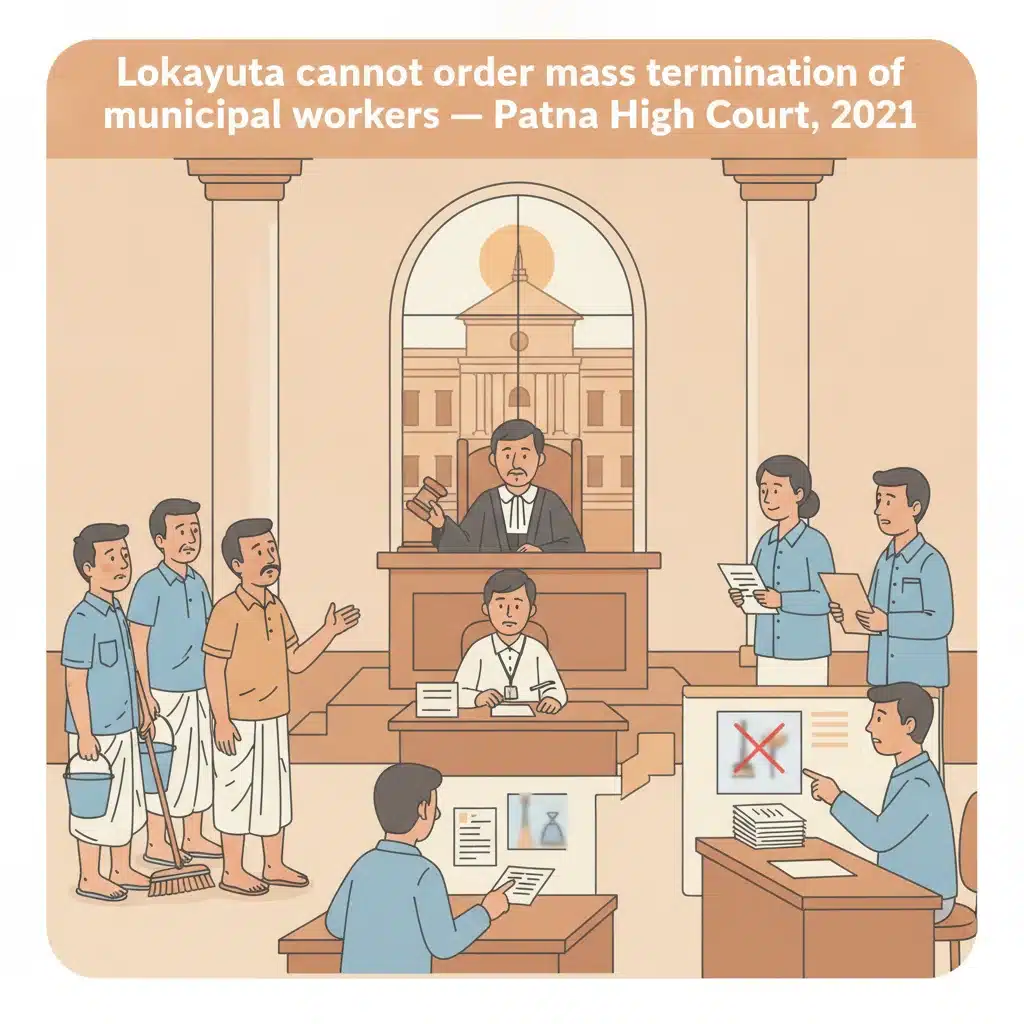
This judgment is important for daily wage workers, especially sweepers and Group D staff engaged by urban local bodies in Bihar. It clarifies that the Lokayukta cannot directly order their mass removal from service.
For municipal bodies and the State Government, the decision draws a boundary: while they must cooperate with anti-corruption efforts, decisions on staffing and employment must be taken under service and municipal laws, not on the strength of Lokayukta orders that go beyond its statute.
For citizens, the Patna High Court reiterates that even powerful watchdog institutions must stay within the law. Anti-corruption goals cannot justify actions that ignore statutory limits or cause large-scale hardship without due process.
Legal Issues and Answers
-
Issue: Can the Lokayukta under the Bihar Lokayukta Act, 2011 direct municipal bodies to stop engaging Group D daily wage employees and thereby effectively terminate their services?
Answer: No. The Patna High Court held that such directions fall within service matters, which are outside the jurisdiction of the Lokayukta. The Lokayukta’s powers are confined to investigating corruption and making recommendations to competent authorities. -
Issue: What is the proper mode of action for the Lokayukta when it finds corruption or mal-administration affecting employment or contracts?
Answer: The Lokayukta may investigate, then submit written reports and recommendations under Sections 28A and 38 to the competent authority. It can recommend cancellation or modification of corruptly obtained contracts and preventive measures, but cannot issue binding orders of termination or blanket bans on engagement of employees. -
Issue: What is the legal status of the Lokayukta’s order dated 28.11.2019 and subsequent departmental actions based on it?
Answer: The Court declared the Lokayukta’s order “non-est in law” and held that any action taken in furtherance of that order is void.
Cases Cited by the Court
- Institution of A.P. Lokayukta/Upa-Lokayukta v. T. Rama Subba Reddy, (1997) 9 SCC 42.
- Justice Chandrashekharaih (Retired) v. Janekere C. Krishna & Others, (2013) 3 SCC 117.
- Bipin Bihari Singh v. The State of Bihar, CWJC No. 18053 of 2019, Patna High Court, decided on 03.06.2020.
- Bihar Local Bodies Employee Federation and Others v. The State of Bihar & Others, CWJC No. 5713 of 2020, interim order dated 28.05.2020 (Patna High Court).
Case Details
Case Number: Civil Writ Jurisdiction Case No. 3599 of 2020
Case Title: Dharmendra Kumar v. The State of Bihar & Others
Court: High Court of Judicature at Patna
Coram: Hon’ble the Chief Justice; Hon’ble Mr. Justice S. Kumar
Date of Judgment: 06.12.2021
Citation: 2022(4) PLJR 267
Nature of the Case: Civil writ petition challenging the legality and jurisdiction of an order passed by the Member (Judicial), Lokayukta, Bihar and consequential departmental actions affecting Group D daily wage workers of Gaya Municipal Corporation.
Advocates:
For the Petitioner: Mr. Ranjeet Kumar, Advocate; Mr. Kundan Kumar, Advocate.
Amicus Curiae: Ms. Vagisha Pragya Vacaknavi.
For the Respondents: Mr. Pawan Kumar, AC to Advocate General; Mr. Rabindr Kumar Priyadarshi, Advocate.
Link to Judgment: Click here to read the full judgment of the Patna High Court
If you found this explanation helpful and wish to stay informed about
how legal developments may affect your rights in Bihar,
you may consider following Samvida Law Associates for more updates.




