

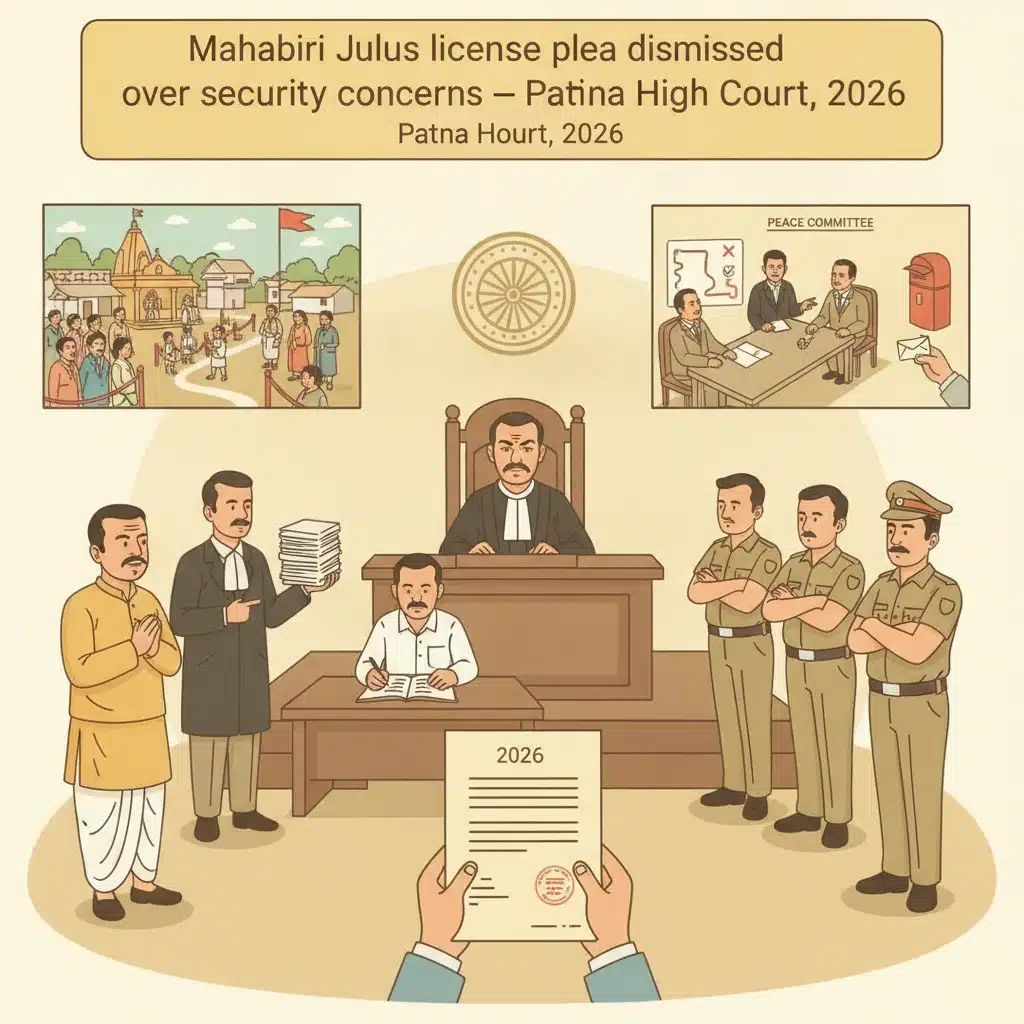
Case Background
The petitioner is a devotee of Akhara No. 1, a Hindu religious group in village Hathaura under Husainganj Police Station, District Siwan.
According to him, since 1958, the administration had been issuing a licence every year to the devotees of Akhara No. 1 to conduct a Mahabiri Julus, a religious procession, on the 11th day of Bhadrapad Krishna Paksha.
The petitioner stated that this procession was traditionally taken out along a fixed route in the village and was meant to offer prayer and worship to Lord Hanuman.
He claimed that in the years 2012 and 2013, around 200 devotees were allowed to participate in the procession. Thereafter, the police authorities allegedly started reducing the permitted number without giving reasons: first to 150 in 2014, then to 100 in 2015, and finally to only 5 devotees from 2023 onwards. The route of the procession was also changed from the traditional one.
The petitioner said that in a Peace Committee meeting held on 16.08.2023, devotees of Akhara No. 1 were forced to agree to limit their number to 5 and accept a changed route, under the threat that otherwise no licence would be granted at all.
He claimed to have submitted representations dated 20.08.2023 and 23.08.2023 to the District Magistrate, Siwan, protesting against the restrictions. As per the petitioner, these representations remained unanswered.
Feeling aggrieved, he approached the Patna High Court by filing this writ petition. He sought a direction to the State authorities to grant a licence allowing him to conduct the Mahabiri Julus of Akhara No. 1 along the old traditional route with at least 300 devotees. He also asked the Court to declare that restricting devotees of Akhara No. 1 from participating in the procession violated their fundamental rights under Article 25 of the Constitution of India.
What the Court Examined and Decided
The petition was heard by Hon’ble Mr. Justice Alok Kumar. The Court heard submissions from both sides and examined the legal position on the right to religious practice and public processions.
On behalf of the petitioner, it was argued that Akhara No. 1 had been regularly granted a licence to conduct the Mahabiri Julus on the same route and that there was never any complaint of breach of peace with respect to that route.
The petitioner’s counsel argued that the sudden and progressive reduction in the number of permitted devotees was arbitrary and without any recorded reasons.
He submitted that the Peace Committee decision of 16.08.2023 was taken under pressure. According to him, the devotees were compelled to accept the limit of 5 persons and the altered route by being told that otherwise no licence would be issued at all.
He pointed out that the two written representations to the District Magistrate, dated 20.08.2023 and 23.08.2023, were not acted upon, leaving the petitioner with no option but to approach the High Court.
To support his plea, the petitioner relied on Supreme Court decisions such as Dargah Committee v. Union of India, AIR 1961 SC 1402, and Gulam v. State of U.P., AIR 1981 SC 2198. From these cases, it was argued that once the right of a community to take out a religious procession along a customary route is established, that right cannot be curbed merely because some other group opposes it. Instead, it is the duty of the police to protect the lawful exercise of such a right and not to surrender before miscreants.
The petitioner also attacked the report of the Sub-Divisional Police Officer, Siwan, dated 31.10.2024. He said that the report exaggerated law-and-order issues by counting devotees of different Akharas as if all belonged to Akhara No. 1.
He further stated that he was not named as an accused in Husainganj P.S. Case No. 304 of 2024, which had been mentioned by the authorities.
The petitioner highlighted what he claimed was discriminatory treatment. He submitted that the Station House Officer and Inspector of Police had themselves recommended a licence for a Tazia procession of 1000 persons, equipped with lathi, bhala and sword, on the very same route. According to him, if such a large Tazia procession could be permitted on that route, restricting Akhara No. 1 to 5 devotees was unjust and discriminatory.
On the other hand, learned counsel for the State defended the restrictions. He submitted that licences in such matters are short-term and are guided primarily by law-and-order concerns.
The State’s case was that although only a limited number of devotees were sanctioned on paper, between 2015 and 2022, the actual crowd swelled to between 1700 and 2000 persons. This was said to have resulted in a number of criminal cases.
The State further submitted that in the year 2024, the petitioner along with the accompanying crowd allegedly set fire to a government vehicle belonging to the Block Development Officer, Husainganj, and pelted stones at police personnel. On this basis, the State argued that reducing the number of permitted devotees and altering the route was a considered and security-driven step.
According to the State, the decision was taken after verification by the Sub-Divisional Police Officer, Sadar, Siwan, and was not discriminatory.
After hearing both sides, the Court considered it necessary to examine the settled legal position regarding the right to practice religion and to take out religious processions.
The Court referred to the Supreme Court’s decision in Dr. M. Ismail Faruqui v. Union of India, reported in (1994) 6 SCC 360. In that case, the Supreme Court held that offering prayer or worship is certainly a religious practice. However, offering prayers at every place where such prayers can physically be offered is not automatically an essential or integral part of the religion.
The Supreme Court clarified that only those places of worship which have special significance for a religion, making them an essential or integral part of that religion, stand on a different footing and must be treated with greater reverence.
The Court also relied on Church of God v. K.K.R. Majestic Colony Welfare, reported in (2000) 7 SCC 282. In that case, the Supreme Court had held that no religion requires prayers to be offered through loudspeakers or in a manner that disturbs public peace. In a civilised society, religious activities must not harm old or infirm people, students, or children.
On the basis of these decisions, the Patna High Court summarised the legal position. It held that Articles 25 and 26 of the Constitution guarantee freedom of religion, but this freedom is expressly subject to considerations of public order, morality and health.
The Court emphasised that while there is a need to protect the freedom of individuals to practice and profess their religion, there is an equally pressing need to maintain public peace and tranquility, especially in residential localities. The State is therefore required to regulate activities that may harm public health and welfare.
The Court then applied this principle to the facts at hand. It held that the right to profess and practice religion, including the right to take out religious processions, is protected under Articles 19(1)(b) and 25. However, this right is not absolute.
The constitutional protection, the Court observed, extends only to what is essential and integral to the religious practice, and not to every chosen mode or manner in which the practice is carried out. In particular, the size of the procession and the exact route are subject to reasonable restrictions based on public order and security.
The Court further reiterated that secularism is part of the basic structure of the Constitution. The State must remain neutral among all religions and treat every faith with equal respect (sarva dharma samabhava), while at the same time enforcing reasonable restrictions to safeguard collective public welfare, national security and social order.
On the specific apprehension raised by the petitioner that in future the number of devotees might again be restricted to 5, the Court found this concern to be premature and unreasonable.
The Court stated that any such restriction in future would depend on the then prevailing law-and-order situation in the locality when permission is applied for. The Court made it clear that it could not decide any hypothetical future contingency based only on fear or assumption.
After considering the materials and the rival submissions, the Court concluded that it found no merit in the writ petition. It therefore dismissed the petition and disposed of all pending interlocutory applications.
Why This Judgment Matters
This judgment underscores that, while religious processions are recognised as important expressions of faith, they are not beyond regulation.
For devotees and organisers of processions in Bihar, the ruling clarifies that permission, route, and the number of participants can be curtailed if the authorities, on security grounds, consider it necessary to prevent law-and-order problems.
The decision also shows that the Patna High Court will not generally interfere with administrative decisions about crowd control and procession routes when they are based on law-and-order assessments, even if long-standing customs or routes are affected.
Finally, the judgment signals that future disputes about permissions must be based on concrete, present facts. Courts are unlikely to issue directions on speculative future scenarios about how many persons may or may not be allowed.
Legal Issues and Answers
- Issue: Whether the petitioner was entitled to a mandamus directing the authorities to grant a licence for the Mahabiri Julus of Akhara No. 1 along the traditional route with at least 300 devotees, treating restrictions as a violation of Article 25.
Answer: No. The Court held that the right to practice religion and to take out religious processions under Articles 19(1)(b) and 25 is not absolute and is subject to public order, morality, health, and reasonable restrictions. On the facts and law, no ground was made out to interfere with the authorities’ security-based restrictions, and the writ petition was dismissed. - Issue: Whether the petitioner’s fear that future permissions might restrict the number of devotees to 5 could be decided by the Court.
Answer: No. The Court held that such apprehension was premature and hypothetical. Any future restriction would depend on the law-and-order situation at the time permission is actually sought and could not be adjudicated in advance.
Cases Cited by the Court
- Dr. M. Ismail Faruqui v. Union of India, (1994) 6 SCC 360
- Church of God v. K.K.R. Majestic Colony Welfare, (2000) 7 SCC 282
- Dargah Committee v. Union of India, AIR 1961 SC 1402 (relied upon by petitioner)
- Gulam v. State of U.P., AIR 1981 SC 2198 (relied upon by petitioner)
Case Details
Case Number: Civil Writ Jurisdiction Case No. 14851 of 2024
Case Title: Bhadai Chaudhary v. The State of Bihar & Ors.
Coram: Hon’ble Mr. Justice Alok Kumar
Citation: 2026 (5) PLJR 317
Advocates: For the petitioner: Mr. Harshvardhan Shivsundaram, Advocate. For the respondents (State): Mr. Madhukar Mishra, AC to SC-16.
Nature of the Case: Writ petition under civil writ jurisdiction seeking mandamus for grant of licence for religious procession.
Link : https://patnahighcourt.gov.in/viewjudgment/MTUjMTQ4NTEjMjAyNCMxI04=-Sc10IWIldp8=
If you found this explanation helpful and wish to stay informed about how legal developments may affect your rights in Bihar, you may consider following Samvida Law Associates for more updates.




