

Case Background
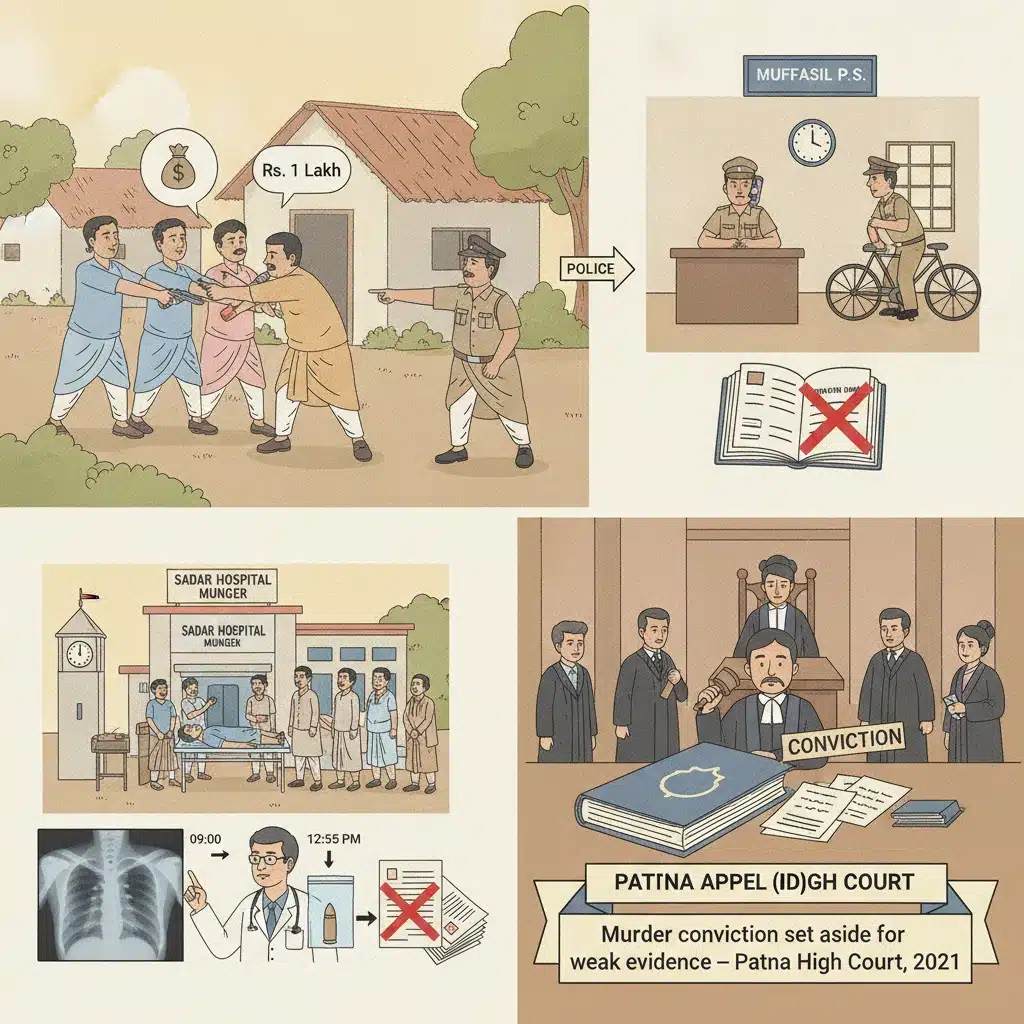
This case started with Muffasil P.S. Case No. 168 of 2010, Munger. The FIR was registered on 13.09.2010 under Section 302/34 of the Indian Penal Code and Section 27 of the Arms Act.
The written complaint was given by one Bindeshwari Yadav. He alleged that around 05:00 AM on 13.09.2010, five people came armed with pistols to his house at village Jaffarnagar. They allegedly dragged his nephew, Madho Yadav, out of the house and shot him dead. The accused named were Tulsi Yadav, Dhuran Yadav, Karelal Yadav, Mallik Yadav and Samtolla Devi.
The informant claimed that Mallik Yadav and Samtolla Devi gave the order and Tulsi Yadav fired into Madho’s chest. He also alleged that one day earlier, on 12.09.2010, the accused had demanded Rs. 1 lakh as rangdari (extortion) from the deceased, and refusal led to the killing.
On 13.09.2010 at 09:00 AM, an inquest report was prepared in village Jaffarnagar by a Sub-Inspector, with the informant and the deceased’s son Vikash Yadav as witnesses. The body reached Sadar Hospital, Munger, at 09:00 AM, and postmortem was conducted at 12:55 PM the same day by Dr. Inamul Rahman.
The Station House Officer, Pravendra Bharti, took up the investigation himself. He inspected the spot, recorded statements of witnesses, and submitted a charge sheet against the present appellants and one Karelal Yadav. Investigation against two other named accused, Dhuran Yadav and Samtolla Devi, was kept pending.
On 11.01.2011, after cognizance, the Chief Judicial Magistrate, Munger, committed the case to the Sessions Court. Since accused Karelal Yadav was a minor at the time of the incident, his case was sent to the Juvenile Justice Board.
On 07.02.2012, charges under Sections 302/34 IPC and 27 Arms Act were framed against the appellants. They pleaded not guilty. The prosecution examined nine witnesses. No defence evidence was led.
On 06.09.2016, the 5th Additional Sessions Judge, Munger, convicted both appellants and sentenced them on 09.09.2016 to life imprisonment with fines for murder and three years’ rigorous imprisonment with fines under the Arms Act, with sentences to run concurrently.
Aggrieved by this conviction and sentence, the appellants filed Criminal Appeal (DB) No. 1036 of 2016 before the Patna High Court.
What the Court Examined and Decided
The Division Bench of the Patna High Court, comprising Hon’ble Mr. Justice Ashwani Kumar Singh and Hon’ble Mr. Justice Madhuresh Prasad, examined the entire trial record. They focused on whether the prosecution had proved beyond reasonable doubt that the appellants caused the death of Madho Yadav.
Counsel for the appellants argued that there was an inordinate and unexplained delay in formally lodging the FIR. They stressed that although the informant and other witnesses claimed to be eyewitnesses, their evidence, when read together, showed serious contradictions on time, place, manner of occurrence and presence at the spot. It was also argued that all the main witnesses were closely related to the deceased and on inimical terms with the accused, and that their testimony, unsupported by independent evidence, was unreliable.
The State, on the other hand, argued that the prosecution witnesses had supported the case and that family members are the best people to speak about the occurrence. It was submitted that the oral evidence was consistent enough and supported by medical evidence. The State maintained that the accused came together with a common intention to kill the deceased following the extortion demand and that the Trial Court had correctly appreciated the evidence.
The High Court first accepted, on the basis of medical evidence from Dr. Inamul Rahman, that Madho Yadav had died a homicidal death caused by firearm injury to the chest. The real question was whether the appellants were responsible for that death.
Delay and defects in FIR and investigation
The Court closely examined the timeline. According to the informant, the murder took place at about 05:00 AM on 13.09.2010, and he telephoned the police at about 06:30 AM. The Investigating Officer said he made a station diary entry on receiving the call, left the police station after half an hour, and reached the village at 08:30 AM. The inquest report showed that it was prepared at 09:00 AM in the village; the postmortem report showed that the body was received at Sadar Hospital at 09:00 AM. Yet, the formal FIR at the police station was registered only at 03:00 PM.
The Court found that a substantial part of the investigation, including inquest and sending the body for postmortem, had been done before the formal FIR was written. The initial station diary entry on the telephone information was never produced before the Court. Because the informant himself admitted that the decision to inform the police was taken after 1½ hours of deliberation, the High Court held that this initial information was unlikely to be vague or cryptic and should have formed the basis of the FIR.
The Court criticised the SHO for ignorance of law and procedure in not registering a case before commencing investigation. It accepted the submission that the FIR appeared to have been lodged belatedly after deliberations and consultations. This delay and manner of registration created doubts and had to be weighed with other facts.
Related witnesses and need for careful scrutiny
The Court noted that all the non-official prosecution witnesses were close relatives of the deceased. It also came on record that the deceased and his family members were accused in another case, Mufassil P.S. Case No. 191 of 2007, instituted by one of the accused, Samtolla Devi. Thus, enmity existed between the two sides.
The Bench reiterated settled law that related witnesses are not to be discarded merely for being relatives, and that even inimical witnesses can be relied upon if found truthful. However, their testimony must be scrutinised with caution to ensure it is not tainted by interest or enmity.
Contradictions about place of occurrence
The Court then examined where exactly the incident happened. The informant said the accused entered his house, dragged Madho out and shot him. Pawan Yadav (P.W.1) said the incident took place in front of the house of appellant Mallik Yadav. Nawal Yadav (P.W.2) said the occurrence took place on the road between the houses of the accused and the deceased and that the body was dragged towards the accused’s house. The Investigating Officer, however, stated that the place of occurrence was away from the house of the appellants.
The inquest report stated that the body was found on a cot in front of the deceased’s house. Yet, P.W.2 claimed the inquest was prepared near the accused’s house. The Investigating Officer also said that when he reached the spot, the dead body was lying on a chowki, and he did not find any evidence of dragging.
There were also contradictions on bloodstains. Some witnesses spoke of profuse bleeding and even marks of dragging, but the Investigating Officer did not refer to any bloodstains or seize blood-stained soil. No seizure memo of such soil was produced.
These conflicting versions about where the shooting took place and where the body lay led the High Court to conclude that the prosecution had failed to prove the place of occurrence.
Contradictions about time and manner of occurrence
On timing, the informant said the incident took place at 05:00 AM, Pawan and Fantush (P.W.6) said 05:30 AM, and Nawal said 06:00 AM. While some variation in rural settings can occur, the Court looked at this along with other contradictions.
On the manner of occurrence, the versions were even more inconsistent. The informant described all five accused entering his house, dragging Madho out, and Tulsi firing on the exhortation of Mallik and Samtolla. Pawan stated that he saw a quarrel between Mallik and Madho in front of Mallik’s house, with Mallik and Dhuran holding the deceased when Tulsi fired. Nawal said four accused were quarreling with Madho on the road when Tulsi came out of his house and fired.
Fantush admitted he came to the spot only after the firing and only saw accused running away. Different witnesses also differed about who was present when the incident occurred. P.W.2 said that when he reached, no one else was there, and others came later. P.W.6 said he reached first and others came after him, but he too had come only after hearing the alarm.
The Court held that if the testimony of P.W.2 was believed, it excluded the possibility of others, including P.W.1, P.W.3, P.W.4 and P.W.5, witnessing the actual murder. If P.W.6’s version was believed, it also ruled out others as eyewitnesses. This cast serious doubt on the claim of multiple family eyewitnesses.
Inquest timing and missing evidence
The Bench also questioned how the inquest report and the hospital entry could both show the time as 09:00 AM for preparation and receipt of the body, when the hospital was some distance away from the village. This suggested ante-dating or inaccuracy in official records. The author of the inquest report, Sub-Inspector Vinay Shankar, was not examined, depriving the defence of a chance to cross-examine him on these irregularities.
Further, the bullet recovered during postmortem was not produced before the Court, and no seizure list of the bullet was prepared. No weapon was recovered from the accused. The Investigating Officer admitted he had not seized any article from the place of occurrence and had not conducted any scientific investigation. He also admitted that three independent witnesses from the locality, whose statements he had recorded, did not fully support the prosecution case and had given a different story and cause of occurrence. None of those independent witnesses was examined at trial.
Court’s overall conclusion
After putting together the unexplained delay and defective FIR process, failure to produce the station diary entry, serious contradictions among related witnesses about time, place and manner of occurrence, lack of independent witnesses, non-production of key material exhibits like the bullet, and glaring lapses in investigation, the Patna High Court held that the prosecution had failed to prove guilt beyond reasonable doubt.
The Bench therefore allowed the appeal, set aside the conviction dated 06.09.2016 and sentence dated 09.09.2016 in Sessions Trial No. 44 of 2011, and acquitted the appellants Mallik Yadav and Tulsi Yadav of all charges. It directed that they be released from jail forthwith, unless required in any other case.
Why This Judgment Matters
This judgment is important for anyone facing serious criminal charges, especially in rural areas where investigations may be casual or biased.
The Patna High Court made it clear that a person cannot be kept in jail for life on the basis of shaky evidence. When the police delay registering the FIR, skip proper seizure of evidence, and do not produce important records like station diary entries or bullets, courts will treat the prosecution story with caution.
The decision also shows that even if witnesses are close relatives of the victim and there is a background of enmity, the Court will not simply accept their version without careful checking. Contradictions about basic facts such as where and how the incident happened can lead to acquittal.
For families on both sides of such disputes, the judgment underlines that investigation must be prompt, transparent and lawful. Otherwise, the benefit of doubt will go to the accused, and convictions will not stand on appeal.
Legal Issues and Answers
- Issue: Did the prosecution prove beyond reasonable doubt that the appellants murdered Madho Yadav in furtherance of a common intention under Section 302/34 IPC and used firearms under Section 27 of the Arms Act?
Answer: No. Because of unexplained delay in FIR, contradictions in witness versions, failure to clearly prove the place and manner of occurrence, and major investigative lapses, the Court held that guilt was not proved beyond reasonable doubt and acquitted the appellants. - Issue: What is the effect of serious delay and irregularities in registering the FIR and conducting the early part of investigation?
Answer: Such delay and irregularities, especially when the station diary entry is withheld and investigation starts before FIR, raise doubt about the truthfulness of the prosecution story. If not satisfactorily explained, they can contribute to acquittal. - Issue: How should courts treat testimony of related or inimical witnesses in a murder case?
Answer: Their evidence is not to be rejected solely because of relationship or enmity, but must be examined with caution. Where their statements contain major inconsistencies on key aspects, and there is no reliable independent corroboration, the Court may find it unsafe to convict.
Cases Cited by the Court
- Thulia Kali vs. State of T.N., AIR 1973 SC 501 – cited on the importance of prompt FIR and dangers of delay.
- State of Punjab vs. Ramdev Singh, (2004) 1 SCC 421 – cited on how courts should assess delay in lodging FIR and when it can be fatal to the prosecution case.
Case Details
Case Number: Criminal Appeal (DB) No. 1036 of 2016; arising out of Muffasil P.S. Case No. 168 of 2010, District Munger.
Case Title: Mallik Yadav & Anr. vs. The State of Bihar.
Citation: 2022(4) PLJR 278.
Court: High Court of Judicature at Patna.
Coram: Hon’ble Mr. Justice Ashwani Kumar Singh; Hon’ble Mr. Justice Madhuresh Prasad.
Date of Judgment: 01.12.2021.
Advocates: For the appellants – Mr. Bindhyachal Singh, Senior Advocate; Mr. Sanjay Sinha, Advocate; Mr. Md. Fazle Karim, Advocate. For the State – Mr. Abhimanyu Sharma, APP. For the informant – Mr. Tarkishor Verma, Advocate.
Nature of Case: Criminal appeal (division bench) against conviction and sentence in a Sessions Trial for offences under Section 302/34 IPC and Section 27 of the Arms Act.
Link to Judgment: Click here to read the full Patna High Court judgment
If you found this explanation helpful and wish to stay informed about
how legal developments may affect your rights in Bihar,
you may consider following Samvida Law Associates for more updates.




