

Case Background
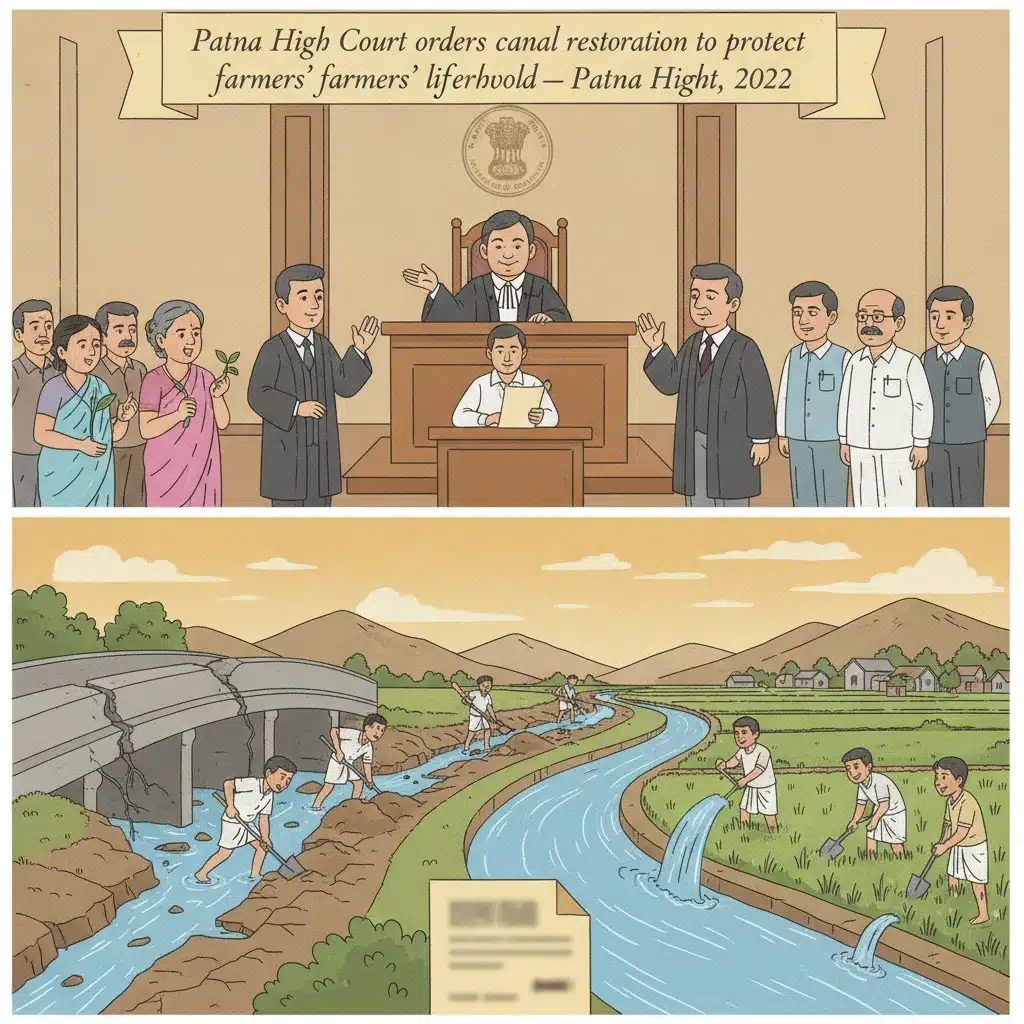
A public interest litigation was filed before the Patna High Court seeking restoration of water supply in the Tarabigha Saidnala Canal. The canal supplies irrigation water to the village of Tarabigha and about twenty-five other villages in Block Katrisarai, District Nawadah, Bihar.
The petitioner alleged that some villagers of Khirbhojna had damaged a bridge and filled up a portion of the canal. As a result, water stopped flowing through the canal from around 2017, leaving the agricultural lands in the command area dry.
According to the writ petition, the Covid-19 pandemic and lockdowns had forced many workers to return home to Bihar. With no other income, they had to depend on their fields for survival. The petitioner stated that around 450 persons, each with at least four family members, were affected, meaning that more than 1,800 people were facing hardship due to the disruption of irrigation.
The petitioner further claimed that the State Government had remained inactive, taking no effective action either to rebuild the damaged portion of the canal or to resume water flow, despite lodging of an FIR regarding the damage.
The case was first taken up on 21.09.2020, and the State was directed to file a reply. A counter affidavit dated 16.12.2020 was then filed on behalf of the concerned irrigation authorities and other State respondents.
What the Court Examined and Decided
In its counter affidavit, the State, through the Executive Engineer, Irrigation Division, Biharsharif, Nalanda, gave a detailed history of the canal project and the steps taken after the damage.
First, the State explained that when the canal was proposed, villagers of Khirbhojna had opposed its construction by filing PLA Case No. 05/07-78-78/02/80-81 before the Additional Collector, Nawadah. On 02.02.1980, the Additional Collector rejected the objection as not maintainable. That order was never challenged, and hence, according to the State, became final and binding.
The notification for construction of the canal was issued on 01.06.1980, and the process of paying compensation for acquired land began on 01.08.1981. The canal construction was completed in the year 2010-11 and was functioning for the benefit of the surrounding villages.
In October 2017, villagers of Tarabigha informed the department that a bridge on the canal had been damaged or destroyed and that the canal had been filled up, blocking the flow of water. On receiving this information, the Executive Engineer directed the S.D.O., Irrigation Sub-Division No. 03, Biharsharif, to inspect the site and lodge an FIR against the miscreants.
The Assistant Engineer and Junior Engineer visited the spot. During this inspection, villagers of Khirbhojna informed them that a writ petition, CWJC No. 16364 of 2017 (Indradeo Prasad v. State of Bihar and Others), had been filed to restrain construction of the canal.
On 08.03.2018, the Executive Engineer wrote to the Circle Officer, Warsliganj, asking for an enquiry regarding this objection and a report. A reminder was sent on 23.03.2018, but no report was submitted. On the same date, the S.D.O., Irrigation Sub-Division No. 03, was asked to submit a proposal regarding repair of the damaged bridge and canal channel.
However, the authorities stated that inspection and survey could not be fully carried out because villagers of Khirbhojna did not permit the S.D.O. to conduct the survey. The S.D.O., Nawadah, and the Land Acquisition Officer, Nawadah, were informed on 04.06.2018 of this situation by the Executive Engineer. The State side claimed that they were taking appropriate steps for reconstruction and for action against those who destroyed the canal.
In rejoinder dated 19.07.2021, the petitioner disputed the existence of LA Case No. 01/1979-80 relating to Tarabigha Saidnala, as mentioned in connected litigation. The petitioner asserted that the correct references were PLA Case No. 05/78-79 and L.A. Case No. 02/80-81. It was stressed that the objection proceedings before the Additional Collector had concluded in 1980 and were never challenged, while the canal was completed in 2010-11 and used for irrigation for several villages.
According to the petitioner, the later writ proceedings initiated in 2017 were aimed at obtaining protection from criminal cases against those who had damaged the canal, rather than questioning the very legality of the canal project.
Along with these factual aspects, the petitioner’s counsel placed extensive written submissions before the Court on the importance of irrigation in human history, the role of water in agriculture, and the development of irrigation policy in India, including references to the first irrigation commission in 1901, post-independence challenges, the Green Revolution, and various government schemes for rural upliftment.
The submissions also discussed Bihar’s agricultural potential, the fertility of Gangetic alluvial soil, and the existing major and medium irrigation schemes as reflected on the official website of the Water Resources Department of the Government of Bihar. The written note pointed out that despite the existence of many projects, in this particular case there was “utmost neutrality of governance” in the face of miscreants damaging a serving canal decades after land acquisition and construction.
The petitioner’s counsel also cited an extract from Kautilya’s “Arthashastra” on the duties of a king to build reservoirs, provide irrigation channels, and ensure that non-cooperating persons do not share in the benefits of such public works. This was used to underline that the State has a primary responsibility to create and protect irrigation systems for the benefit of people.
In its opinion, the Patna High Court acknowledged that the issue raised was of great importance. The Court noted that water is a core essential of life and that food production is directly connected to irrigation. It recorded that India remains largely an agrarian economy and referred to data indicating that a large share of the workforce and rural households depend on agriculture, with most being small or marginal farmers.
The Court pointed out that both “Agriculture” and “Water, irrigation and canals” fall under the State List (List II) of the Seventh Schedule to the Constitution of India. Thus, ensuring proper irrigation facilities lies squarely within the State’s exclusive domain and responsibility.
The Court observed that the canals for irrigation and water needs of surrounding villages had been constructed and later damaged or destroyed, and though an FIR had been filed in 2017, there had been no significant progress in restoring water supply to the approximately twenty-five dependent villages. Five years had passed, including the difficult period of the Covid-19 pandemic, and yet the canal remained dry.
The Court described it as a “questionable state of affairs” that courts are required to intervene even to secure basic essential services like irrigation, which directly affect not only the individuals concerned but the larger society.
Placing the matter in the context of a welfare State, the Court cited the Supreme Court’s decision in Lala Ram v. Union of India, which explains that a welfare State must promote the economic, social and political welfare of its people, including means of livelihood and the well-being of weaker sections. The Court noted that a welfare State is committed to ensuring maximum happiness of the maximum number of people.
The Court further relied on N.D. Jayal v. Union of India, where the Supreme Court discussed social conflicts arising from large projects involving natural resources and emphasised that in such conflicts, a welfare State must give prior attention to the poor and less advantaged groups who lose their source of livelihood.
Most importantly, the Patna High Court drew upon the landmark judgment in Olga Tellis v. Bombay Municipal Corporation. The Supreme Court in that case held that the right to livelihood is an integral part of the right to life under Article 21 of the Constitution. The extract quoted by the Court highlighted that without livelihood, life loses its meaning and becomes impossible to live, and that deprivation of livelihood is effectively deprivation of life.
The Patna High Court noted that the petitioner had highlighted a list of 450 people who, due to the pandemic, had only their farmland to depend upon. Because of the damage and absence of water in the canal, even this last source of survival had been compromised for them and for residents of about twenty-five villages in Block Katrisarai.
The Court held that the right to life and the right to livelihood are “connected in inextricable terms” and that the State is constitutionally obliged to ensure that livelihood is not taken away except in accordance with procedure established by law. The Court clearly stated that non-supply of water in a canal, thereby causing widespread hardship to those dependent on it, cannot by any stretch be regarded as being in accordance with law.
On this reasoning, the Court issued clear directions. First, it ordered the concerned State authorities to take all necessary measures, with expedition, to repair the damaged canal and restore water supply. Secondly, it directed the District Magistrate, Nawadah, after completion of repair and restoration, to ensure that no further damage is caused to the canal or other public property by anti-social elements. Thirdly, it directed that the FIRs filed in connection with the destruction of public property be taken to their logical and lawful conclusion at the earliest.
With these directions, the writ petition and any interlocutory applications were disposed of.
Why This Judgment Matters
This judgment is significant for farming communities in Bihar and similar agrarian regions. It recognises that irrigation is not a luxury but a basic support for the constitutional right to livelihood under Article 21.
The Patna High Court treated the long disruption of canal water, affecting around twenty-five villages, as a serious rights issue and not a mere administrative lapse. By doing so, it sends a strong message that State inaction in restoring essential infrastructure can amount to denial of fundamental rights.
For small and marginal farmers, the decision confirms that they can approach the courts through public interest litigation when public irrigation systems are damaged or blocked and the administration fails to react promptly. The State can be directed not only to repair the facility but also to protect it from future damage and to pursue criminal action against those who destroy public property.
For government departments, the judgment reinforces that irrigation and water supply are core responsibilities under the State List and must be handled with urgency, particularly during crises like the pandemic when people rely even more on agriculture for survival.
Legal Issues and Answers
Issue: Whether the prolonged non-restoration of a damaged irrigation canal, resulting in denial of water to several villages, violates the constitutional obligation of the State to protect livelihood under Article 21.
Answer: Yes. The Court held that the right to life and livelihood are inseparably connected and that failure to restore water supply in the canal, causing widespread hardship, cannot be justified in law. The State is constitutionally bound to restore and protect such essential irrigation facilities.
Issue: What directions can the Court issue to ensure effective restoration and protection of an irrigation canal damaged by private individuals.
Answer: The Court directed State authorities to urgently repair the canal and restore water, ordered the District Magistrate to protect the canal from further damage, and required that FIRs relating to destruction of public property be taken to their logical and lawful conclusion at the earliest.
Cases Cited by the Court
- Lala Ram v. Union of India, (2015) 5 SCC 813
- N.D. Jayal v. Union of India, (2004) 9 SCC 362
- Olga Tellis v. Bombay Municipal Corpn., (1985) 3 SCC 545
Case Details
Case Number: Civil Writ Jurisdiction Case No. 7857 of 2020
Case Title: Bidhan Kumar v. The State of Bihar & Others
Citation: 2022 (4) PLJR 470
Court: High Court of Judicature at Patna
Coram: Hon’ble the Chief Justice Sanjay Karol; Hon’ble Mr. Justice S. Kumar
Date of Judgment: 18-10-2022
Nature of the Case: Public Interest Litigation under Civil Writ Jurisdiction seeking directions for restoration and protection of an irrigation canal and for action on FIRs regarding its damage.
Advocates:
- For the Petitioner: Mr. Gautam Kumar Kejriwal, Advocate; Mr. Alok Kumar Jha, Advocate; Mr. Pawan Kumar Singh, Advocate
- For the Respondents: Mr. Anjani Kumar, AAG-IV; Mr. Alok Kumar Rahi, AC to AAG-IV
Link to Judgment: Click here to read the full judgment on the Patna High Court website
If you found this explanation helpful and wish to stay informed about
how legal developments may affect your rights in Bihar,
you may consider following Samvida Law Associates for more updates.




