

Case Background
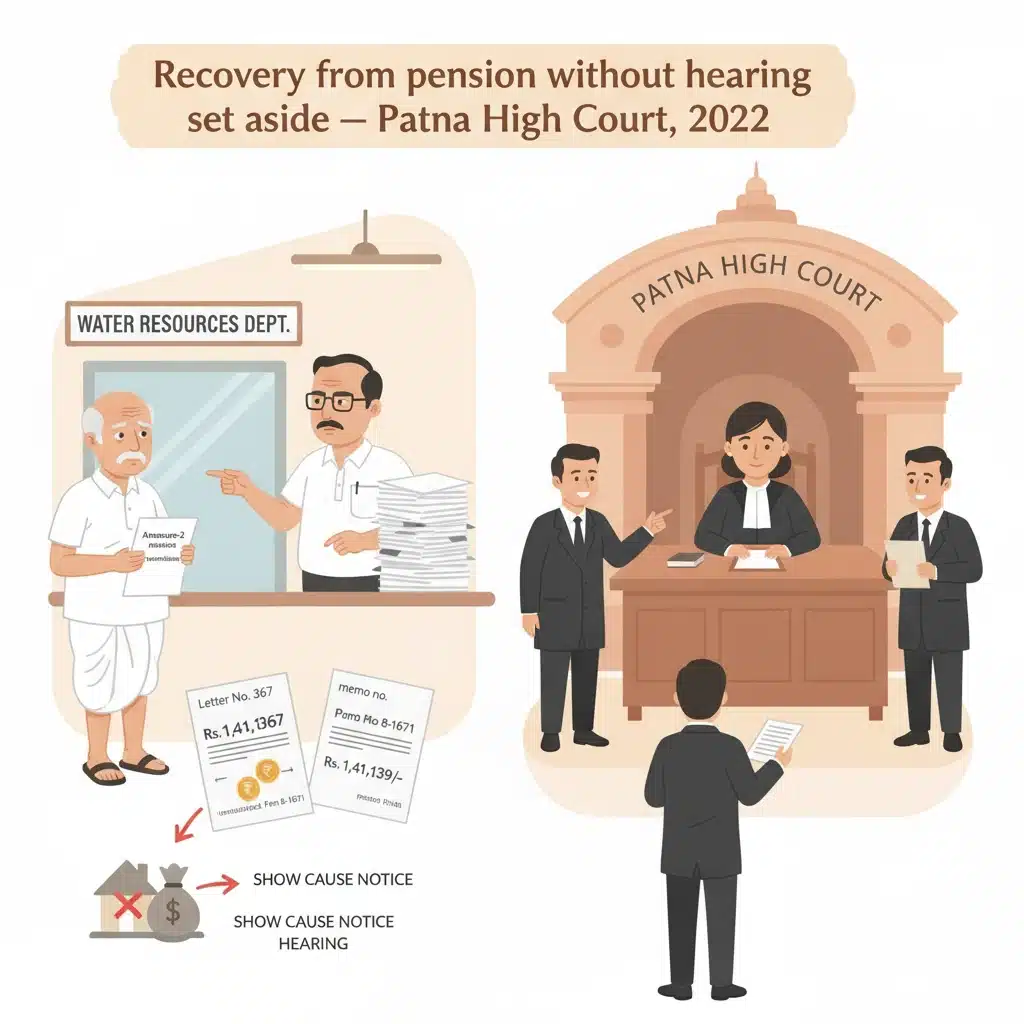
The petitioner is a retired employee of the Water Resources Department, Government of Bihar. After his retirement, the department issued Letter No. 367 dated 07.09.2020 through the Executive Engineer, Planning and Monitoring Division, Anisabad, Patna. By this letter he was directed to deposit Rs. 1,41,139/-. The same communication was also sent to the Accountant General for recovering this amount from his pension.
Later, by memo no. Pen 8-1671 dated 28.01.2021, a further direction was issued to the Treasury Officer, Ara, to deduct the same amount of Rs. 1,41,139/- from the petitioner’s pension. Thus, the recovery was to be made directly from the pension that the petitioner was receiving after years of service.
The petitioner claims that these orders were passed behind his back. He says no show cause notice was issued to him. He was also not given any chance to explain his side before his pension was targeted for recovery.
Feeling aggrieved, he submitted a representation to the authorities, which is referred to in the judgment as Annexure-2. In this representation, he put forward his defence and requested that his case be considered. According to him, this representation was never considered. Left with no other remedy, he filed Civil Writ Jurisdiction Case No. 9891 of 2022 before the Patna High Court.
What the Court Examined and Decided
The writ petition was heard by Hon’ble Mr. Justice Harish Kumar on 02.11.2022. The petitioner was represented by Mr. Alok Ranjan, Advocate. The State and departmental authorities were represented by Mr. Sanjay Kumar, Assistant Counsel to AAG 4.
The petitioner’s argument was simple and focused. He challenged the two orders: the letter dated 07.09.2020 (Annexure-1) and the memo dated 28.01.2021 (Annexure-4). His main grievance was that these orders caused serious “civil as well as evil consequences” because they directly affected his pension and required him to pay a large sum.
He stated that despite the severe impact of these orders, no opportunity of hearing or show cause notice was ever given to him. He stressed that he had already filed a detailed representation (Annexure-2) explaining his defence. Still, the authorities did not consider it and went ahead with recovery. Therefore, he approached the Patna High Court seeking quashing of both communications and protection of his pension.
On the other side, the State opposed the petition. The State’s counsel pointed to the departmental record. According to the State, the petitioner had “unauthorizedly occupied the quarter” and, at the same time, he received house rent allowance. They argued that this conduct amounted to misconduct. On that basis, they said that the order of recovery was justified and was passed “in accordance with law”.
Thus, the central conflict before the Court was not yet about whether the petitioner was guilty of misconduct or not. The immediate question was whether the department could order recovery from pension without giving him a chance to be heard.
Before deciding this, the Court considered the broader legal principle of natural justice. The Court observed that the old distinction between “judicial acts” and “administrative acts” has largely withered away. Today, even when authorities are passing administrative orders, if these orders have civil consequences, they must follow the principles of natural justice.
To support this, the Court relied on several important decisions of the Hon’ble Supreme Court.
First, it referred to State of Orissa vs Dr. (Miss) Binapani Dei & Ors., reported in 1967 (2) SCR 625. In that case, the Supreme Court held that even administrative orders which involve civil consequences must be made consistently with rules of natural justice.
Secondly, the Court cited the Constitution Bench judgment in Mohinder Singh Gill & Anr. vs The Chief Election Commissioner, New Delhi & Ors., reported in (1978) 3 SCR 272. Justice Krishna Iyer, speaking for the Bench, explained the wide meaning of “civil consequences”. He stated that civil consequences include not just loss of property or formal rights, but also any material deprivations, non-pecuniary damages, and generally “everything that affects a citizen in his civil life”. In short, if a person’s civil life is affected, civil consequences arise.
Thirdly, the Court referred to Union of India & Ors. vs E.G. Nambudiri, reported in AIR 1991 SC 1216. This decision underlined that when an administrative order affects a vested right or leads to civil consequences, the person concerned must be given an opportunity of hearing, even if the statute itself is silent on such requirement.
From these judgments, the Patna High Court drew a clear principle: an administrative order which leads to civil consequences must be passed only after observing natural justice. This generally includes giving the affected person notice of the proposed action, a chance to show cause, and an opportunity to be heard.
Applying this principle to the petitioner’s case, the Court examined the impugned orders. From the face of the order dated 07.09.2020, the Court found no indication that any show cause notice had been issued to the petitioner. There was also no mention of any hearing. The State did not show any document to prove that the petitioner was given a formal opportunity to explain his position before the recovery order was passed.
The Court noted that the order directing the petitioner to deposit Rs. 1,41,139/- and the subsequent direction for recovery from pension clearly had serious civil consequences. Pension is often the main source of livelihood for a retired employee. Deducting a substantial amount from it obviously affects his civil life and financial security.
Because no notice or hearing was provided, the Court held that the order violated principles of natural justice. On this ground alone, without going into the question of alleged unauthorized occupation or receipt of house rent allowance, the Court found the recovery order to be legally unsustainable.
Therefore, the Court set aside the impugned order dated 07.09.2020. Since the second impugned memo dated 28.01.2021 was merely a follow-up direction to the Treasury Officer to actually deduct the amount, that too could not survive once the main order of recovery was quashed.
However, the Court did not finally decide whether the petitioner was innocent or guilty regarding unauthorized occupation of the quarter or double benefit of government accommodation and house rent allowance. Instead, it adopted a balanced approach.
The Court remanded the matter back to the Executive Engineer, Planning and Monitoring Division, Anisabad, Patna (Respondent No. 5). The Executive Engineer was directed to consider the petitioner’s representation (Annexure-2 to the writ petition) and then pass a fresh order in accordance with law.
While doing so, the authority must take into account the defence that the petitioner has raised both in his representation and in the writ petition. It is implicit that this reconsideration must follow the principles of natural justice — meaning the petitioner must be given a genuine opportunity to be heard before any fresh decision on recovery is taken.
With these directions, the Patna High Court disposed of the writ application. Thus, the recovery from pension, as ordered earlier, stands cancelled for the time being, and the matter is to be freshly examined by the departmental authority after hearing the petitioner.
Why This Judgment Matters
This judgment is particularly important for government employees and pensioners in Bihar and elsewhere. It makes clear that departments cannot simply order recovery from salary or pension without first giving the affected person a fair chance to be heard.
Pension is often the only source of income for a retired employee. Any deduction can cause real hardship. The Patna High Court has reaffirmed that such decisions are not mere “administrative steps”. They have serious civil consequences and must follow natural justice.
The judgment also shows that even if the department believes that an employee has committed misconduct, like unauthorized occupation of quarters or wrongful receipt of allowance, it still has to follow due process. Guilt cannot be presumed, and punishment cannot be imposed behind a person’s back.
For employees facing similar recovery orders, this decision offers a clear path: they can challenge orders that were passed without prior notice or opportunity to reply, especially when pension or other vested rights are affected.
Legal Issues and Answers
- Issue: Can the department recover Rs. 1,41,139/- from a retired employee’s pension by an administrative order passed without any prior notice or hearing?
Answer: No. The Patna High Court held that such an order, involving civil consequences, must follow the principles of natural justice. Since no show cause notice or opportunity of hearing was given, the recovery order dated 07.09.2020 was set aside and the matter remanded for fresh decision after considering the petitioner’s representation.
Cases Cited by the Court
- State of Orissa vs Dr. (Miss) Binapani Dei & Ors., 1967 (2) SCR 625
- Mohinder Singh Gill & Anr. vs The Chief Election Commissioner, New Delhi & Ors., (1978) 3 SCR 272
- Union of India & Ors. vs E.G. Nambudiri, AIR 1991 SC 1216
Case Details
Case Number: Civil Writ Jurisdiction Case No. 9891 of 2022
Case Title: Awadhesh Pandey vs The State of Bihar & Ors.
Court: High Court of Judicature at Patna
Coram: Hon’ble Mr. Justice Harish Kumar
Date of Judgment: 02.11.2022
Citation: 2022(4) PLJR 720
Advocates: For the petitioner – Mr. Alok Ranjan, Advocate; For the respondents – Mr. Sanjay Kumar, AC to AAG 4
Nature of the Case: Writ petition (civil) challenging recovery from pension by administrative orders
Impugned Communications: Letter No. 367 dated 07.09.2020 issued by the Executive Engineer, Planning and Monitoring Division, Anisabad, Patna; Memo no. Pen 8-1671 dated 28.01.2021 directing Treasury Officer, Ara, to deduct Rs. 1,41,139/-
Result: Impugned order dated 07.09.2020 set aside; matter remanded to Executive Engineer to consider petitioner’s representation (Annexure-2) and pass a fresh order in accordance with law; writ petition disposed of.
Link to Judgment: Click here to read the full judgment of the Patna High Court
If you found this explanation helpful and wish to stay informed about how legal developments may affect your rights in Bihar, you may consider following Samvida Law Associates for more updates.




