

Case Background
The petitioner is a sugar manufacturing company running a factory at Harinagar in the District of West Champaran, Bihar.
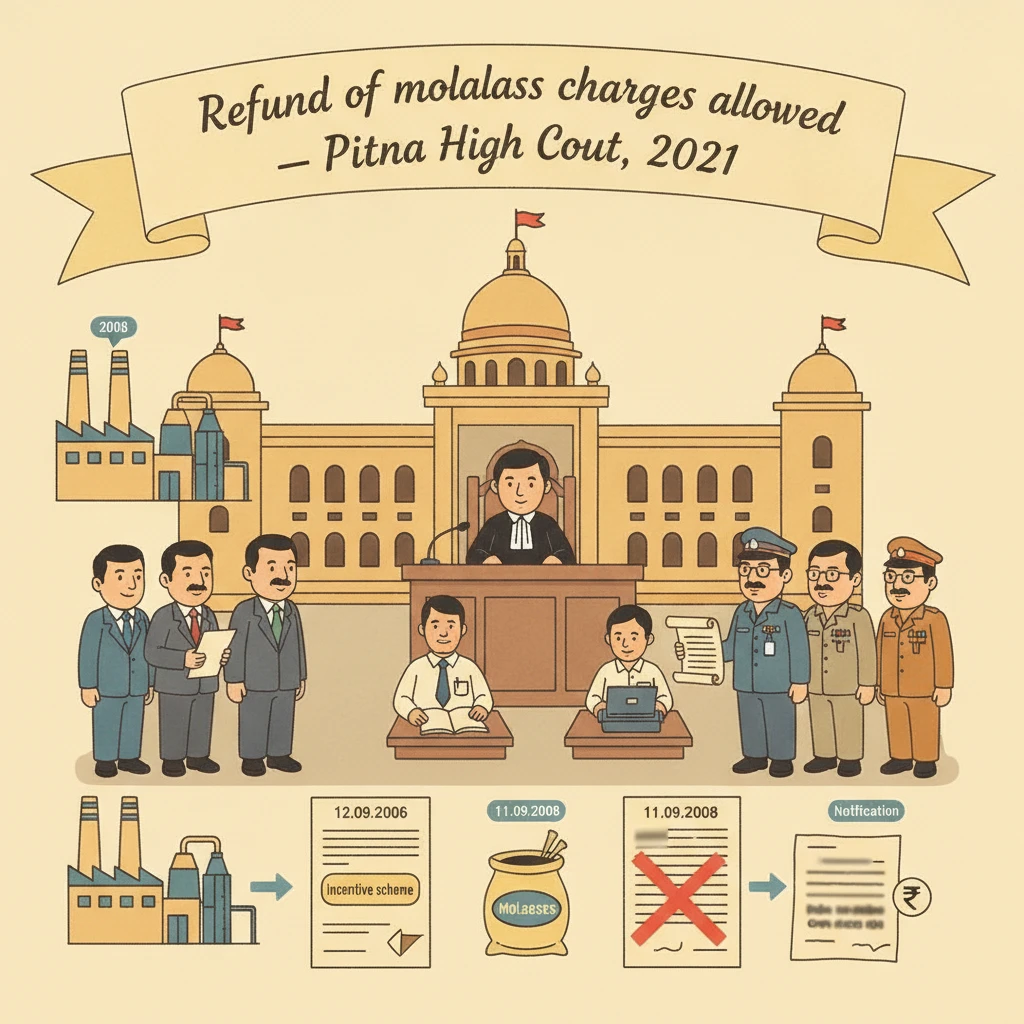
The State Government issued a resolution dated 12.09.2006 announcing an “incentive Scheme” for establishment and development of sugar and sugar-based industries in Bihar. This scheme promised several benefits and concessions to new sugar mills and sugarcane-based industries, as well as to existing sugar mills which expanded capacity.
Under Clause 4 (k)(ii) of this scheme, the State promised exemption from administrative charges on molasses for five years to new distilleries and ethanol units being established in Bihar. The same exemption was also promised for expansion of capacity of existing distilleries and ethanol units.
Clause 5 (x) and (N) of the scheme, read together, made it clear that the benefit was linked to the date when commercial production started, and that commercial production would be certified by the Director, Technical Development, Industries Department.
To implement the incentive scheme, the Sugar Industries Department issued detailed guidelines on 24.07.2007. Clause 6 of these guidelines stated that a separate notification would be issued by the Industries Department regarding exemption from administrative charges on molasses and that action would be taken according to that notification.
Acting under Clause 6, the Registration, Excise and Prohibition Department issued a notification on 11.09.2008 under Section 8(A) of the Bihar Molasses (Control) Act, 1947. This notification fully exempted administrative charges on all grades of molasses for new distillery/ethanol plants and for expansion of existing distillery plants in Bihar. It clearly provided that this exemption would be available for a period of five years from the date of commercial production of the new or expanded unit.
In the meantime, the petitioner had already set up a new 45 KLPD ethanol/distillery plant within its sugar factory premises. This new plant was commissioned on 05.03.2008 for trial. Commercial production started on 05.04.2008 (there is also an admission at one place that commercial production commenced from 15.04.2008, but both dates are prior to the notification of 11.09.2008).
The petitioner claimed that, under the 2006 incentive scheme and the 2008 excise notification, it was entitled to exemption from administrative charges on molasses for five years starting from the date of commercial production, i.e. from 05.04.2008. The company, therefore, sought refund of Rs. 37,51,350/-, which it had deposited as administrative charges on molasses consumed between 05.04.2008 and 30.06.2008. After 30.06.2008, the State started giving the exemption, and the dispute relates only to this short initial period.
What the Court Examined and Decided
The core dispute before the Patna High Court was narrow but important: whether the exemption from administrative charges on molasses, promised under the State’s own incentive scheme, could be denied for the period between 05.04.2008 and 30.06.2008 simply because the formal excise notification was issued later on 11.09.2008.
The State, through the Department of Registration, Excise and Prohibition (respondent nos. 4 to 7), opposed the writ petition. It relied on Clause 6 of the 24.07.2007 guidelines to argue that exemption could be given only after the Excise Department issued its notification. Since that notification came into force on 11.09.2008, the State contended that no exemption could be applied retrospectively for any period prior to that date. On this basis, the State claimed that the petitioner was not entitled to refund for the period from 15.05.2008 to 30.06.2008 (the period referred to in the State’s stand), and by implication for any time between commencement of commercial production and the notification date.
The State took the stand that the 11.09.2008 notification did not have retrospective effect, and therefore exemption from administrative charges on molasses could be claimed only from the date of the notification onwards.
The petitioner did not dispute that Clause 6 of the 24.07.2007 guidelines required a notification by the Excise Department and that such notification was indeed issued on 11.09.2008. However, the petitioner argued that both the 2006 incentive resolution and the 11.09.2008 notification clearly fixed the starting point of exemption as “the date of commercial production”. Once commercial production began on 05.04.2008, the company argued, the five-year exemption had to run from that date, regardless of when the Excise Department actually published its notification.
The Court carefully examined three key documents: the incentive scheme resolution dated 12.09.2006, the implementation guidelines dated 24.07.2007, and the Excise Department notification dated 11.09.2008.
From the resolution dated 12.09.2006, the Court noted that exemption of administrative charges for molasses was available to new distillery/ethanol units established under the scheme.
It was admitted that the petitioner’s new distillery/ethanol plant was set up after the incentive policy came into force on 12.09.2006. It was also an admitted fact that commercial production began in April 2008 and that the Excise Department’s notification under Section 8(A) of the Bihar Molasses (Control) Act was issued only on 11.09.2008.
The Court highlighted that the resolution of 12.09.2006, the guidelines of 24.07.2007 and the notification of 11.09.2008 all consistently provide that exemption from administrative charges on molasses is to be given for five years “from the date of commercial production” of the new distillery or ethanol plant.
Given this clear language, the Court rejected the Excise Department’s plea that exemption could not be granted from the date of commercial production if that date was earlier than the notification. The Court found this stand “unsustainable in the eyes of law” and contrary to the incentive policy, the guidelines, and the notification itself.
The Court further noted an important clause in the 24.07.2007 guidelines. Paragraph 11 (kha) clearly states that in case of any dispute, the decision of the Principal Secretary, Department of Sugarcane Industry, would be final.
In this context, the Court referred to paragraphs 12, 13 and 14 of the counter affidavit filed by respondent nos. 2 and 3 (Principal Secretary, Sugarcane Industries Department and Commissioner-cum-Secretary, Cane Development Department). In those paragraphs, these authorities admitted key facts and supported the petitioner’s claim.
They recorded that, encouraged by the incentive package announced by Resolution No. 1433 dated 12.09.2006, the petitioner had obtained permission from the State Investment Promotion Board, established the ethanol production unit, and commenced commercial production from 05.04.2008.
They further stated that the 24.07.2007 guidelines had already foresaw that the Excise Department would issue a notification for exemption of administrative charges on molasses, which it did only on 11.09.2008, despite the incentive package having been declared in 2006 itself. To correct this delay, the Sugarcane Industries Department recommended that Notification No. 989 dated 11.09.2008 should be effective from the date of issuance of the original resolution dated 12.09.2006, and that Harinagar Sugar Mill should therefore get exemption from the date of commencement of commercial production, i.e., 05.04.2008.
Paragraph 14 of the same counter affidavit also reiterated that clause 11 (Gha) of Letter No. 1355 dated 24.07.2007 gave final authority to the Principal Secretary, Sugarcane Industries Department in case of any dispute, and that all relevant letters were approved by the Principal Secretary.
On this basis, the Court held that the decision of the Department of Sugarcane Industry, through its Principal Secretary, was the relevant and final decision for resolving this dispute. The Excise Department was bound to acknowledge this decision and extend the exemption from administrative charges on molasses consumed from 05.04.2008 onwards.
The Court observed that the Excise Department’s stand effectively frustrated the object and intent of the incentive scheme for the sugarcane and sugar-based industries in Bihar. The “bogey of retrospectivity” raised by the Excise Department was described as “legally unsustainable”, especially when their own notification dated 11.09.2008 expressly provided that exemption would apply for five years from the date of commencement of commercial production of a new distillery/ethanol plant.
According to the Court, by insisting on this unsustainable position, the petitioner was wrongly deprived of the benefit of the incentive scheme from the date of commercial production and was compelled to engage in “most baseless and undesirable litigation” for more than 13 years.
Even during the writ proceedings, the Excise Department failed to reconsider its stand, despite the Principal Secretary, Sugarcane Industry, filing an affidavit accepting that the petitioner was entitled to exemption from 05.04.2008.
Ultimately, the Court concluded that the petitioner could not have been denied exemption from administrative charges for the period it claimed, namely from 05.04.2008, the admitted date of commencement of commercial production. As a result, the company was entitled to refund of Rs. 37,51,350/-, the amount it had deposited towards administrative charges during that period.
The Court went further and criticised the State for retaining this amount “without any justification”, terming it an “enrichment of the State” based on an unfounded and unsustainable stand of the Excise Department and in disregard of the Sugarcane Department’s clear decision.
The Court directed the authorities to refund the said amount along with interest at the varying bank rate applicable during this period on fixed deposits. It also described the case as a “glaring example of baseless and unwanted litigation” generated by the Excise Department, which frustrated the State Government’s own incentive scheme. Though the Court was tempted to impose costs, it refrained, and instead directed that the refund with interest be paid along with a calculation chart within three months of receipt or production of a copy of the order.
With these directions, the writ petition was allowed.
Why This Judgment Matters
This decision of the Patna High Court has clear practical importance for industries that invest based on State incentive schemes.
First, it confirms that when a government promises an exemption from a particular date, like the “date of commercial production”, departments cannot use delays in issuing internal notifications to cut down the benefit period.
Second, it establishes that where a scheme designates a specific authority—in this case, the Principal Secretary, Sugarcane Industries Department—to decide disputes, other departments must respect that decision.
Third, the judgment warns government departments against “mindless opposition” to legitimate claims under State policies. The Court openly criticised the Excise Department for creating unnecessary litigation and causing unjust enrichment to the State at the expense of the investor.
For companies investing in Bihar, particularly in sugarcane and sugar-based industries, this judgment provides reassurance that courts will enforce the State’s incentive schemes according to their true intent and wording, not according to technical pleas raised later.
Legal Issues and Answers
-
Issue: Whether a new distillery/ethanol plant established under the 12.09.2006 incentive scheme was entitled to exemption from administrative charges on molasses from the date of commercial production, even though the Excise notification granting such exemption was issued later on 11.09.2008.
Answer: Yes. The Patna High Court held that the exemption must run for five years from the date of commercial production (05.04.2008), as provided in the incentive resolution, guidelines, and the 11.09.2008 notification. The Excise Department’s plea against “retrospectivity” was rejected as unsustainable. -
Issue: Whether the Excise Department could ignore the decision of the Principal Secretary, Sugarcane Industries Department, regarding the petitioner’s entitlement under the scheme.
Answer: No. Under paragraph 11 of the 24.07.2007 guidelines, the Principal Secretary’s decision was final in case of disputes. The Court held that the Excise Department should have followed this decision and granted exemption from the date of commercial production. -
Issue: Whether the State could retain administrative charges collected during the disputed period despite the petitioner’s entitlement to exemption.
Answer: No. The Court held that retaining Rs. 37,51,350/- for over 13 years on an unfounded stand amounted to unjust enrichment by the State. It ordered refund with interest at the applicable bank rate on fixed deposits.
Cases Cited by the Court
- The judgment does not mention or rely on any other reported case law. No prior decisions are cited.
Case Details
Case Number: Civil Writ Jurisdiction Case No. 6658 of 2011
Case Title: Harinagar Sugar Mill Ltd. vs. The State of Bihar & Ors.
Citation: 2022(4) PLJR 345
Court: High Court of Judicature at Patna
Coram: Hon’ble Mr. Justice Chakradhari Sharan Singh and Hon’ble Mr. Justice Madhuresh Prasad
Date of Judgment: 23.12.2021
Advocates:
- For the Petitioner: Mr. Ramesh Kumar Agrawal, Advocate
- For the Respondents: Mr. Vikash Kumar, SC-11
Nature of the Case: Writ petition under civil writ jurisdiction challenging denial of exemption and refund of administrative charges on molasses under the State incentive scheme for sugar and sugarcane-based industries.
Relevant Statute/Instrument: Bihar Molasses (Control) Act, 1947; State Government Resolution dated 12.09.2006 on incentive scheme; Guidelines dated 24.07.2007; Notification No. 989 dated 11.09.2008 issued under Section 8(A) of the Bihar Molasses (Control) Act, 1947.
Link to Full Judgment: Click here to read the original Patna High Court judgment
If you found this explanation helpful and wish to stay informed about how legal developments may affect your rights in Bihar, you may consider following Samvida Law Associates for more updates.