

Case Background
The case arises out of a dispute regarding an Indane LPG distributorship at Kuchaikote in Gopalganj district. An advertisement was issued in 2007 inviting applications for distributorships. The petitioner’s father applied under the “Freedom Fighters” category and was selected.
A Letter of Intent (LOI) dated 30.10.2008 was issued in his favour. However, he died the very next day on 31.10.2008. Under the policy then in force, the petitioner, being the son of the deceased LOI holder, became eligible to apply for the distributorship.
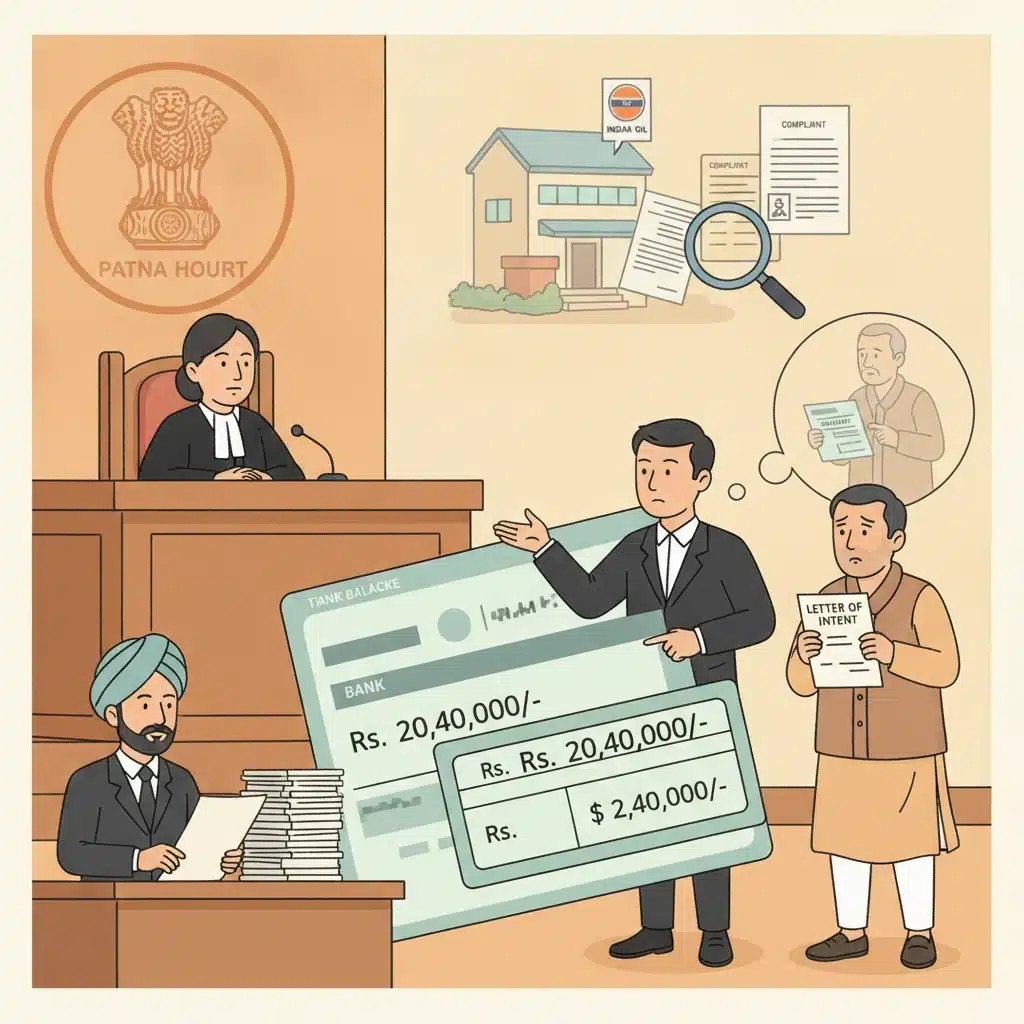
The petitioner submitted his application on 17.02.2009. In clause 14.2 of the application form he declared that he had a balance of Rs. 20,40,000/- in bank account number 014111 with the Siwan Central Cooperative Bank Limited. Based on the points obtained for this declared financial capacity and other documents, the distributorship was allotted to him and later commissioned. A fresh agreement was entered into in 2016 in the ordinary course of business.
Trouble began when, on 23.10.2017, an ex-employee lodged a complaint in the Prime Minister’s Office alleging irregularities. The complaint was forwarded to Indian Oil Corporation Limited (IOCL). IOCL conducted a verification and, by letter dated 09.02.2018, informed the PMO that no fraud had been found against the petitioner.
However, another complaint was received in the Vigilance Department of IOCL at Kolkata. This complaint specifically alleged that the petitioner had obtained the LPG distributorship by using forged and fabricated documents. The complainant enclosed a photocopy of the petitioner’s bank passbook.
According to that passbook, on the crucial date the actual balance in account number 14111 at Siwan Central Cooperative Bank was only Rs. 2,40,000/- and not Rs. 20,40,000/- as claimed in the application form.
IOCL’s Vigilance Department then made an enquiry with the bank. The bank responded that between 14.02.2009 and 31.03.2009 the balance in the account was Rs. 2,40,000/-. It also confirmed that the petitioner had withdrawn Rs. 2,39,500/- by cheque number 019577.
When further queries were raised regarding a copy of the passbook dated 14.09.2009 and certificates dated 14.02.2009 and 09.03.2009 which the petitioner had produced at the time of selection, the bank, by its letter dated 29.01.2019, stated that those documents had not been issued by the bank.
On the basis of these materials, IOCL served a show cause notice on the petitioner on 29.08.2009. He submitted replies denying all allegations. After considering the entire material, hearing the petitioner and his advocate in person, the General Manager (I/c LPG), IOCL passed an order dated 30.12.2019 terminating the distributorship of M/s Gauri Shankar Indane Service, Kuchaikote with immediate effect.
The petitioner challenged the termination order in C.W.J.C. No. 559 of 2020 before a Single Judge of the Patna High Court. On 22.05.2020 the writ petition was dismissed. The petitioner then filed Civil Review No. 79 of 2020 seeking review of that order, which was also dismissed on 22.09.2021.
He thereafter preferred Letters Patent Appeal No. 625 of 2021 against both orders. By judgment dated 02.08.2022, a Division Bench of the Patna High Court dismissed the LPA and upheld the termination.
The present Civil Review No. 283 of 2022 was filed to seek review of that Division Bench judgment dated 02.08.2022. There was a delay in filing the review, but the Court condoned it by allowing I.A. No. 1 of 2022. The Court then proceeded to examine the review petition on merits.
What the Court Examined and Decided
In the review proceedings, the petitioner’s main grievance was directed at one part of the earlier LPA judgment. In that judgment, the Court had examined page 224 of ledger book no. 88 of the Siwan Central Cooperative Bank Ltd., where a ledger page had been pasted, and inferred connivance of bank officials in preparing forged and manipulated documents for the petitioner.
The petitioner’s counsel argued that this inference was erroneous. He submitted that, if the petitioner had been involved in fabrication, he would not have allowed page 225 of the ledger, referred to in the earlier judgment, to continue to show a balance of Rs. 2,40,000/- on 14.02.2009. According to him, this inconsistency showed that the petitioner was not part of any manipulation, and the Court’s conclusion of connivance was a mistake of fact needing correction.
To support his plea, the petitioner relied heavily on the Supreme Court’s decision in Board of Control for Cricket in India v. Netaji Cricket Club, particularly paragraph 90, which explains that a court’s own mistake of fact or law can be a ground for review. The argument was that the Division Bench had misunderstood the bank ledger and therefore misapplied the facts while dismissing the LPA.
The Division Bench, speaking through Hon’ble Mr. Justice Partha Sarthy, examined this submission against the settled law on the limited scope of review.
The Court first referred to the decision in Lily Thomas v. Union of India. There, the Supreme Court held that review is a statutory remedy, not an inherent one, and is not an “appeal in disguise”. A court may correct an earlier order only where there is an error apparent on the face of the record, or where the judgment was built on an assumption that was plainly wrong and would cause miscarriage of justice if left uncorrected.
The judgment in Lily Thomas, which in turn relied on earlier cases like Patel Narshi Thakershi, S. Nagaraj v. State of Karnataka and others, emphasised that review is meant to remove accidental mistakes or clear misapprehensions, not to reargue the whole case. It also explained that even where no specific rule existed, higher courts have recognised a narrow power to recall orders to prevent irremediable injustice, but that power is to be used sparingly.
The Division Bench then discussed Kerala State Electricity Board v. Hitech Electrothermics & Hydropower Ltd. In that case, the Supreme Court clearly held that a review petition cannot be used to reappreciate evidence or to reach a different factual conclusion, even if another view might be possible. The only permissible ground is an error apparent on the face of the record.
The Court next referred to Jain Studio Ltd. v. Shin Satellite Public Co. Ltd., where the Supreme Court stated that seeking the same relief that had been refused earlier, on the same arguments, is not a proper use of review. The power of review cannot be confused with appellate power; it is not a rehearing of the original matter. Old and overruled arguments cannot reopen concluded adjudications.
Further, in Kamlesh Verma v. Mayawati, the Supreme Court summarised when review is and is not maintainable. Review lies only in three situations: discovery of new and important evidence which could not be produced earlier despite due diligence; mistake or error apparent on the face of the record; or any other sufficient reason analogous to these. It is not maintainable for mere repetition of arguments, minor mistakes, or when the possibility of two views exists.
The Patna High Court also cited Hari Vishnu Kamath v. Ahmed Ishaque, which explained the concept of “error apparent on the face of the record”. An error must be self-evident and not one which requires detailed reasoning or argument to discover. The boundary between a simple error and an “apparent” error is not rigid, but courts must be cautious and decide on the facts of each case.
After laying out this legal framework, the Division Bench turned back to the petitioner’s complaint about page 224 of the ledger book. The Court recalled that during the hearing of the LPA, it had directed the Siwan Cooperative Central Bank Ltd. to produce the original ledger relating to the petitioner’s account. Despite the first direction, the bank did not comply.
Only when the Chairman and Managing Director were warned to produce the original documents or face consequences did the bank finally produce ledger book no. 88 before the Court. On inspecting it, the Court found that a blank page had been pasted on page 224. This unusual alteration, in the Court’s view, indicated connivance by bank officials in helping the petitioner prepare forged and manipulated documents, which he later used to misrepresent his financial position before IOCL.
The earlier LPA judgment had also noted other significant facts: the petitioner never questioned the disappearance of the alleged “eighteen lakh rupees” from his account. The account, as per the bank, had only Rs. 2,40,000/-. The Court observed that it was “quite intriguing” that a person who believed he had Rs. 20,40,000/- never raised any protest with the bank about such a large shortfall. This strongly suggested that Rs. 2,40,000/- had been fraudulently shown as Rs. 20,40,000/-.
Moreover, the petitioner had never produced any independent material to show his financial capacity. No other bank statements, no statement of account for this or any other account, no income tax returns, or any similar evidence were produced before any authority or court. His case rested solely on the bank statement and verification report which had already been discredited.
In the review petition, the petitioner did not claim that any new evidence had been discovered which was not available earlier. His entire plea was that the Court’s earlier interpretation of the ledger (especially page 224 and 225) was wrong.
The Division Bench held that this is exactly the kind of argument that amounts to seeking a rehearing of the appeal on merits. It involves reappreciation of evidence, which is outside the narrow scope of a review. Even if it were possible to take a different view on the ledger entries, that by itself would not show an “error apparent on the face of the record”.
Applying the principles from the Supreme Court decisions, the Bench concluded that no error of law or fact, apparent on the face of the record, had been pointed out. The review petition, therefore, did not meet any of the grounds under Order XLVII of the Code of Civil Procedure.
Accordingly, the Court held that the review petition lacked merit and dismissed it. The earlier judgment dated 02.08.2022 in LPA No. 625 of 2021, which upheld the termination of the LPG distributorship, remains undisturbed.
Why This Judgment Matters
This judgment is important for LPG dealers and applicants for government-linked distributorships or contracts. It reinforces that misrepresentation about financial capacity, especially through forged bank documents, can lead to cancellation of distributorships even years after allotment.
For litigants, the decision clarifies that once the Patna High Court has finally decided an appeal, a review is not a second chance to argue the same facts. Only obvious mistakes or truly new evidence can justify reopening the case.
The Court has also indicated that where bank records show suspicious alterations, and the account-holder never questions missing large sums, courts may infer manipulation and misrepresentation. This has a direct impact on how banks and beneficiaries of such documents should maintain and present their records.
Legal Issues and Answers
-
Issue: Can the Division Bench’s earlier judgment upholding termination of an LPG distributorship be reviewed on the ground that it wrongly inferred connivance from altered bank ledger pages?
Answer: No. The Court held that no error apparent on the face of the record had been shown and that the petitioner was merely seeking reappreciation of evidence, which is not permitted in review. -
Issue: Did the petitioner establish any statutory ground for review under Order XLVII of the Code of Civil Procedure?
Answer: No. The Court found that there was no discovery of new evidence, no mistake apparent on the record, and no other sufficient reason analogous to the statutory grounds.
Cases Cited by the Court
- Lily Thomas and Others v. Union of India and Others, (2000) 6 SCC 224
- Board of Control for Cricket in India and Another v. Netaji Cricket Club and Others, (2005) 4 SCC 741
- Kerala State Electricity Board v. Hitech Electrothermics & Hydropower Ltd. and Others, (2005) 6 SCC 651
- Jain Studio Ltd. v. Shin Satellite Public Co. Ltd., (2006) 5 SCC 501
- Kamlesh Verma v. Mayawati and Others, (2013) 8 SCC 320
- Hari Vishnu Kamath v. Ahmed Ishaque and Others, AIR 1955 SC 233
- Patel Narshi Thakershi v. Pradyumansinghji Arjunsinghji (citation as referred in Lily Thomas)
- S. Nagaraj v. State of Karnataka (citation as referred in Lily Thomas)
- Raja Prithwi Chand Lal Choudhury v. Sukhraj Rai (as referred in Lily Thomas)
- Rajunder Narain Rae v. Bijai Govind Singh (Privy Council, as referred in Lily Thomas)
- Chhajju Ram v. Neki (as referred in Kamlesh Verma)
- Moran Mar Basselios Catholicos v. Most Rev. Mar Poulose Athanasius (as referred in Kamlesh Verma)
- T.C. Basappa v. T. Nagappa (as referred in Lily Thomas)
- Batuk K. Vyas v. Surat Borough Municipality, AIR 1953 Bom 133 (as referred in Hari Vishnu Kamath)
- Union of India v. Sandur Manganese & Iron Ores Ltd. (as referred in Kamlesh Verma)
Case Details
Case Number: Civil Review No. 283 of 2022 in Letters Patent Appeal No. 625 of 2021; arising out of C.W.J.C. No. 559 of 2020 and Civil Review No. 79 of 2020
Case Title: M/s Gauri Shankar Indane Service Kuchaikote, District Gopalganj through its Proprietor Ravi Pandey v. Indian Oil Corporation Ltd. and Others
Citation: 2022 (4) PLJR 744
Coram: Hon’ble the Chief Justice; Hon’ble Mr. Justice Partha Sarthy (CAV judgment per Hon’ble Mr. Justice Partha Sarthy)
Advocates:
- For the petitioner: Mr. Ranjan Kumar Srivastava, Advocate; Mr. Amol Chitlay, Advocate; Mr. Anukriti Jaypuriar, Advocate; Mr. Aishwarya Nand Kumar, Advocate
- For Indian Oil Corporation Ltd.: Dr. K.N. Singh, Senior Advocate; Mr. Sanat Kumar Mishra, Advocate
Date of Judgment: 29.11.2022 (CAV date 22.11.2022; uploading date 30.11.2022)
Nature of the Case: Civil review petition against a Division Bench judgment in a Letters Patent Appeal arising from a writ petition challenging termination of LPG distributorship
Link to the Judgment: Click here to read the full judgment of the Patna High Court
If you found this explanation helpful and wish to stay informed about
how legal developments may affect your rights in Bihar,
you may consider following Samvida Law Associates for more updates.




