

Case Background
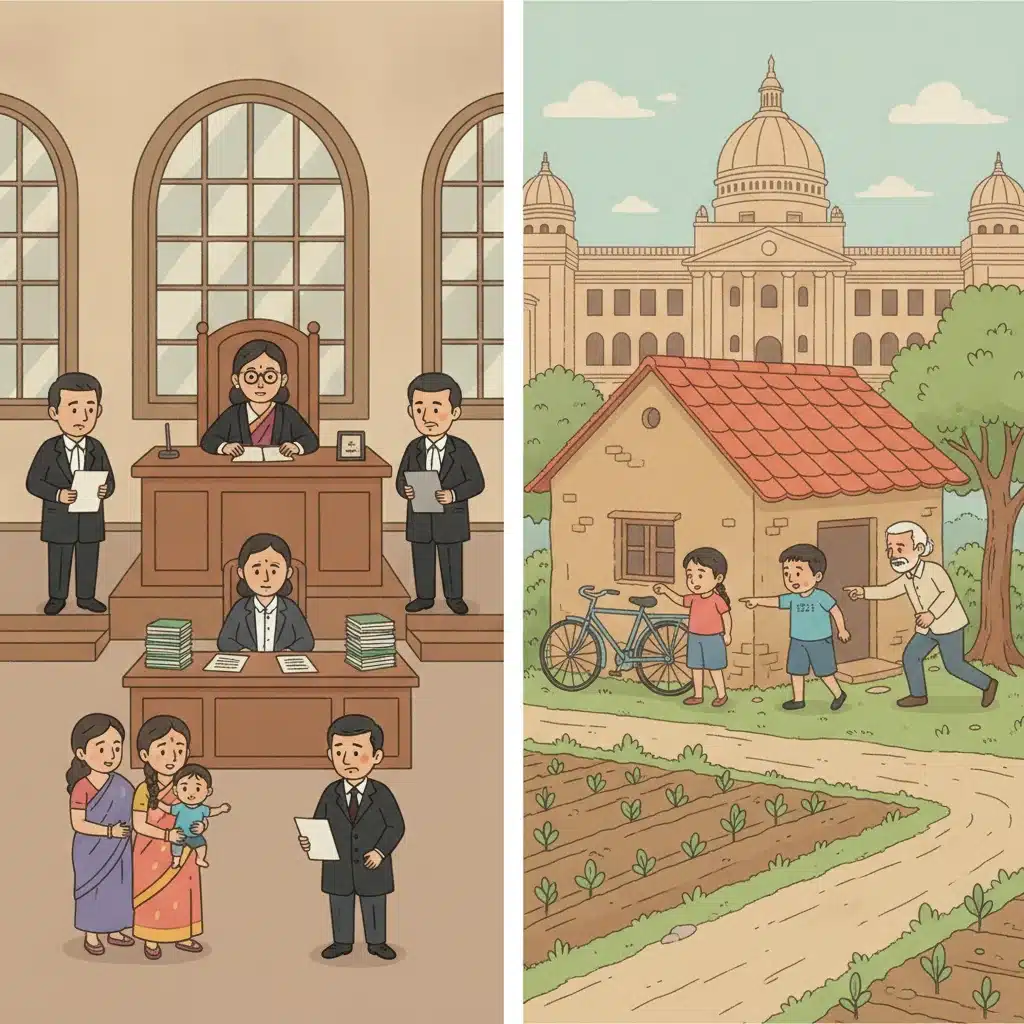
This criminal appeal arose from an incident that took place on 3 January 2014 in Bochahan, District Muzaffarpur.
According to the written report of the child’s father (PW 2), addressed to the Officer Incharge of Bochahan Police Station, his minor daughter, about six years old at that time, was shut inside the house of the appellant around 3 p.m. and raped.
The report stated that the child later narrated the incident, and that the accused had fled from the place. The father requested that the police conduct an inquiry and take legal action.
On this written statement, Bochahan P.S. Case No. 3 of 2014 was registered on 3.1.2014 under section 376 of the Indian Penal Code (IPC). The police investigated the case.
After investigation, chargesheet no. 122 of 2014 was submitted on 9.9.2014 under section 376 IPC. Cognizance was taken, and the case was committed to the Court of Sessions.
The trial court framed charge under section 376(2)(i) IPC and section 6 of the Protection of Children from Sexual Offences (POCSO) Act, 2012. The case was tried as Sessions Case No. 538 of 2015 / Sessions Trial No. 33 of 2016 before the 1st Additional Sessions Judge-cum-Special Judge, POCSO Act, Muzaffarpur.
The defence of the accused throughout was that he was innocent and falsely implicated due to an alleged land dispute. He denied that any such occurrence had taken place.
By judgment of conviction dated 5.7.2018 and order of sentence dated 9.7.2018, the trial court convicted the appellant under section 376(2) IPC and section 6 of the POCSO Act, 2012 and sentenced him to rigorous imprisonment (RI) for 10 years under section 376(2) IPC with a fine of Rs. 25,000/-, and six months’ RI in default of payment of fine. No separate effective sentence was imposed under the POCSO Act.
The appellant then filed Criminal Appeal (SJ) No. 713 of 2019 in the Patna High Court, challenging both conviction and sentence.
What the Court Examined and Decided
The Patna High Court, presided by Hon’ble Mr. Justice Partha Sarthy, heard the submissions of the appellant’s counsel and the Additional Public Prosecutor for the State of Bihar.
The Court carefully examined the evidence of the five prosecution witnesses: the mother (PW 1), father and informant (PW 2), victim child (PW 3), doctor (PW 4), and Investigating Officer (PW 5). It also considered the medical report and the legal provisions under the IPC and the POCSO Act.
Evidence of the Mother (PW 1)
PW 1, the victim’s mother, stated that the incident occurred about three years before her deposition, at around 3 p.m. Her daughter was playing at the doorstep of the appellant’s house along with 2–3 other children.
A child named Neha Kumari came and informed her that the appellant had taken her daughter inside his house. On receiving this information, PW 1 and her husband (PW 2) went to the appellant’s house.
They found their daughter crying, and the appellant had fled. No one else was present in the house. PW 1 stated that her daughter told her that the appellant had opened her pant and that, due to his act of rape, she was bleeding from her urinary passage. Thereafter her husband lodged the case and the child was medically treated.
In cross-examination, PW 1 admitted she had not personally seen the act of rape. She clarified that the accused was the elder brother of her husband and lived nearby. She denied the suggestion that a false case had been lodged due to any old dispute.
Evidence of the Father and Informant (PW 2)
PW 2 stated that the occurrence took place in 2014 at about 3 p.m. He was at home when his niece Neha Kumari informed him that the appellant had shut his daughter inside his house.
On reaching the house, PW 2 saw that his daughter’s mouth was tied and the appellant had run away. On opening her mouth, the child began to cry. According to him, he saw that she was bleeding. He then took her to the police station and identified his signature on the FIR.
He said the child was treated by a doctor and her statement was recorded by the police. In cross-examination, PW 2 described the accused as his ‘phuphera’ brother, who had settled in the village, and said the accused had 3–4 children. He also stated there had never been any prior litigation between the parties and admitted that he had not actually seen the act of rape.
Evidence of the Child Victim (PW 3)
Before recording the child’s testimony, the trial court put questions to her and found her competent to depose.
PW 3 stated that she was playing in an agricultural field when the appellant came on a cycle with bread and asked her to come along, promising to give her bread.
He took her into a room, shut the door, and it was evening. Her mouth was closed, her pant was opened, and the appellant did “dirty work” with her. She identified the appellant.
In cross-examination, she said the accused was her uncle and that she had no injuries on her cheeks, mouth, hands or stomach, nor did she bleed from any part of her body. She also said she did not know of any land dispute between her father and the accused.
Medical Evidence (PW 4)
PW 4, the doctor, examined the child on 4.1.2014. He found no external injury on her body. On local examination of the genital region, he found a small abrasion about 5 mm on the fourchette (a part of the vagina).
There was no bleeding and no spermatozoa were seen in the pathology report dated 4.1.2014. He found no other scratch marks on any part of the victim’s body.
Investigating Officer (PW 5)
PW 5 stated that he took over the investigation on 15.8.2014. Finding the case true against the accused, he submitted a chargesheet under section 376 IPC. He proved the formal FIR, its contents, and the signature of the Officer Incharge.
Consistency of Witnesses and Minor Contradictions
The High Court noted that PW 1, PW 2, and PW 3 all consistently stated that the appellant lured the child with bread, took her inside his house, shut the room, tied or closed her mouth, opened her pant, and committed a sexual act described as rape or “dirty work”.
The Court recognised some differences: PW 1 and PW 2 spoke of bleeding, while PW 3 and PW 4 did not. PW 1 also did not mention in her main statement that the child’s mouth was tied. However, the Court held that these were minor contradictions which did not affect the core of the prosecution story or make it unreliable.
The Court gave importance to the medical evidence. The injury of a 5 mm abrasion on the fourchette, though small and without bleeding, matched the allegation that the appellant had opened the girl’s pant and done a sexual act.
Understanding Fourchette and the Law on Rape
The Court referred to medical books to explain that the vulva is the outer part of the female reproductive system. It has two folds of skin: the outer labia majora and the inner labia minora. The fourchette lies at the bottom where the inner folds meet.
The Court then quoted section 375 IPC defining rape, including Explanation 1 which says that “vagina” for this section shall also include labia majora.
From the evidence, the Court noted three key points together: the child’s statement that the appellant did “dirty work” after opening her pant; the mother’s evidence that the child pointed towards her urinary passage and said the appellant had inserted his male organ; and the doctor’s finding of an abrasion at the fourchette.
Reading these together with section 375 IPC and Explanation 1, the Court concluded that sexual penetration sufficient to constitute rape was proved beyond reasonable doubt, even though signs like sperm or heavy injuries were absent.
Position of Trust and Correct Section under IPC
The Court accepted that the appellant was the cousin brother of the victim’s father and thus the victim’s uncle. This put him in a position of a relative or guardian of the minor child.
On these facts, the Court held that the correct provision attracted was section 376(2)(f) IPC, which covers rape committed by a relative, guardian or person in a position of trust, and not section 376(2)(i) IPC under which he had originally been charged and convicted.
Assessment under POCSO Act
The trial court had convicted the appellant under section 6 of the POCSO Act, treating the act as “penetrative sexual assault”.
The High Court examined section 3 of the POCSO Act, which defines “penetrative sexual assault”. It noted that, unlike section 375 IPC, section 3 does not contain wording similar to Explanation 1 (which extends “vagina” to include labia majora).
In the Court’s view, on the specific evidence—especially the doctor’s deposition—the ingredients of “penetrative sexual assault” were not fully made out under section 3 POCSO. Therefore, a conviction under section 6 (which punishes aggravated penetrative sexual assault) could not be sustained.
However, the Court held that the prosecution had certainly proved “sexual assault” within the meaning of section 7 of the POCSO Act. Considering that the victim was below 12 years of age and that the appellant was her uncle, the case fell within aggravated sexual assault under section 9(m) and (n) POCSO.
Accordingly, the Court held that the appellant was liable to be punished under section 10 of the POCSO Act.
Final Outcome
In conclusion, the Patna High Court upheld the finding of guilt but modified the exact provisions:
- The conviction under section 376(2)(i) IPC and section 6 POCSO was altered to conviction under section 376(2)(f) IPC and sections 9(m) and (n) POCSO, 2012.
- The sentence of RI for 10 years and fine of Rs. 25,000/- remained, now attached to section 376(2)(f) IPC.
- In addition, a further sentence of 7 years’ imprisonment was imposed under section 10 of the POCSO Act for aggravated sexual assault.
- Both sentences were directed to run concurrently.
Finding no merit in the appeal, the Court dismissed it.
Why This Judgment Matters
This judgment is important for families and child victims because it shows how the Patna High Court treats sexual crimes against children by relatives.
The Court trusted the clear and simple words of the child victim, supported by her parents and medical evidence, even though there were no major injuries or sperm found.
The decision explains that touching and penetration of the outer parts of the genital area, proved with even a small injury, can be enough to establish rape under the IPC when read with the legal definition.
At the same time, the Court carefully separated the IPC definition of rape from the POCSO definition of “penetrative sexual assault” and did not overstretch the POCSO provision where its wording did not directly fit the evidence.
For child protection cases in Bihar, this ruling reinforces that:
- Evidence of a young child, if consistent and natural, carries great weight.
- Relatives in positions of trust face harsher punishment when they abuse that trust.
- Courts will ensure correct legal sections are applied, even if they have to modify what the trial court did, while still protecting the victim.
Legal Issues and Answers
Issue: Whether the prosecution proved beyond reasonable doubt that the appellant sexually assaulted and raped his minor niece.
Answer: Yes. Relying on the victim’s testimony, supporting statements of her parents, and medical evidence of an abrasion at the fourchette, the Court held that rape under section 375 IPC was proved beyond reasonable doubt, attracting section 376(2)(f) IPC.
Issue: Whether the act amounted to “penetrative sexual assault” under section 3 of the POCSO Act justifying conviction under section 6.
Answer: No. The Court found that section 3 POCSO does not have wording like Explanation 1 to section 375 IPC, and on the specific medical and oral evidence, penetrative sexual assault in terms of section 3 was not made out. However, sexual assault under section 7, read with aggravated factors under section 9(m) and (n), was proved.
Issue: Whether the conviction and sentence passed by the trial court required interference on appeal.
Answer: Only to the limited extent of correcting the sections. The High Court maintained the 10-year RI sentence for rape, added a 7-year sentence under section 10 POCSO for aggravated sexual assault to run concurrently, and dismissed the appeal on merits.
Cases Cited by the Court
- No earlier judgments or case law have been cited or relied upon in the text of this decision.
Case Details
Case Number: Criminal Appeal (SJ) No. 713 of 2019 in Criminal Appeal (DB) No. 1264 of 2018; arising out of Bochahan P.S. Case No. 3 of 2014
Case Title: Pramod Sahani vs. The State of Bihar
Citation: 2022 (4) PLJR 798
Coram: Hon’ble Mr. Justice Partha Sarthy
Advocates: Ms. Bela Singh, Advocate and Mr. Tribhuwan Narayan, Advocate for the appellant; Mr. Ajay Mishra, Additional Public Prosecutor for the State of Bihar
Nature of the Case: Criminal appeal against judgment of conviction and sentence passed in a Sessions trial under section 376(2) IPC and provisions of the POCSO Act, 2012
Link to Judgment: Patna High Court Judgment Link
If you found this explanation helpful and wish to stay informed about
how legal developments may affect your rights in Bihar,
you may consider following Samvida Law Associates for more updates.




