

Case Background
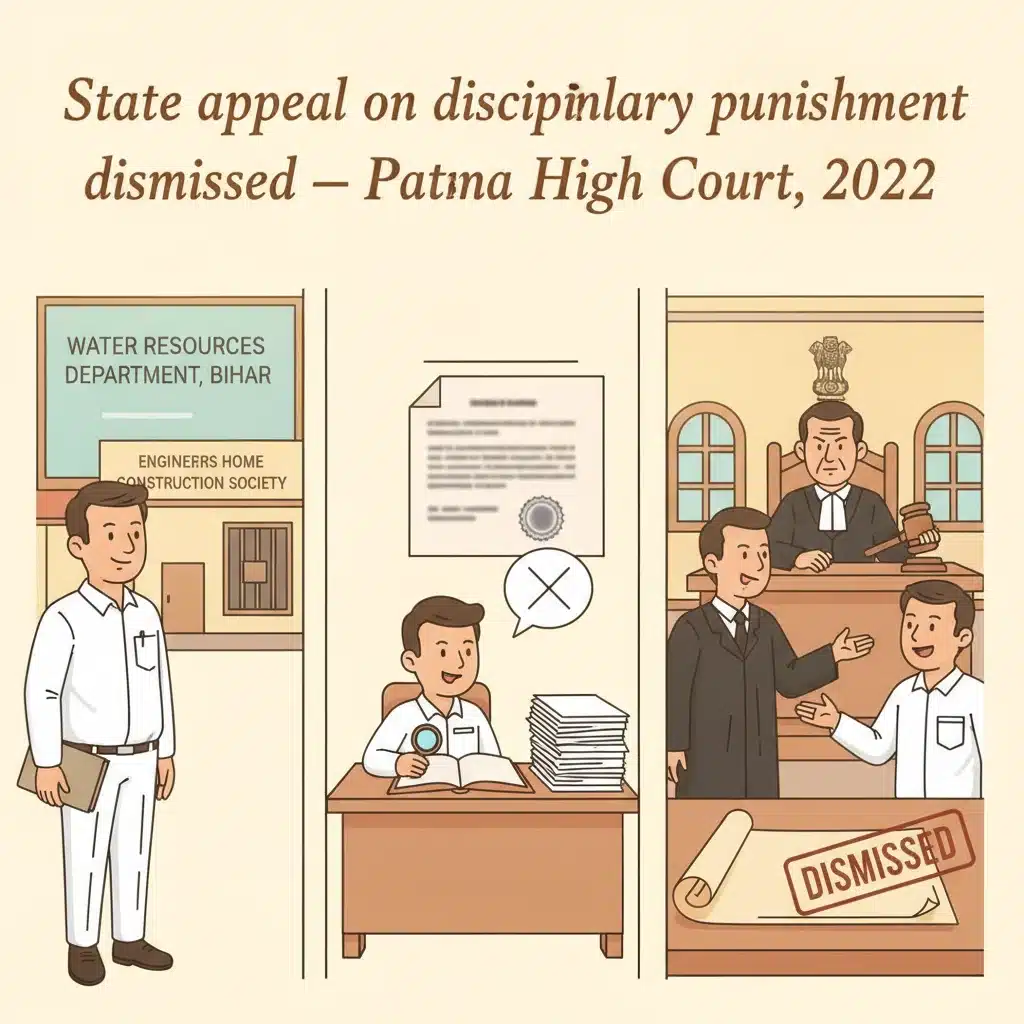
The respondent in this case was working as an Assistant Engineer in the Master Planning, Investigation Division, Jhanjharpur under the Water Resources Department, Government of Bihar.
Allegations of irregularities were made in relation to an Engineers Home Construction Society at Bailey Road, Patna. An FIR bearing Danapur P.S. Case No. 336 of 1994 was registered, and departmental proceedings were initiated against the Assistant Engineer for alleged gross violation of the Bihar Government Servant Conduct Rules.
The departmental proceeding was initiated vide Departmental Order No. 379 dated 30.11.1996. During the enquiry, the conducting officer (enquiry officer) held the allegations against the Assistant Engineer to be proved, but recommended sympathetic consideration.
On the basis of this report, the Government first imposed certain punishments and later, after issuing a second show cause notice, imposed a different set of punishments. Subsequently, the disciplinary authority itself felt that the penalties earlier imposed were not in accordance with law and passed a “corrected” order dated 04.08.2000.
Both the punishment order dated 08.07.2000 and the corrected order dated 04.08.2000 were challenged by the Assistant Engineer in Civil Writ Jurisdiction Case No. 9252 of 2000 before a learned Single Judge of the Patna High Court. By order dated 28.06.2019, the learned Single Judge granted relief to the writ petitioner.
Aggrieved by that order, the State of Bihar and its departmental authorities filed the present Letters Patent Appeal No. 71 of 2021 before the Division Bench of the Patna High Court.
What the Court Examined and Decided
The Division Bench, consisting of Hon’ble Mr. Justice P. B. Bajanthri and Hon’ble Mr. Justice Rajiv Roy, heard the appeal on 25.08.2022. The core question was whether the punishment orders passed in the departmental proceedings were valid and whether the Single Judge was right in interfering with them.
The background of the departmental case, as recorded in the judgment, was that the Assistant Engineer had been associated with the Engineers Home Construction Society, Bailey Road, Patna. It was alleged that:
First, he had assumed charge as Chairman and Secretary of the Engineers Home Construction Society from 07.02.1980 to 02.07.1989 without obtaining prior permission from the Government as required by Rule 16(3) of the Bihar Government Servant Conduct Rules.
Second, an audit report of the Society, as per a letter from the Registrar, Cooperative Societies, Patna, indicated that the audit report was incomplete and that irregularities were possible in the conduct of the Society.
Third, an FIR (Danapur P.S. Case No. 336 of 1994) had been lodged against him in his capacity as Secretary of the Engineers Home Construction Society. It was noted that he remained in custody from 29.11.1994 to 05.12.1994 but did not inform the department about his imprisonment.
Fourth, the authorities alleged that the Society was not limited to engineers alone but had general members, and that members signed the bye-laws as general persons instead of as engineer members, indicating that the Society had a commercial character.
On the basis of these allegations, the Government initially imposed certain penalties. It ordered that the Assistant Engineer would receive the lowest pay scale of the post of Assistant Engineer, that he would be posted outside Patna and would not be assigned flood duty, and that he would receive only subsistence allowance during the period of suspension.
Along with these proposed punishments, a second show cause notice was issued to him vide Letter No. 1375 dated 21.06.1999. He submitted his detailed reply on 15.10.1999, contesting the allegations, particularly claiming that it was not mandatory to obtain permission merely for being a member of a housing cooperative society.
After considering the matter again, the Government noted two main “proved irregularities” in its own words:
(A) That the Assistant Engineer did not obtain permission under Rule 16(3) while functioning as Chairman and Secretary of the Engineers Home Construction Society from 07.02.1980 to 02.07.1989 and that, in light of the Registrar’s report and audit material, irregularities in the Society were possible.
(B) That he was in prison from 29.11.1994 to 05.12.1994 in the said FIR but did not inform the department, which was treated as gross irregularity.
For these alleged proven charges, a revised set of punishments was imposed:
(i) Censure for the year 1994-1995.
(ii) Withholding of one increment with cumulative effect.
(iii) Revocation of suspension with a direction that he would get only subsistence allowance for the suspension period, but that period would count for pension and he would earn increments during that period. He was directed to report to headquarters.
According to paragraph 3 of the Division Bench judgment, the disciplinary authority later concluded that these penalties were not in accordance with law and accordingly passed a “corrected” order on 04.08.2000. Both the order dated 08.07.2000 and the corrected order dated 04.08.2000 were challenged in the writ petition.
When the Division Bench analysed the two orders, it found a crucial flaw. The respondent employee had been supplied with the enquiry officer’s report along with the second show cause notice dated 21.06.1999, and he had submitted his reply on 15.10.1999. However, the punishment orders did not show that his reply was actually considered.
The Bench held that on a bare perusal of the punishment order dated 08.07.2000 and the corrected order dated 04.08.2000, it was “crystal clear” that they were not speaking and reasoned orders. None of the specific points raised by the employee in his explanation were discussed or addressed.
The Court emphasised that the very purpose of issuing a second show cause notice along with the enquiry report is to give the delinquent employee a fair opportunity to persuade the disciplinary authority to disagree with the enquiry findings or to take a lenient view. If the disciplinary authority passes the final order without discussing the reply and without giving reasons, this purpose is defeated.
The learned Single Judge had relied on the Supreme Court decision in Kranti Associates Private Limited and another v. Masood Ahmed Khan and others, (2010) 9 SCC 496. The Division Bench reproduced paragraph 40 of the Supreme Court’s subsequent judgment in ORYX Fisheries Private Limited v. Union of India and others, (2010) 13 SCC 427, which itself summarised the principles from Kranti Associates.
These principles stress that:
Administrative, quasi-judicial, and judicial authorities must record reasons when their decisions affect individuals prejudicially. Recording reasons is part of the wider concept that justice must not only be done but must be seen to be done. Reasoned orders prevent arbitrary exercise of power, reassure parties that relevant factors have been considered, and allow effective judicial review.
The Supreme Court also noted that reasons have become virtually indispensable to decision-making and are an aspect of fairness and human rights. A mere “rubber-stamp” order without real reasoning is not acceptable.
Relying on these binding principles, the Division Bench stated that the disciplinary authority, while exercising powers under the Bihar Government Servants (Classification, Control & Appeal) Rules, 2005, functions as a quasi-judicial authority when imposing punishment. Therefore, the final punishment order must clearly disclose the application of mind and indicate how each contention of the delinquent officer has been dealt with.
In the present case, since the orders dated 08.07.2000 and 04.08.2000 lacked such reasoning and did not show consideration of the reply dated 15.10.1999, they were not sustainable in law.
On this basis, the Division Bench concluded that the appellants (the State and departmental authorities) had failed to demonstrate any error in the learned Single Judge’s order dated 28.06.2019 in C.W.J.C. No. 9252 of 2000. Consequently, no interference was warranted in Letters Patent Appeal No. 71 of 2021.
The appeal was therefore dismissed. The judgment records this conclusion succinctly in paragraph 7: “Accordingly, L.P.A. No. 71 of 2021 stands dismissed.”
Why This Judgment Matters
This decision of the Patna High Court is significant for all government employees in Bihar and for departments conducting disciplinary inquiries.
First, it reinforces that before imposing any punishment, especially after a second show cause notice and supply of an enquiry report, the disciplinary authority must read and deal with the employee’s reply. It is not enough to merely mention that a reply was received; the authority must show, in writing, why it accepts or rejects each material point.
Second, the judgment underlines that disciplinary orders are not mere office notes. They are quasi-judicial decisions that can affect a person’s pay, posting, reputation, pension, and career. Such orders must therefore be “speaking orders” containing clear, cogent, and succinct reasons.
Third, the Court’s reliance on Supreme Court judgments like Kranti Associates and ORYX Fisheries confirms that the requirement to give reasons is not a technicality but part of fairness and even human rights. If a punishment order is unreasoned, it is vulnerable to being set aside in judicial review.
For employees facing departmental proceedings, this case shows that they have a right to expect that their replies will be seriously considered. For departments, it serves as a reminder to follow due process and to draft detailed, reasoned orders to withstand court scrutiny.
Legal Issues and Answers
-
Issue: Whether the punishment orders dated 08.07.2000 and 04.08.2000 passed against the Assistant Engineer in departmental proceedings were valid when they did not discuss his reply to the second show cause notice.
Answer: No. The Patna High Court held that the orders were not speaking and reasoned; they did not show consideration of the employee’s explanation, thereby defeating the purpose of issuing a second show cause notice. Hence, interference with the Single Judge’s order was unwarranted and the State’s appeal was dismissed. -
Issue: Does a disciplinary authority, acting under the Bihar Government Servants (Classification, Control & Appeal) Rules, 2005, have to pass a reasoned order while imposing punishment?
Answer: Yes. The Court held that the disciplinary authority exercises quasi-judicial functions and must therefore record clear reasons, reflecting consideration of each contention, in line with the principles laid down by the Supreme Court in Kranti Associates and ORYX Fisheries.
Cases Cited by the Court
- Kranti Associates Private Limited and another v. Masood Ahmed Khan and others, (2010) 9 Supreme Court Cases 496.
- ORYX Fisheries Private Limited v. Union of India and others, (2010) 13 Supreme Court Cases 427.
Case Details
Case Number: Letters Patent Appeal No. 71 of 2021 in Civil Writ Jurisdiction Case No. 9252 of 2000
Case Title: The State of Bihar & Ors. v. Ravindra Thakur
Citation: 2022(4) PLJR 917
Court: High Court of Judicature at Patna
Coram: Hon’ble Mr. Justice P. B. Bajanthri and Hon’ble Mr. Justice Rajiv Roy
Date of Judgment: 25.08.2022
Advocates: Mr. Sanjay Prasad, Advocate and Mr. Anjani Kumar, AAG 4 for the appellants (State and departmental authorities); Mr. Arun Kumar for the respondent (Assistant Engineer).
Nature of the Case: Letters Patent Appeal filed by the State against the order of a learned Single Judge in a writ petition concerning departmental disciplinary punishment.
Link to Judgment: https://patnahighcourt.gov.in/viewjudgment/MyM3MSMyMDIxIzEjTg==-BhtLI223vyw=
If you found this explanation helpful and wish to stay informed about how legal developments may affect your rights in Bihar, you may consider following Samvida Law Associates for more updates.




