

Case Background
This case arises from recruitment of Panchayat/Block Teachers in Bihar under a notification dated 1 July 2006. Applications were invited for different schools, with the Mukhiya of the Gram Panchayat as Chairman of the selection unit and the Panchayat Secretary as Member Secretary.
The writ petitioner applied on 26 August 2006 for the post of Panchayat Teacher for Gram Panchayat Raj Keyal, Block Karpi, District Arwal, under the Backward Class category. Counselling was fixed for 8 October 2006. The petitioner says he appeared for counselling along with other candidates.
According to the petitioner, respondent no. 13 never applied for the Keyal Panchayat post and did not appear in counselling. He alleges that respondent no. 13’s father, the Headmaster of the upgraded Middle School, Andhra Chak, Karpi, misused his position to secure his son’s appointment in the same school.
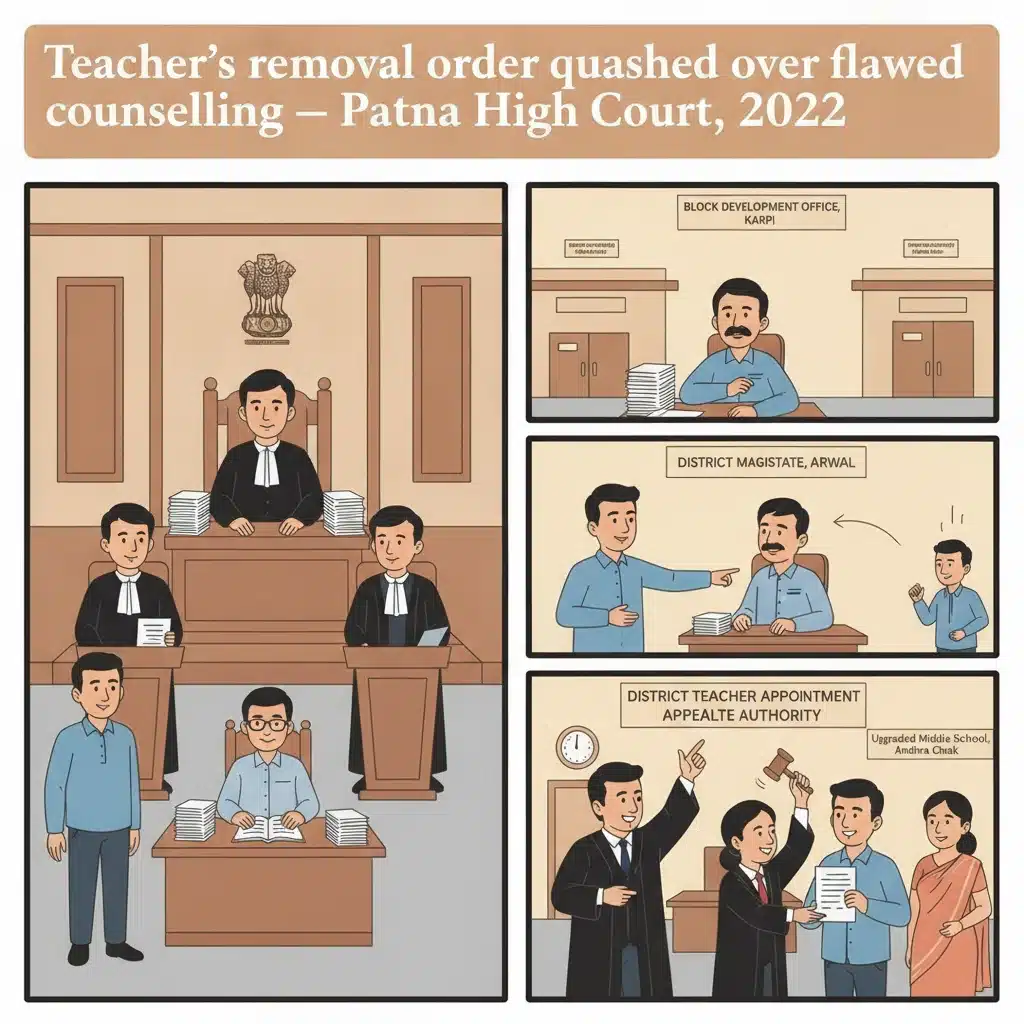
A Supervisor-cum-Member Teacher complained to the Block Development Officer (BDO), Karpi, about irregularities in the preparation of the merit panel. The petitioner also filed a complaint before the BDO, who at that time was the Appellate Authority under Rule 18 of the Bihar Panchayat Elementary Teacher (Employment and Service Condition) Rules, 2006.
The BDO did not decide the complaint. The petitioner then approached the District Magistrate (DM), Arwal, on 28 July 2007. The DM remanded the matter to the BDO for decision. Meanwhile, the 2006 Rules were amended in 2008 and the appellate power shifted from the BDO to the District Teacher Appointment Appellate Authority. The petitioner’s appeal was transferred and registered as Appeal No. 01/2008-09.
On 8 February 2010, the District Appellate Authority held the appointment of respondent no. 13 to be illegal and tainted with malice, finding that his father had misused his power. It set aside respondent no. 13’s appointment and directed that the petitioner be considered for appointment. The DM, Arwal, issued orders on 11 March 2010 and the petitioner’s joining was accepted on 22 March 2010. He served as Panchayat Teacher thereafter.
Respondent no. 13 challenged the appellate order in C.W.J.C. No. 4612 of 2010. On 11 April 2013, the High Court dismissed the writ petition but set aside the portion directing appointment of the petitioner. The petitioner then filed L.P.A. No. 602 of 2013, while respondent no. 13 also filed an appeal. On 27 January 2014, the Division Bench set aside both the District Appellate Authority’s order dated 8 February 2010 and the Single Judge’s order, and remanded the case to the Tribunal (District Appellate Authority) for fresh decision.
Pursuant to this, the petitioner filed Appeal No. 24 of 2014 before the District Appellate Authority. By judgment dated 23 June 2015, the Authority again held respondent no. 13’s appointment to be illegal and directed initiation of fresh proceedings for appointment to the post.
The petitioner sought implementation of this order before the BDO, Karpi. Meanwhile, on 10 December 2015, respondent no. 13 was again appointed to the post but this appointment was set aside by the Panchayat Secretary on 15 December 2015.
The petitioner approached the DM, Arwal, yet again for implementation of the District Appellate Authority’s order. Instead of appointing the petitioner, appointment was once more issued in favour of respondent no. 13. The DM then submitted a report on 28 May 2016 recommending cancellation of respondent no. 13’s appointment. By communication dated 10 November 2016, respondent no. 13 was informed, through letter dated 24 October 2016, of his removal from the post.
Because the order dated 23 June 2015 had not been implemented in his favour, the petitioner moved contempt proceedings before the District Appellate Authority. Respondent no. 13’s writ petition C.W.J.C. No. 12477 of 2015, challenging the 23 June 2015 order, was dismissed on 6 February 2017.
Following this, the petitioner was asked by letter dated 17 March 2017 to appear for counselling with other candidates in the merit list. On the same date, based on his highest overall merit, an appointment letter was issued to him. He joined on 27 March 2017.
Respondent no. 13 had also filed C.W.J.C. No. 19798 of 2016 against the order dated 23 June 2015. That writ petition was dismissed as withdrawn on 30 July 2019, with liberty to move the State Appellate Authority.
Exercising that liberty, respondent no. 13 filed Appeal No. 383 of 2019 before the State Appellate Authority. On 30 March 2022, the State Appellate Authority allowed the appeal, ordered that the petitioner be removed from service within a fortnight and directed reinstatement of respondent no. 13.
The petitioner then filed the present writ petition, C.W.J.C. No. 5823 of 2022, before the Patna High Court challenging the State Appellate Authority’s order and seeking release of arrears of salary.
What the Court Examined and Decided
The High Court first noted the petitioner’s main grievance: the State Appellate Authority had reversed the District Appellate Authority’s detailed findings and ordered his removal, despite past litigation where respondent no. 13 had failed to secure relief and despite fresh counselling in which the petitioner had been selected on merit.
The petitioner argued that respondent no. 13 had concealed several key facts from the State Appellate Authority. These included: dismissal of his earlier writ petition C.W.J.C. No. 4612 of 2010, the Division Bench’s remand order in L.P.A., dismissal of C.W.J.C. No. 12477 of 2015 on 6 February 2017, and the fact that fresh counselling had been held in 2017 in which the petitioner was selected and appointed.
The petitioner’s counsel pointed out that although the State Appellate Authority itself noted suppression of these facts and described it as a “blunder,” it still proceeded to allow the appeal. According to the petitioner, the State Appellate Authority wrongly interpreted the District Appellate Authority’s orders and passed an illegal, perverse order.
On 29 April 2022, the High Court had stayed operation of the State Appellate Authority’s order. Respondent no. 13 then applied for vacating the stay, alleging that the petitioner had made false statements before the Court. Considering the seriousness of the rival assertions, the High Court decided to hear and finally dispose of the writ petition.
Respondent no. 13 contended that the petitioner had never participated in counselling and that his alleged selection through counselling could not be proved. He also relied on an observation of the Division Bench in L.P.A. No. 1125 of 2020 that “the respondent no. 13 did not appear for counselling, he had thus forfeited his right to appointment.” However, the Court clarified that the person referred to in that L.P.A. was not the present petitioner, noting that the context there related to a female candidate whereas the present petitioner is male.
Counsel for respondent no. 13 argued that the subsequent counselling, held after the Division Bench remand, had to be conducted excluding the petitioner, and that the State Appellate Authority was therefore right in concluding that he had no valid claim.
Respondent nos. 7 and 8 (District Education Officer and District Programme Officer, Establishment, Arwal) filed a counter affidavit supporting the petitioner. They confirmed that the petitioner had higher merit than respondent no. 13, that he had been selected again on the basis of counselling and appointed on 27 March 2017, and that only after the State Appellate Authority’s order was his salary stopped.
After examining the entire record, the High Court found serious errors in the order of the State Appellate Authority. The Authority had concluded that the petitioner, Rajesh Kumar, did not participate in counselling. The Court contrasted this with documentary material showing that his application had been received on 26 August 2006, while respondent no. 13 had not applied at all.
The Court further observed that the petitioner did participate in the subsequent counselling ordered by the District Appellate Authority, and was selected on merit. By contrast, respondent no. 13 had been appointed only after what was described as an “8th round” of counselling, where he was the only candidate called. The Court described this so-called counselling as an “eye wash” which could not be accepted as a genuine selection process.
The Court expressed its inability to understand how respondent no. 13 could be offered appointment when he had not even applied for the post. It noted that while counselling was fixed for 8 October 2006, in reality no proper counselling appeared to have taken place; instead respondent no. 13 was somehow given appointment without participating in any valid process.
Given these facts, the Court endorsed the District Appellate Authority’s direction to conduct fresh counselling. It held that once it was established that the original preparation of the panel was wrongful, the District Appellate Authority was well within its power to order a fresh counselling process. The State Appellate Authority’s view that such a direction was unjustified was termed “wholly perverse.”
The Court stressed that where a candidate with higher merit is available, appointing a person of lower merit, particularly when his name is added through an irregular “8th round” counselling and when he is the son of the Headmaster, gives rise to an inference of malice. The Court underlined that merit cannot be ignored in public appointments.
The High Court also found that important facts were not placed before the State Appellate Authority. These included the fact that counselling was conducted as per the District Appellate Authority’s directions, that the petitioner was appointed following that counselling, and that respondent no. 13 did not participate in that process. It also noted that the order of the District Appellate Authority had already been implemented and upheld by the High Court in the writ petition filed by respondent no. 13.
In view of these omissions and distortions, the Court concluded that the State Appellate Authority’s decision rested on findings that “no ordinary person could have arrived at” and were, therefore, perverse. The Court also referred to the principle of “suppressio veri, suggestio falsi” in relation to respondent no. 13’s conduct, meaning suppression of truth and suggestion of falsehood.
Ultimately, the Court held that the State Appellate Authority had misinterpreted both the High Court’s earlier orders and the District Appellate Authority’s order, and had failed to consider crucial facts. Consequently, its order could not stand in law.
The writ petition was allowed. The Patna High Court quashed and set aside the State Appellate Authority’s order dated 30 March 2022. It directed that the petitioner be allowed to continue on the post to which he had been appointed. It also ordered that he be permitted to draw his salary and that all withheld arrears be released in his favour forthwith. No costs were awarded.
Why This Judgment Matters
This judgment is important for Panchayat Teacher appointments and similar recruitment disputes in Bihar. It shows that selection authorities and appellate bodies must respect merit and the original rules of recruitment.
The Patna High Court made it clear that no candidate can be given a government job without even applying or attending proper counselling. Attempts to regularise such appointments through repeated or sham counselling rounds will not be accepted.
The decision also warns that candidates who hide earlier court orders or facts when approaching appellate forums risk losing their case. Suppressing material facts, as seen in the conduct attributed to respondent no. 13, weakens a claimant’s position.
For teachers and job-seekers, this ruling shows that persistent challenge against illegal appointments, backed by documents and prior orders, can succeed even after many years. For administration, it emphasises that once a district appellate order is implemented and upheld by the High Court, higher authorities cannot casually undo it without full consideration of the record.
Legal Issues and Answers
- Issue: Could the State Appellate Authority lawfully remove the petitioner and reinstate respondent no. 13 despite earlier findings that respondent no. 13’s appointment was illegal and despite fresh counselling in which the petitioner was selected?
Answer: No. The Patna High Court held that the State Appellate Authority misread earlier orders, ignored crucial facts about applications, counselling and merit, and passed a perverse order that was unsustainable in law. - Issue: Was the direction of the District Appellate Authority to conduct fresh counselling for the Panchayat Teacher post justified?
Answer: Yes. Once the original panel and appointment were found to be wrongful, the District Appellate Authority had power to direct fresh counselling, and its decision to do so was proper. - Issue: What is the effect of a candidate not applying or not participating in counselling for a public post?
Answer: A person who has not applied or has not taken part in valid counselling cannot be offered appointment. Any such appointment, especially through irregular counselling rounds, is liable to be struck down as illegal and tainted by malice.
Cases Cited by the Court
- The judgment text does not mention or rely on any specific reported case law by name. The Court primarily examined earlier proceedings between the same parties, including C.W.J.C. No. 4612 of 2010, C.W.J.C. No. 12477 of 2015, C.W.J.C. No. 19798 of 2016, and L.P.A. No. 602 of 2013, as well as a reference to L.P.A. No. 1125 of 2020.
Case Details
Case Number: Civil Writ Jurisdiction Case No. 5823 of 2022
Case Title: Rajesh Kumar v. The State of Bihar & Ors.
Citation: 2022 (4) PLJR 740
Court: High Court of Judicature at Patna
Coram: Hon’ble Mr. Justice Sanjeev Prakash Sharma
Date of Judgment: 25-11-2022
Advocates: Mr. Rajeev Kumar Singh, Advocate for the petitioner; Mr. Jitendra Kr. Roy 1 (SC13), for the respondents
Nature of Case: Writ petition under civil writ jurisdiction challenging an order of the State Appellate Authority regarding appointment and removal of a Panchayat Teacher
Impugned Order: Order dated 30.03.2022 passed by the State Appellate Authority, Patna, in Appeal No. 383 of 2019
Final Outcome: Writ petition allowed; order of the State Appellate Authority dated 30.03.2022 quashed; petitioner to continue as Panchayat Teacher with salary and arrears to be released
Link to Judgment: Click here to view the official Patna High Court judgment
If you found this explanation helpful and wish to stay informed about how legal developments may affect your rights in Bihar, you may consider following Samvida Law Associates for more updates.




