

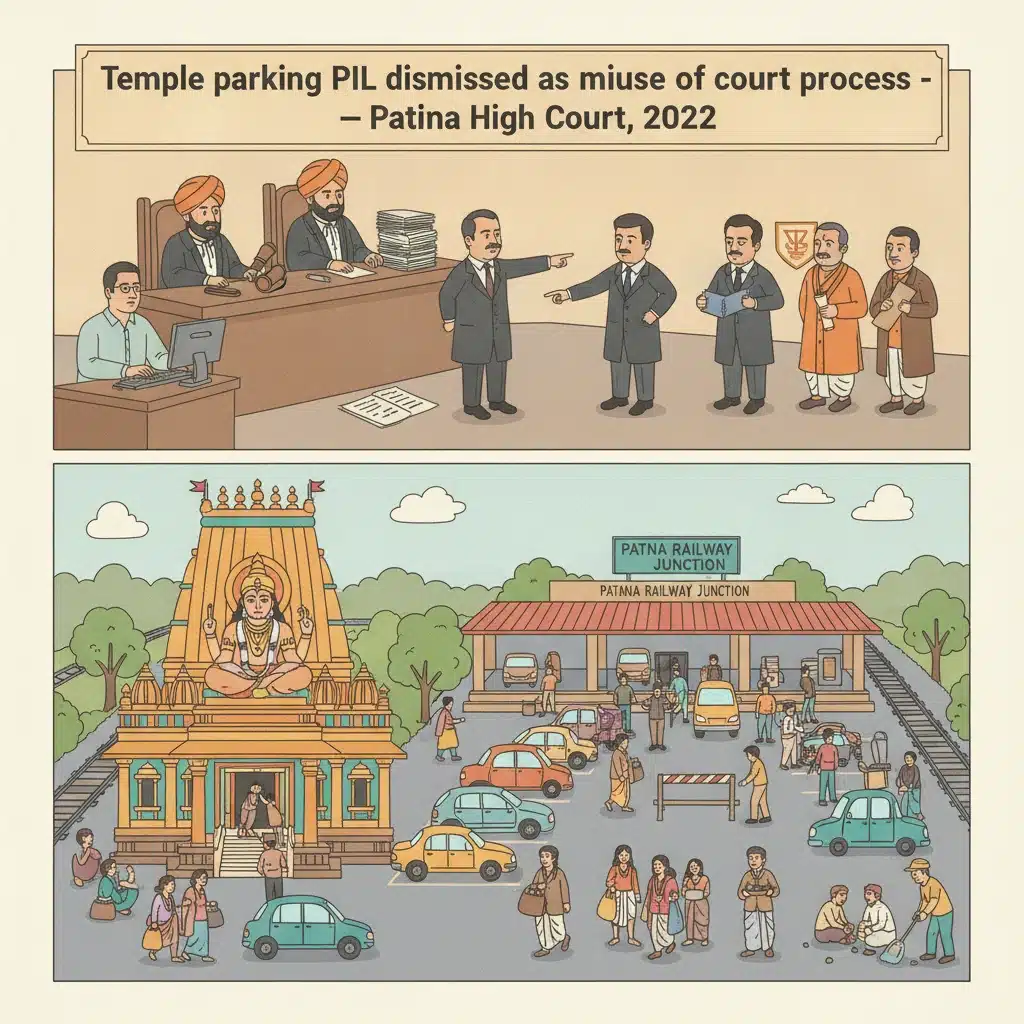
Case Background
The case arose from a writ petition filed as a supposed public interest litigation before the Patna High Court. The petitioner described himself as a public spirited citizen and devotee of a temple situated at Patna Railway Junction.
The temple referred to in the judgment is dedicated to Lord Hanuman and is located at the entrance of Patna Railway Junction, near Mahavir Temple at the railway station. The petitioner approached the Court under its civil writ jurisdiction, arraying the Union of India through the Railways, senior railway officials, the State of Bihar, senior state officials, the Bihar State Board of Religious Trusts, and the temple trust as respondents.
The matter was heard by a Division Bench comprising Hon’ble Mr. Justice Ashutosh Kumar and Hon’ble Mr. Justice Nawneet Kumar Pandey. Arguments were addressed by learned senior counsel for the petitioner, learned senior counsel for the Railways, and counsel representing the State of Bihar.
The judgment was delivered on 21-11-2022. It records only the reliefs sought and the Court’s reasoning on whether these reliefs could be granted in exercise of public interest jurisdiction. No prior or parallel proceedings are mentioned in the text of the judgment.
What the Court Examined and Decided
The Patna High Court first noted the nature of the reliefs claimed. The petitioner sought a direction to the railway authorities to allocate sufficient space near Mahavir Temple, located at Patna Railway Station, for parking vehicles of devotees visiting the temple.
According to the petition, devotees were allegedly facing difficulty in parking their vehicles near the temple. To address this, the petitioner wanted the Court to order the Railways to earmark dedicated parking space specifically for these devotees near the temple.
The petitioner also sought a further direction to prevent the Railway Administration from putting up any barrier, obstruction, or hindrance near the eastern entrance of the temple. The stated purpose was to ensure a safe, secure, and comfortable passage for devotees who might choose to visit the temple at any time of the day.
In addition, the petitioner requested the Court to direct both the Railways and the temple trust to utilize all the space under the possession of the temple for developing more devotee-friendly amenities. The aim, as pleaded, was to ensure comfortable “darshan” and performance of rituals with ease.
Simultaneously, the writ petition included a prayer for directions to the local administration and the Mahavir Sthan Nyas Samiti Trust to maintain cleanliness and hygiene in the area. It also sought proper arrangements for beggars, who the petitioner claimed were “not a good sight” in front of the temple.
After setting out these prayers, the Bench expressed doubt whether such demands could fall within the domain of public interest litigation at all. The Court recalled that public interest litigation has been an important tool for advancing social justice, and that the traditional concept of locus standi has been “widely loosened” in this area.
However, the Bench stressed that a person invoking public interest jurisdiction must still demonstrate certain basic legal requirements. Either there must be a violation of a fundamental right, or there must be a clear failure by a public authority to perform a duty imposed on it, in a manner that is blatant or flagrant.
Looking at the petition, the Court understood that the case centred around a temple dedicated to Lord Hanuman located at the entrance of Patna Railway Junction. It then turned to the core question: whether parking arrangements and access for devotees to such a temple justified intervention by the Court in public interest.
The Bench observed that Railways are one of the most important means of communication in the country. Because of this, the “prime responsibility” of the Railway Administration is to ease traffic at railway stations.
Against that backdrop, the Court pointed out that allocating public space specifically so that devotees of a temple can park their vehicles cannot be the main focus of the Railway Administration. Their prime concern must remain railway operations, passenger movement, and general traffic flow at the station.
The Court further analysed the nature of public buildings, whether charitable, religious, or secular. Any such public building naturally attracts a “footfall” which must be regulated. The regulation of traffic and allocation of proper parking spaces, the Court stated, falls in the “secular field”. In such matters, a court can, in appropriate cases, interfere and issue directions about regulation and allocation.
But the Bench drew a clear line: sub-allocating a portion of public space at a railway junction exclusively for parking by devotees of a particular temple was not a situation in which the “instrument of social justice” could be invoked through public interest litigation.
In other words, while general issues of traffic regulation and public parking can in some circumstances justify judicial intervention, a demand for special, exclusive parking facilities for a particular group of worshippers at a specific temple did not, in the Court’s view, amount to an enforceable public interest.
The Court also noted that on an earlier occasion, another Bench of the Patna High Court had expressed the view that such issues are best settled between the Railway Administration and the local administration. This indicated that institutional coordination, rather than court orders, is the appropriate way to resolve questions about movement and parking around the station and the temple.
At the same time, the Bench was careful not to block any consensual solution outside the courtroom. It specifically stated that it would not preclude the parties from entering into any kind of settlement for the benefit of the public at large. This means that if the Railways, local authorities, and temple trust wish to devise better arrangements for parking, cleanliness, or facilities, they are free to do so.
However, in the Court’s assessment, to grant the directions sought in this case under the label of public interest would itself amount to “an abuse of the process of the court.” The phrase signals that, in the Court’s view, the PIL mechanism was being stretched beyond its legitimate purpose and used for issues that should be handled by administrative decision-making rather than by constitutional litigation.
On this reasoning, the Bench concluded that the petition lacked merit. It therefore dismissed the writ petition. No specific further orders were passed regarding directions to any authority, and the judgment does not mention any costs being imposed on the petitioner.
Why This Judgment Matters
This judgment is important for citizens and organisations who think of filing public interest litigations about temple access, local facilities, or convenience-based issues. The Patna High Court made it clear that the PIL route is not meant for every grievance, even if it is genuine or arises from devotion.
The decision underlines that public interest litigation must be connected either to a violation of fundamental rights or to a clear failure of a public authority to perform a legal duty. Mere inconvenience in parking near a temple, or a desire for better devotee-friendly amenities, is not enough.
The judgment also reinforces that core public spaces like railway stations are meant to serve all citizens. Demanding special, exclusive allocation of such public land for a particular set of devotees will not ordinarily be treated as a matter of constitutional importance.
At the same time, the Court left room for administrative and negotiated solutions. Railways, local administration, and temple trusts can still work together to improve traffic management, cleanliness, and facilities, but without invoking the extraordinary jurisdiction of the High Court in public interest.
Legal Issues and Answers
-
Issue: Can the High Court, in a public interest litigation, direct the Railways and authorities to allocate exclusive parking space and remove barriers for devotees of a specific temple at Patna Railway Junction and to ensure related devotee facilities?
Answer: No. The Court held that such reliefs do not involve violation of any fundamental right or blatant non-performance of a public duty, and that sub-allocation of public space for exclusive temple devotee parking is not an appropriate subject for public interest litigation. The petition was dismissed as lacking merit and as an abuse of the court’s process if entertained.
Cases Cited by the Court
- The judgment does not mention or rely upon any earlier decided case by name or citation.
Case Details
Case Number: Civil Writ Jurisdiction Case No.2081 of 2021
Case Title: Law Kumar Mishra v. The Union of India through the General Manager, East Central Railway, Hazipur & Ors.
Coram: Hon’ble Mr. Justice Ashutosh Kumar and Hon’ble Mr. Justice Nawneet Kumar Pandey
Citation: 2022(4) PLJR 667
Date of Judgment: 21-11-2022
Advocates:
- For the Petitioner: Mr. P.K. Sahi, Senior Advocate; Mr. Vikas Kumar, Advocate
- For the Respondent Railways/Union of India: Mr. Dr. K. N. Singh, Senior Advocate/ASG; Mr. Anshuman Singh, Advocate/CGC
- For the State of Bihar: Mr. Shankar Kumar, Advocate
Nature of the Case: Public interest writ petition seeking directions regarding parking space, access, cleanliness, and related facilities for devotees near a temple at Patna Railway Junction.
Link to the Judgment: View full judgment of the Patna High Court
If you found this explanation helpful and wish to stay informed about how legal developments may affect your rights in Bihar, you may consider following Samvida Law Associates for more updates.




