

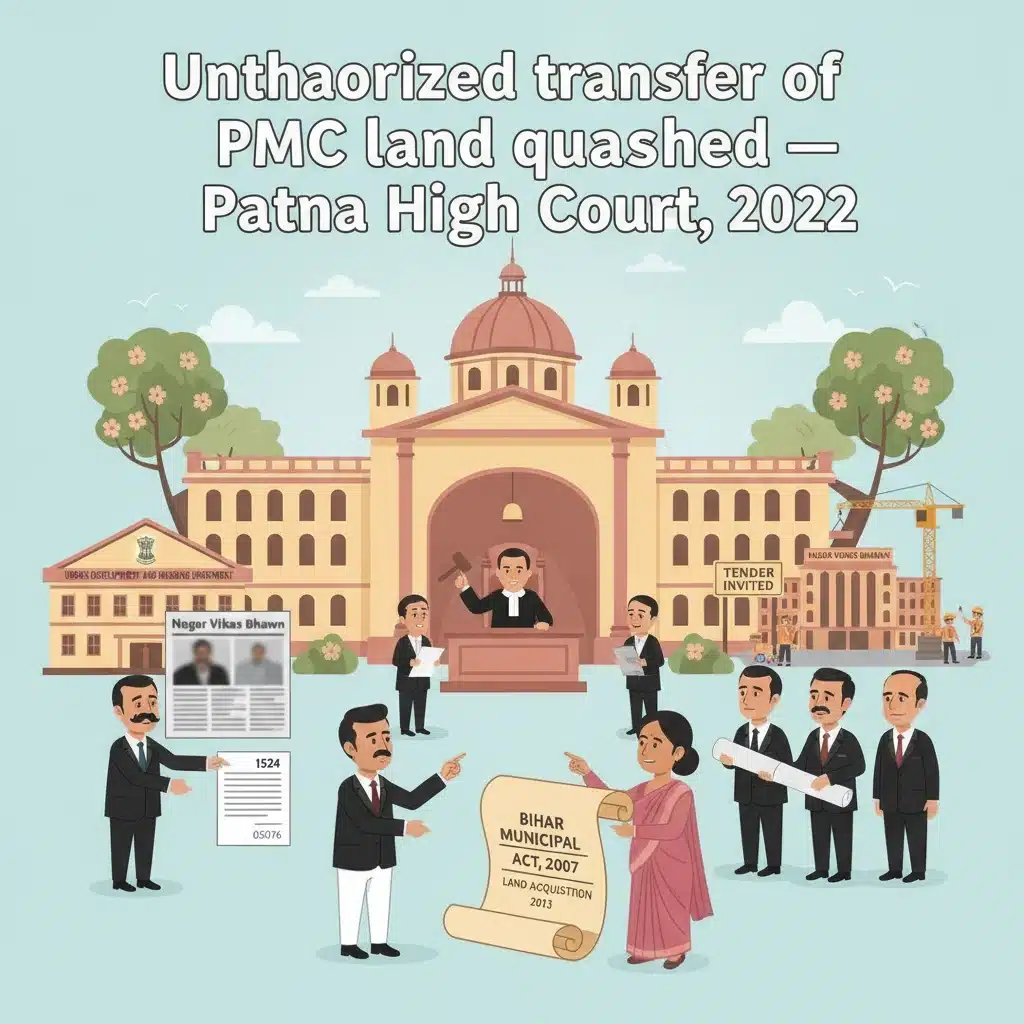
Case Background
The case arose from a proposal of the Urban Development and Housing Department, Government of Bihar, to construct a large office complex called “Nagar Vikas Bhawan” in Patna.
The Department wanted a building on the lines of Sardar Patel Bhawan, which presently houses the State Police Headquarters. Because its various directorates and missions were scattered across different buildings, the Department looked for a single campus to bring all its wings under one roof.
On 31.03.2021, the Deputy Secretary, Urban Development and Housing Department issued Letter No. 1524 to Patna Municipal Corporation (PMC). He asked the Municipal Commissioner to submit details of a 3.5 acre plot of PMC land near A.N. College, Patna, and to report how much of it was vacant and suitable for the proposed construction.
In response, on 01.04.2021, the Municipal Commissioner, PMC, wrote back to the Principal Secretary, Urban Development and Housing Department. He stated that out of the total 3.35 acre land, 1.5 acre was vacant and “may be used” for construction of Nagar Vikas Bhawan.
This letter was sent without placing the matter before the Empowered Standing Committee of PMC and without its consent, even though the petitioners were members of that committee.
The councillors came to know of the proposed use of PMC land through newspaper reports. The issue was discussed in the 49th General Meeting of the Empowered Standing Committee on 05.06.2021, where members unanimously resolved that land belonging to PMC cannot be acquired without its consent and without either compensation or alternative land of equal value, in accordance with the Bihar Municipal Act, 2007 and the Land Acquisition Act, 2013.
Feeling aggrieved by what they saw as a unilateral and illegal act of the Municipal Commissioner, the petitioners filed Civil Writ Jurisdiction Case No. 13077 of 2021 before the Patna High Court on 23.07.2021. They challenged the permission letter dated 01.04.2021 (Annexure-2).
While the writ petition was pending, Bihar State Building Construction Corporation Limited, a Government of Bihar undertaking, issued Memo No. 34 dated 05.01.2022 publishing a tender for construction of Nagar Vikas Bhawan on the PMC land near A.N. College. This tender was brought on record through a supplementary affidavit and was also challenged.
What the Court Examined and Decided
The Patna High Court examined whether the Municipal Commissioner could, on his own, offer PMC land for construction of Nagar Vikas Bhawan without approval of the Empowered Standing Committee and without following the procedure under the Bihar Municipal Act, 2007.
On behalf of the petitioners, it was argued that under Section 22 of the Bihar Municipal Act, 2007, the executive power of a municipality is to be exercised by the Empowered Standing Committee.
It was further pointed out that under Section 2(21), the Municipal Commissioner is the Chief Municipal Officer of a Municipal Corporation. Section 27-B makes the Chief Municipal Officer the Principal Executive Officer, but clearly states that his executive functions are subject to the “supervision and control” of the Empowered Standing Committee.
Counsel for the petitioners emphasised that the Municipal Commissioner’s job is to carry out the decisions of the Empowered Standing Committee, not to bypass it. By unilaterally offering 1.5 acre of PMC land for the State’s project, he violated his statutory duties.
The petitioners also relied on Section 104 of the Bihar Municipal Act, which lays down how municipal property can be disposed of. Under Clause (a), the Empowered Standing Committee may sell, transfer or otherwise dispose of immovable property belonging to the municipality, but only with prior approval of the State Government and by following the procedure prescribed under the Rules.
Section 104 makes it clear that disposal or transfer of municipal property is a power of the Empowered Standing Committee, not of the Municipal Commissioner acting alone.
The petitioners further drew attention to Section 102 of the Act, which deals with compulsory acquisition of land for public purpose at the request of the municipality. Under this provision, when land is acquired at the request of a municipality, the municipality must bear the cost. The petitioners argued that, by corollary, if the State wants to acquire land vested in a municipal corporation for a public purpose, it must compensate the corporation by paying cost and charges.
They also contended that there is no concept of “ex-post facto approval” in the Bihar Municipal Act, 2007. Hence, an initially illegal act by the Municipal Commissioner cannot be cured later by seeking after-the-event approval from the Empowered Standing Committee.
On the other hand, respondents no. 2 and 3 (the Department authorities) stated in their counter affidavit that Nagar Vikas Bhawan was to house several wings such as RERA, RERT, PMRA, MBT, Namami Gange, DDAY, NULM, etc., under one roof, and that the project was in larger public interest and for public convenience.
They explained that, after learning that approval of the PMC Board had not been obtained on the Municipal Commissioner’s letter, the Department wrote to the Municipal Commissioner on 24.01.2022 to obtain approval of the PMC Board for construction on the vacant land and to send a report. A reminder was sent on 17.03.2022.
They also stated that the Chief General Manager of Bihar State Building Construction Corporation Limited was informed by departmental letter dated 17.03.2022 not to issue any work order for construction until the approval of the PMC Board was obtained.
It was further clarified that there was no proposal to pay compensation to PMC for the land because Nagar Vikas Bhawan was a combined office for various directorates set up in larger public interest to bring all wings under the administrative control of the Urban Development and Housing Department into one building.
On behalf of the State, learned counsel submitted before the Court that construction would proceed only after the Empowered Standing Committee of PMC granted approval. If the Committee did not agree, the building would not be constructed on that land. Any conditions imposed by the Committee would be considered by the State and an appropriate decision taken.
Respondent no. 4 (PMC) also filed a counter affidavit. It was stated that the Joint Director of the Department, by letter dated 24.01.2022, requested the Municipal Commissioner to place the matter before the Board of PMC for ex-post facto approval for construction of Nagar Vikas Bhawan. On this request, the Municipal Commissioner directed on 19.02.2022 that the matter be placed in the next meeting of the Empowered Standing Committee. However, only one special meeting was held on 25.03.2022, limited to discussion of the PMC budget.
Counsel for PMC argued that the impugned letter dated 01.04.2021 should be seen merely as an information letter regarding availability of 1.5 acre vacant land, not as an approval for construction. Since the issue of ex-post facto approval was already before the Empowered Standing Committee, it was submitted that there was no need to quash the letter.
In reply, petitioners’ counsel maintained that the Act does not provide any scheme for ex-post facto approval. The proposal ought first to have been placed before the Empowered Standing Committee, and only after its approval could the land have been offered or tenders floated.
After hearing all parties, the Patna High Court analysed the statutory scheme of the Bihar Municipal Act, 2007. The Court noted that there was no dispute on the factual point that the Municipal Commissioner issued the impugned letter dated 01.04.2021 without any approval from the Empowered Standing Committee.
The Court held that under Section 22, the executive power of the municipality is vested in the Empowered Standing Committee, and under Section 27-B, the Chief Municipal Officer (Municipal Commissioner) acts under its supervision and control and must carry into effect its resolutions.
From Section 104, the Court concluded that any disposal or transfer of property belonging to the municipality must be done by the Empowered Standing Committee, with prior State approval and prescribed procedure.
The Court also noted that none of the respondents disputed the legal position that land belonging to PMC cannot be acquired by the State without the consent of the Empowered Standing Committee, and that such consent was admittedly not taken before the impugned letter.
To reinforce the principle that legal procedures must be followed strictly, the Court referred to the rule from Taylor v. Taylor (1875) LR 1 Ch D 426, approved in Nazir Ahmed v. King Emperor, AIR 1936 PC 253 (2), that where a power is given to do a certain thing in a certain way, it must be done in that way or not at all.
The Court also cited the Supreme Court in Chandra Kishore Jha v. Mahavir Prasad and Others, (1999) 8 SCC 266, and in State v. Sanjeev Nanda, AIR 2012 SC 3104, where the same rule was reiterated.
Applying this settled principle, the Court held that the Municipal Commissioner’s act of writing to the Department about availability of 1.5 acre land for construction, without approval of the Empowered Standing Committee, was an arbitrary, unjust and illegal exercise of power.
The Court further held that the tender notice dated 05.01.2022 issued by Bihar State Building Construction Corporation Limited for construction of Nagar Vikas Bhawan on PMC land was also “apparently illegal” in the eyes of law because it flowed from that initial illegal step.
The Court agreed with the petitioners that mere ex-post facto approval could not cure the inherent lack of competence in the Municipal Commissioner’s action. Since he did not have the power to permit use of PMC land on his own, his act could not be validated later by after-the-event approval.
Accordingly, the Patna High Court set aside Letter No. 05076 dated 01.04.2021 issued by the Municipal Commissioner, PMC, as well as Memo No. 34 dated 05.01.2022 inviting tenders for construction of Nagar Vikas Bhawan on the PMC land.
The writ petition was allowed. However, the Court clarified that it remains open to the respondent-State to take fresh steps, in accordance with law, with regard to the vacant land of PMC for construction of Nagar Vikas Bhawan.
Why This Judgment Matters
This judgment is important for councillors, municipal officers and citizens across Bihar.
First, it clearly holds that municipal land cannot be offered for State projects by the Municipal Commissioner alone. The Empowered Standing Committee must first approve, and the procedure under the Bihar Municipal Act, 2007 must be followed.
Second, it shows that even projects claimed to be in “public interest” must respect local self-government laws. Convenience of a department cannot override legal safeguards for municipal property.
Third, the Patna High Court makes it clear that illegal administrative acts cannot be “fixed” later by ex-post facto approval. If an officer acts without power, his action is void and must be struck down.
For ordinary residents and local representatives, this means that decisions regarding municipal land, markets, buildings or parks must go through the proper elected bodies. If those processes are ignored, affected persons can approach the Court.
Legal Issues and Answers
- Issue: Could the Municipal Commissioner of Patna Municipal Corporation lawfully offer 1.5 acre of PMC land for construction of Nagar Vikas Bhawan without prior approval of the Empowered Standing Committee?
Answer: No. The Court held that the executive power of the municipality rests with the Empowered Standing Committee and that disposal or transfer of municipal property must follow Section 104. The Commissioner’s unilateral letter was arbitrary, unjust and illegal. - Issue: Was the tender dated 05.01.2022 for construction of Nagar Vikas Bhawan on PMC land valid when issued on the basis of the Commissioner’s unilateral letter?
Answer: No. Since the foundational letter was illegal and issued without competence, the tender based on it was also illegal and was quashed. - Issue: Could later “ex-post facto” approval by the Empowered Standing Committee validate the Municipal Commissioner’s earlier unauthorized act?
Answer: No. The Court held that when a statute prescribes a particular manner of doing an act, it must be done in that manner alone. Ex-post facto approval could not cure the inherent lack of competence.
Cases Cited by the Court
- Taylor v. Taylor, (1875) LR 1 Ch D 426
- Nazir Ahmed v. King Emperor, AIR 1936 PC 253 (2)
- Chandra Kishore Jha v. Mahavir Prasad and Others, (1999) 8 SCC 266
- State v. Sanjeev Nanda, AIR 2012 SC 3104
Case Details
Case Number: Civil Writ Jurisdiction Case No. 13077 of 2021
Case Title: Manoj Kumar & Anr. v. The State of Bihar & Ors.
Citation: 2022 (4) PLJR 778
Court: High Court of Judicature at Patna
Coram: Hon’ble Mr. Justice Ashwani Kumar Singh and Hon’ble Mr. Justice Dr. Anshuman
Date of Judgment: 24.06.2022
Advocates:
- For the Petitioners: Ms. Mayuri, Advocate
- For the State/Respondent Authorities: Mr. Abbas Haider (SC-6)
- For Patna Municipal Corporation: Mr. Prasoon Sinha, Advocate
Nature of the Case: Writ petition under civil writ jurisdiction challenging permission for use of municipal land and related tender for construction.
Link to Judgment (Official): Patna High Court Judgment
If you found this explanation helpful and wish to stay informed about how legal developments may affect your rights in Bihar, you may consider following Samvida Law Associates for more updates.




