

Case Background
The dispute arose from a sand mining settlement in Patna district. On 16.09.2015, the petitioner company entered into a written agreement with the State under the Bihar Minor Mineral Concession Rules, 1972.
Under this agreement, the company received rights to mine sand for five calendar years, from 2015 to 2019. The settlement amount was fixed in advance and increased every year by 20% over the previous year.
The agreement recorded the following settlement amounts:
For 2015: Rs. 41,15,41,390/-
For 2016: 120% of 2015, i.e. Rs. 49,38,49,668/-
For 2017: 120% of 2016, i.e. Rs. 59,26,19,602/-
For 2018: 120% of 2017, i.e. Rs. 71,11,43,522/-
For 2019: 120% of 2018, i.e. Rs. 85,33,72,226/-
Importantly, the agreement did not give the company any automatic right to renewal or extension of the lease beyond 2019.
Separately, Rule 34 of the 1972 Rules allowed a lessee to seek renewal of a mining lease by making an application. The company did not avail this route. No renewal application was filed under the Rules.
Meanwhile, sand mining issues relating to the area were pending before the Supreme Court and also before the National Green Tribunal. Because of these pending proceedings, the State could not conduct fresh auctions or grant new mining leases for sand ghats.
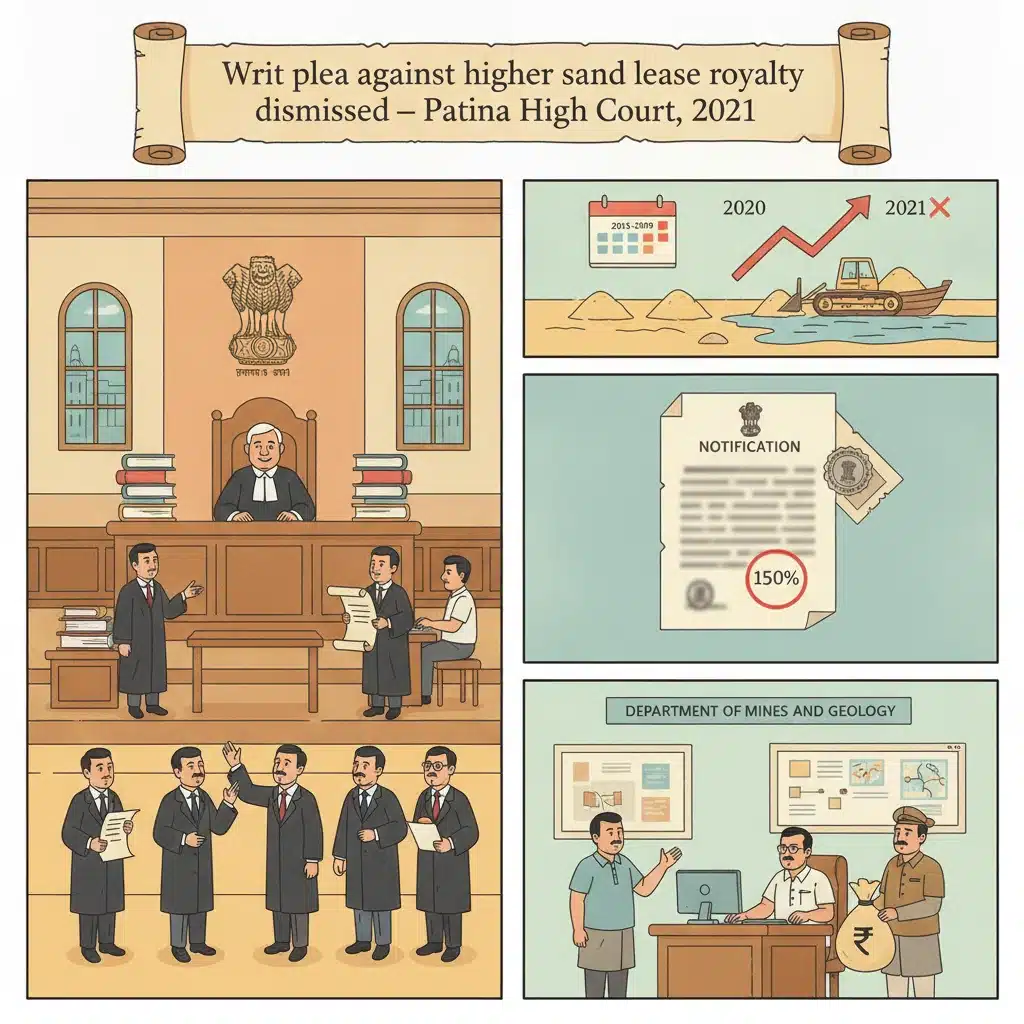
To avoid a complete halt of sand mining, the State Government decided to allow existing lessees to continue operations for a further period, by way of extension, on revised terms and conditions. This was done through government notification and communication dated 27.12.2019, referred to as Annexures 8 and 9 in the judgment.
Under this policy decision, the State extended the existing settlements up to 31.10.2020 or until new environmentally cleared leases could be granted, whichever was earlier. However, the settlement amount for the extended period was fixed at 150% of the 2019 amount, instead of the earlier pattern of 120%.
The company accepted this extension, continued to mine sand, and paid royalty at the enhanced 150% rate for the extended periods from 01.01.2020 to 31.10.2020 and from 01.11.2020 to 31.12.2020.
Only later, on 30.01.2021, after enjoying the benefits of continued mining under the extension, the company approached the Patna High Court by filing a writ petition under its civil writ jurisdiction.
What the Court Examined and Decided
The Patna High Court, speaking through the Chief Justice, framed the central question in simple terms: did the conduct of the petitioner disentitle it from claiming that the State’s decision to extend the mining lease on a higher rate was unconscionable, illegal, arbitrary, or unreasonable?
The company’s prayer before the Court was wide. It sought a direction to the State to levy and charge royalty for the extended period strictly according to the sand policy 2013, the tender document for 2015–2019, and the original settlement agreement. It also sought a refund of the alleged “excess” royalty paid during the extended period.
The company wanted the Court to declare that the extensions from 01.01.2020 to 31.10.2020 and from 01.11.2020 to 31.12.2020 were mere extensions of the earlier settlement on the same terms. According to the company, it was liable to pay royalty at only 120% of the 2019 rate, and charging 150% was illegal and amounted to altering the contract terms.
Further, the company asked the Court to interpret State memos bearing numbers 4948 and 4949 dated 27.12.2019 as only extending the existing lease, without any power to change royalty calculation.
On the other hand, the State relied on its policy decision under Annexure 8, which had been taken in the backdrop of constraints due to pending Supreme Court and National Green Tribunal proceedings. The State emphasised that the extension and higher rate were a specific policy measure allowed under the 2019 mining rules.
The Court first looked at the contract position. The original agreement of 16.09.2015 did not contain any clause giving the petitioner a right to extension or renewal. Any renewal could have been sought only under Rule 34 of the 1972 Rules, which the petitioner never invoked.
Therefore, the petitioner had no contractual or statutory right to insist on extension at the old pattern of royalty. Its right to continue operations after 31.12.2019 flowed only from the State’s later decision dated 27.12.2019, not from the original agreement or the old Rules.
The Court then examined Rule 77(2) of the Bihar Minerals (Concession, Prevention of Illegal Mining, Transportation & Storage) Rules, 2019. This provision, reproduced in the judgment, empowers the State Government, in public interest, to grant a mining lease or settlement and to authorise permits “on terms and conditions other than those prescribed in these rules,” for reasons to be recorded in writing.
Relying on this provision, the Court held that the State was legally permitted to depart from the usual rule-based conditions and design a special scheme, as long as reasons were recorded. In this case, the special scheme was limited extension of existing settlements, with royalty fixed at 150% of the 2019 settlement amount.
The Court noted that the State faced a peculiar situation. Because of ongoing proceedings before the Supreme Court and the National Green Tribunal, fresh auctions under the rules could not be held. To avoid complete stoppage of sand mining, the State extended the existing settlements with revised financial terms. In the Court’s view, this was a reasonable policy response.
The Court specifically compared the earlier contractual position and the new policy terms. Under the original lease, the lessee had to pay 120% of the previous calendar year’s amount. Under the extension policy, the rate was increased to 150%. The Court held that this extra 30% could not be described as grossly disproportionate or excessively high.
The petitioner relied on Supreme Court judgments on distinction between “extension” and “renewal”, particularly Provash Chandra Dalui v. Bisawanath Banerjee and State of Gujarat v. Nirmalaben S. Mehta. Those cases explain that an “extension” generally means continuation of the same lease on existing terms, whereas a “renewal” usually requires a fresh lease.
However, the Patna High Court found these precedents inapplicable in the petitioner’s favour. Here, the continued right to mine did not arise from a contractual extension clause but from a separate statutory policy under Rule 77(2) of the 2019 Rules. The State was not mechanically extending the old lease; it was granting a fresh benefit in public interest on new terms.
The company also argued that the State had acted in an unconscionable manner, amounting to unjust enrichment and misuse of its dominant position. For this, it relied on the leading Supreme Court judgment in Central Inland Water Transport Corporation Limited v. Brojo Nath Ganguly, which deals with unconscionable contracts contrary to public policy.
The High Court carefully reproduced and considered the tests laid down in Brojo Nath Ganguly, including what constitutes an “unconscionable bargain” and when courts can declare contractual terms void as opposed to merely voidable.
Applying those principles, the Court concluded that the petitioner’s case did not meet the high threshold laid down in Brojo Nath Ganguly. The policy in question did not shock the conscience of the Court. It was not a case of exploitation of a poor or ignorant party. There was no material to show that the State used its position to impose terms so unfair and unreasonable as to be opposed to public policy.
Crucially, the Court focused on the petitioner’s conduct. The company had full knowledge of the State’s policy decision and the 150% rate. It chose to accept the extended grant, continued mining operations, and paid royalty accordingly. It never objected at the time.
Only after enjoying the benefit of continued mining for the extended period did the company come to the Court, seeking reduction of royalty and refund. The Court described this as an “afterthought” and “nothing short of dishonesty”.
To support this view, the Court relied on Section 8 of the Indian Contract Act, 1872, which says that acceptance of the conditions of a proposal, or receiving consideration offered with a proposal, amounts to acceptance of that proposal.
The Court also cited Bharat Petroleum Corporation Ltd. v. Great Eastern Shipping Co. Ltd., where the Supreme Court recognised that acceptance can be inferred from conduct, not only from express words. Silence combined with positive action may amount to acceptance of contractual terms.
Further, the Court referred to M.P. Mittal v. State of Haryana, where the Supreme Court held that High Courts can refuse writ relief when a petitioner seeks to use writ jurisdiction to secure a dishonest advantage or perpetuate unjust gain.
Applying these principles, the Patna High Court held that the petitioner, by its conduct, had clearly accepted the State’s offer under Annexure 8. It was therefore bound by those terms and could not turn around later to challenge the same policy after having taken full benefit.
The Court also rejected the argument that the policy was against public interest because it would allegedly increase retail sand prices. No retailer had complained. The decision was a policy measure of the State, and on the material before the Court, it could not be labelled arbitrary, capricious, illegal, or unreasonable.
In the end, the Court held that the State’s decision dated 27.12.2019 (Annexure 8) and its communication of the same date (Annexure 9) were valid. The petitioner’s delay and conduct barred it from relief. No interference was warranted with the royalty rate of 150% for the extended period.
The writ petition was therefore dismissed. Any interlocutory applications also stood dismissed.
Why This Judgment Matters
This judgment is important for all mining leaseholders and contractors dealing with the State of Bihar, especially in sand mining.
First, it makes clear that if a company or contractor willingly accepts revised terms from the Government, continues work, and enjoys the benefits, it cannot later challenge those same terms as unfair just to claim a refund.
Second, the Patna High Court has confirmed that under Rule 77(2) of the 2019 mining rules, the State can, in public interest, grant leases or extensions on terms that are different from the normal rule-based pattern, provided reasons are recorded. This gives legal backing to special policy measures during difficult situations like pending environmental cases.
Third, the decision sends a message that courts will look closely at the conduct of the party seeking relief. If the approach appears opportunistic, courts may refuse to use their writ powers, even when legal arguments are raised.
For other sand ghat settlers and mining operators, the case acts as a caution: once you accept a government policy and act upon it, it becomes very difficult to challenge it later purely on the ground of financial burden.
Legal Issues and Answers
- Issue: Can a sand mining lessee, after accepting an extension of settlement on enhanced royalty, later challenge the increased rate as unconscionable, illegal, arbitrary, or unreasonable and seek refund?
Answer: No. The Patna High Court held that the petitioner, having accepted and acted upon the State’s policy decision under Rule 77(2) and paid royalty at 150%, was bound by those terms and could not, after reaping benefits, seek to challenge them or demand refund. - Issue: Was the State Government’s decision under Annexure 8, fixing royalty at 150% of the 2019 rate for the extended period, beyond its powers or against public policy?
Answer: No. The Court held that Rule 77(2) of the 2019 Rules expressly empowered the State to grant leases or settlements on terms different from the rules, in public interest, and the 30% enhancement could not be termed grossly disproportionate or opposed to public policy. - Issue: Did the case satisfy the test of an unconscionable bargain under the Supreme Court’s ruling in Central Inland Water Transport Corporation Limited v. Brojo Nath Ganguly?
Answer: No. The Court found nothing to suggest that the State’s policy was so unfair or unreasonable as to shock the conscience of the Court, or that it resulted from a dominant position being abused. Hence, the petitioner’s reliance on Brojo Nath Ganguly failed.
Cases Cited by the Court
- Provash Chandra Dalui v. Bisawanath Banerjee, 1989 Supp (1) SCC 487
- State of Gujarat & Ors. v. Nirmalaben S. Mehta and Ors., (2016) 9 SCC 240
- Bharat Petroleum Corpn. Ltd. v. Great Eastern Shipping Co. Ltd., (2008) 1 SCC 503
- M.P. Mittal v. State of Haryana & Ors., (1984) 4 SCC 371
- Central Inland Water Transport Corporation Limited v. Brojo Nath Ganguly & Ors., (1986) 3 SCC 156
- Kedar Nath Motani v. Prahlad Rai, AIR 1960 SC 213 : (1960) 1 SCR 861 (quoted within Brojo Nath Ganguly)
- A. Schroeder Music Publishing Co. Ltd. v. Macaulay, (1974) 1 WLR 1308 (referred within Brojo Nath Ganguly)
Case Details
Case Number: Civil Writ Jurisdiction Case No. 3337 of 2021
Case Title: Broad Son Commodities Private Limited v. The State of Bihar & Ors.
Citation: 2022 (4) PLJR 113
Court: High Court of Judicature at Patna
Date of Judgment: 14.12.2021
Coram: Hon’ble the Chief Justice Sanjay Karol; Hon’ble Mr. Justice S. Kumar
Advocates:
- For the petitioner: Mr. Suraj Samdarshi, Advocate
- For the respondents (State of Bihar): Mr. Sunil Kumar Mandal, SC-3; Mr. Ravi Ranjan Kumar Singh, AC to SC-3
Nature of the Case: Writ petition under civil writ jurisdiction challenging State Government policy decision on extension of sand mining settlement and enhanced royalty, with prayer for refund of alleged excess royalty.
Link to Judgment: Click here to access the full Patna High Court judgment
If you found this explanation helpful and wish to stay informed about how legal developments may affect your rights in Bihar, you may consider following Samvida Law Associates for more updates.




