

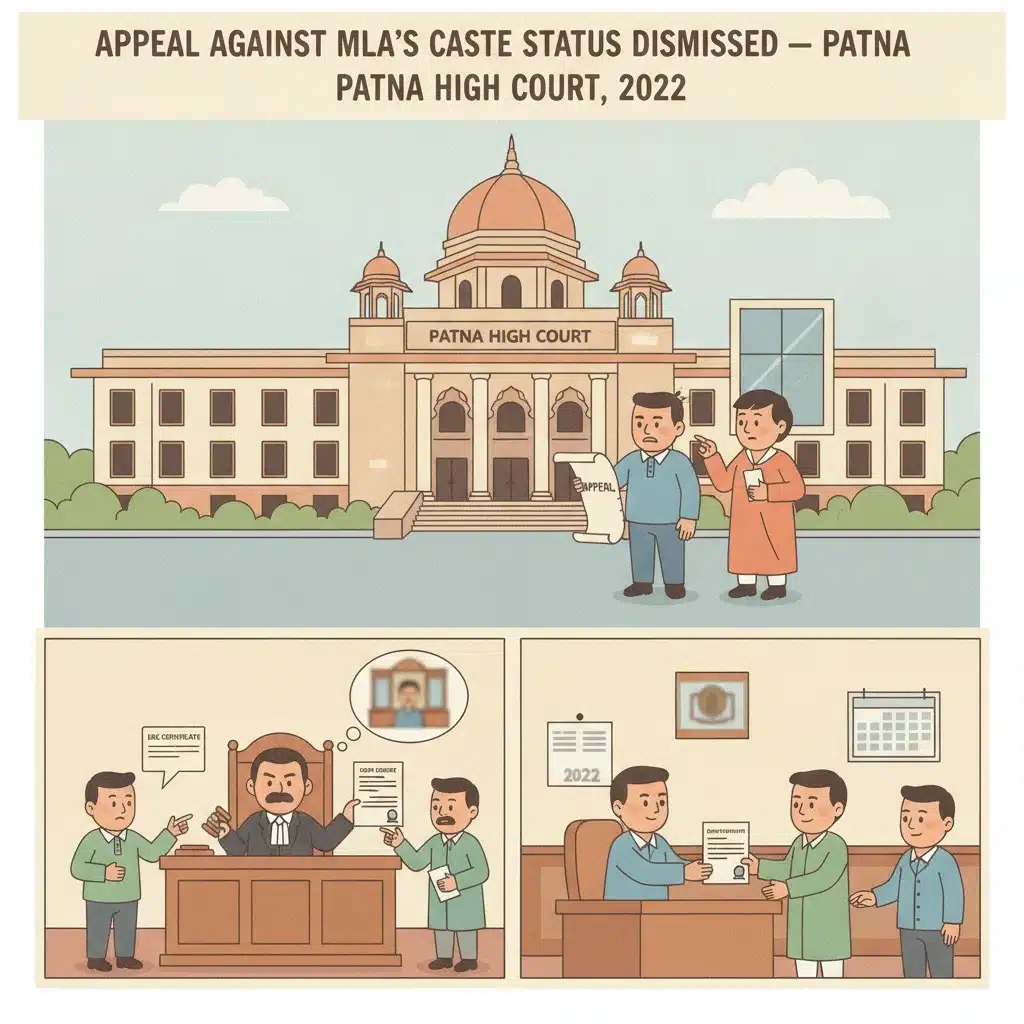
Case Background
The case arose from an election to the Bihar Legislative Assembly from a reserved constituency, 72 Singheshwar (Reserved), in Madhepura district. This constituency is reserved for candidates belonging to the Scheduled Castes.
The appellants are voters of this constituency. They challenged the election of the returned candidate, arrayed as respondent no. 11, who had been declared elected as a Member of the Legislative Assembly (M.L.A.) from this reserved seat.
The voters’ core allegation was that respondent no. 11 was not actually a member of any Scheduled Caste, and therefore was not qualified to contest from a constituency reserved for Scheduled Caste candidates.
Respondent no. 11’s eligibility to contest was based on a caste certificate issued by the concerned District Magistrate. This certificate described him as belonging to “Chaupal” caste, which is included in the State list of Scheduled Castes.
Believing that this certificate was wrongly issued and that the candidate did not genuinely belong to a Scheduled Caste, the voters first approached the High Court by filing Civil Writ Jurisdiction Case No. 2298 of 2021. They sought a writ of quo warranto against respondent no. 11 and also challenged the validity of the caste certificate issued by the District Magistrate in his favour.
The learned Single Judge rejected their writ petition. The Single Judge held that since the caste certificate issued by the Collector/District Magistrate had not been cancelled or nullified by any competent authority, a writ of quo warranto to unseat the elected MLA was not maintainable. However, the Single Judge reserved liberty for the voters to approach the competent authority for cancellation of the caste certificate.
Aggrieved by the dismissal of their writ petition, the voters preferred Letters Patent Appeal No. 82 of 2022 before the Patna High Court.
What the Court Examined and Decided
The Division Bench of the Patna High Court, comprising Hon’ble Mr. Justice Ashutosh Kumar and Hon’ble Mr. Justice Nawneet Kumar Pandey, heard the Letters Patent Appeal. The judgment was delivered orally by Hon’ble Mr. Justice Ashutosh Kumar on 14-11-2022.
The appellants, through their senior counsel, argued that respondent no. 11 had no legal right to occupy the reserved MLA seat because he did not truly belong to a Scheduled Caste. They claimed that his candidature and subsequent election from a Scheduled Caste reserved constituency were based entirely on an invalid caste certificate.
The appellants’ counsel submitted that respondent no. 11 had earlier contested Panchayat elections as an Extremely Backward Class (E.B.C.) candidate. From this, counsel attempted to show that respondent no. 11’s actual social category was E.B.C., not Scheduled Caste. According to them, this history suggested that respondent no. 11 had later obtained a Scheduled Caste certificate in collusion with authorities only to contest the Assembly election from the reserved seat.
The voters argued that the caste certificate issued by the Collector was void ab initio. Their contention was that the State Government, or its officers, had no power to add or alter any caste in the list of Scheduled Castes. Under Article 341 of the Constitution of India, the list of Scheduled Castes is maintained by the Union of India. Therefore, if the State or its officer had acted beyond jurisdiction in recognising “Chaupal” caste or in issuing the impugned certificate, the certificate itself, they argued, was without legal authority.
From this reasoning, the appellants urged the Court to treat the certificate as a nullity from the very beginning, requiring no formal cancellation. They said that the disqualification attached to respondent no. 11 operated proprio vigore, meaning automatically, since he was never actually a member of a Scheduled Caste. Consequently, they asked the Court to issue a writ of quo warranto to unseat him from the reserved constituency.
The Division Bench gave anxious consideration to these arguments. The key question before it was not directly whether respondent no. 11 truly belonged to a Scheduled Caste, but whether the High Court could, in a quo warranto proceeding, unseat him while his caste certificate continued to exist on the record as valid.
The Court noted that even if, for the sake of argument, it assumed (without admitting) that the certificate issued by the Collector was legally bad, the crucial fact remained that it had not yet been cancelled by any competent authority. No proceeding had so far determined that the certificate was obtained on a false declaration or that it had been wrongly issued.
The Court carefully examined the reliefs sought in the original writ petition. That petition had asked for two main reliefs: first, the quashing of the caste certificate issued by the Collector in favour of respondent no. 11; and second, issuance of a writ of quo warranto declaring that a person not belonging to a Scheduled Caste could not have contested and been declared elected from a Scheduled Caste reserved seat.
The Bench observed that the first relief required the Court to decide on the correctness and validity of the caste certificate itself. This is a substantive factual and legal issue, which is different in character from the limited and specific inquiry under a writ of quo warranto.
The Court relied on the principle that a writ of quo warranto cannot be issued in collateral proceedings. In simpler terms, the Court cannot, within a quo warranto case, carry out a prior and independent investigation into the validity of a document that forms the basis of a person’s claim to office. Instead, the document—here, the caste certificate—must first be held to be bad in a proper, direct proceeding before a competent authority or court.
To support this position, the Division Bench referred to the Supreme Court decision in Bharati Reddy vs. State of Karnataka and Others; 2018 (6) SCC 162. That decision clarified that for a quo warranto petition, the Court examines whether a person is holding a public office contrary to the statutory provisions, but it does not serve as a forum to test disputed facts and collateral issues.
Applying this principle, the Patna High Court held that as long as the Scheduled Caste certificate issued by the District Magistrate in favour of respondent no. 11 remained in force and had not been nullified or cancelled, the appellants could not succeed in having his election declared invalid through a writ of quo warranto.
The Court affirmed the reasoning of the learned Single Judge: it was not enough for the appellants to allege that the certificate was illegal or void ab initio. Unless and until some competent authority or appropriate proceeding first declared that the certificate was wrongly issued or obtained by misrepresentation, the Court could not treat the certificate as non-existent.
Because the foundation of the appellant voters’ challenge was the alleged invalidity of the caste certificate, and that foundation had not yet been removed, the Court found no ground to interfere with the election of respondent no. 11 by way of quo warranto.
Finally, the Division Bench noted that the Single Judge had already preserved the right of the appellants to approach the competent authority for cancellation of the caste certificate. This avenue remained open. If that authority, upon proper inquiry, were to cancel the certificate, a different legal position could arise in future. For the present case, however, the Court concluded that there was no legal basis to disturb the election.
On these reasons, the Letters Patent Appeal was dismissed, and the judgment of the Single Judge was upheld.
Why This Judgment Matters
This judgment is important for voters and activists who wish to challenge the election of representatives in reserved constituencies on the ground of false caste claims.
The Patna High Court has made it clear that as long as a caste certificate issued by the competent authority remains in force, courts will not use a writ of quo warranto to unseat the elected person based only on allegations that the certificate is wrong or illegal.
Before asking the High Court to remove an elected representative from a reserved seat, affected voters must first take steps to cancel or nullify the caste certificate through the proper administrative or legal process. Only after that foundation is removed can a quo warranto petition be appropriately considered.
This ruling protects the certainty of election results while still leaving room for genuine complaints to be taken up before the right authority.
Legal Issues and Answers
- Issue: Can voters seek a writ of quo warranto to unseat an elected MLA from a Scheduled Caste reserved constituency when his Scheduled Caste certificate has not yet been cancelled by any authority?
Answer: No. The Patna High Court held that as long as the caste certificate issued by the District Magistrate stands and has not been nullified or cancelled, a writ of quo warranto is not maintainable to challenge the MLA’s election. - Issue: Can the High Court, in a quo warranto proceeding, simultaneously decide on the correctness of a caste certificate which forms the basis of eligibility?
Answer: No. The Court held that the validity of the caste certificate is a separate and distinct issue. A writ of quo warranto cannot be used in a collateral manner to first test the certificate’s validity; that must be done in appropriate proceedings before the competent authority.
Cases Cited by the Court
- Bharati Reddy vs. State of Karnataka and Others; 2018 (6) SCC 162.
Case Details
Case Number: Letters Patent Appeal No. 82 of 2022 in Civil Writ Jurisdiction Case No. 2298 of 2021
Case Title: Mahendra Rishideo & Others vs. The Union of India & Others
Citation: 2022(4) PLJR 848
Court: High Court of Judicature at Patna
Coram: Hon’ble Mr. Justice Ashutosh Kumar and Hon’ble Mr. Justice Nawneet Kumar Pandey
Date of Judgment: 14-11-2022
Advocates:
- For the appellants: Mr. P.K. Shahi, Senior Advocate
- For the Election Commission of India: Mr. Siddhartha Prasad, Advocate; Mr. Sonit Kumar, Advocate
- For the Union of India: Mr. Ravindra Kumar Sharma, Advocate; Mr. Lokesh, Advocate
Nature of the Case: Letters Patent Appeal against dismissal of writ petition seeking writ of quo warranto and quashing of caste certificate.
Link to the Judgment: Read full judgment on Patna High Court website
If you found this explanation helpful and wish to stay informed about
how legal developments may affect your rights in Bihar,
you may consider following Samvida Law Associates for more updates.




