

Case Background
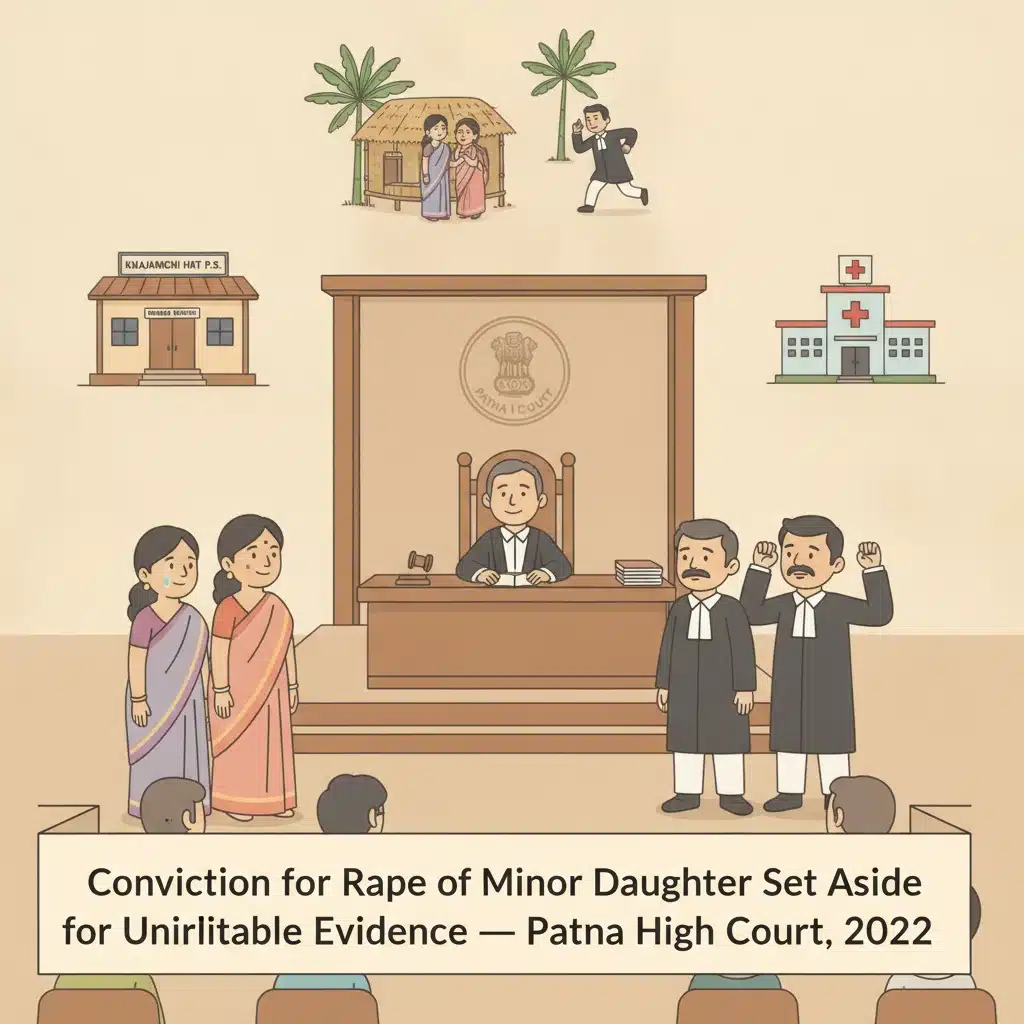
This case arose from an incident alleged to have taken place on 01.07.2006 in village Chandpur Bhangha, under Banmankhi/Jankinagar police station in Purnea district.
The prosecution case was that a minor girl, referred to in the judgment as “Ms. N” (P.W.1), then about 13 years old, was living with her parents. Around 12 noon on 01.07.2006, her father, referred to as “S” in the judgment (the appellant/accused), allegedly enticed her from the house to their agricultural field, about two kilometres away.
According to the police report, he took her inside a bamboo hut and forcibly had sexual intercourse with her. She allegedly felt severe pain and started bleeding from the vagina. On her cries, two women from the village — the daughter‑in‑law and granddaughter (Anjana Kumari) of one Radhe Yadav — supposedly came to the spot, raised alarm, and villagers gathered. The accused allegedly fled through nearby banana fields.
The women then took Ms. N home. Her grandfather arrived and later took her to her parental house. Her mother (P.W.3, referred to as “Mrs. J”) was not present at that time. When Mrs. J returned, the girl narrated the incident to her.
The prosecution further claimed that because the accused had “good relations” with the local Jankinagar police outpost, Mrs. J chose to take Ms. N the next day, 02.07.2006, to Khajanchi Hat (K. Hat) Police Station at Purnea instead. There, Sub‑Inspector B. Bhushan recorded the First Information Report (FIR) in Ms. N’s name. The FIR was forwarded to Jankinagar outpost under Police Station Banmankhi, where Banmankhi P.S. Case No.149 of 2006 under Section 376 of the Indian Penal Code (IPC) was registered on 03.07.2006.
On 03.07.2006 itself, Ms. N was sent for medical examination and ossification test at Sadar Hospital, Purnea, where Dr. Sushila Das (P.W.7) examined her. After investigation, the police filed charge‑sheet for rape under Section 376 IPC.
The Additional Sessions Judge‑V, Purnea, tried the case as Sessions Case No.557 of 2009. After framing charge, the accused pleaded not guilty and faced trial. The prosecution examined nine witnesses including the girl, her family members, villagers, the doctor and the investigating officers. On 21.03.2017 and 22.03.2017, the trial court convicted the father under Section 376 IPC and sentenced him to 10 years’ rigorous imprisonment.
Aggrieved, the father filed Criminal Appeal (SJ) No.1297 of 2017 before the Patna High Court, challenging the conviction and sentence.
What the Court Examined and Decided
The appeal was heard by Hon’ble Mr. Justice A. M. Badar. The main question was whether the conviction for rape could stand on the evidence produced.
Counsel for the appellant argued that the evidence of the prosecution witnesses was inconsistent and full of gaps. He submitted that Ms. N had been tutored by her mother, Mrs. J, who had serious disputes with her husband and in‑laws. He also contended that the medical evidence did not support the allegation of forcible sexual intercourse and that the appellant was entitled to benefit of doubt.
The Additional Public Prosecutor opposed the appeal, submitting that this was a case of rape of a minor girl by her own father and that the evidence of the prosecutrix and her mother should be trusted, ignoring minor discrepancies.
The Court began by acknowledging the gravity of an allegation that a father raped his minor daughter. It reiterated settled law that in rape cases, the testimony of the victim, if truthful and reliable, can by itself be sufficient for conviction, even without medical corroboration. The Court referred to the Supreme Court decision in Radhu v. State of Madhya Pradesh, 2007 Criminal Law Journal 4704, which held that a conviction can rest on the uncorroborated testimony of the prosecutrix, while also sounding a note of caution that false rape charges are not uncommon and that sometimes even parents persuade daughters to make false allegations.
The High Court emphasised that Ms. N was a child witness, around 13 years old at the time of the alleged incident. Evidence of a child witness needs careful scrutiny because children can be susceptible to fear, inducement or tutoring. Therefore, the Court examined her deposition very closely.
In her examination‑in‑chief, Ms. N stated that on 01.07.2006 she was cutting grass in the field when her father came, took her to the bamboo hut and committed rape. She said she bled from her vagina and shouted. According to her, the “wife of Nepali, wife of Radhe and wife of Samiti” came there, after which her father ran away. These women allegedly took her to her house, where she later informed P.W.6 Indira Devi and then her mother about the incident.
Regarding the FIR, she merely identified her signature on it and said that her statement was recorded by police but it was not read over to her. The contents of the FIR were never put to her in court and were not proved through her testimony.
In cross‑examination, however, Ms. N completely changed the picture. She stated that there had been long‑standing disputes between her mother and her grandparents, and that her mother had earlier lodged a case under Section 498A IPC against her father and grandparents, which led to their imprisonment. When they were released, her mother became angry and started deliberating how to send them back to jail.
Ms. N further admitted that her mother took her to Purnea, then to K. Hat Police Station, and got her signature on a paper there. She explained that her mother was acquainted with criminals and politicians and that her mother’s object in lodging the present case was to keep her father in jail and to keep her grandfather’s land in her own possession. She clearly stated that she had deposed in court “as per say of her mother” and had come to court with her.
The Court noted that this candid admission by the prosecutrix during cross‑examination demolished the prosecution case. It showed that she was a tutored witness and that the FIR had been obtained by her mother without reading its contents to her. The Court also noticed that, although Ms. N had clearly stated that the FIR was not read over to her, the prosecutor did not read the FIR in court to get it proved, apparently fearing that she might disown it.
The Court then considered the medical evidence of Dr. Sushila Das (P.W.7). The doctor examined Ms. N on 03.07.2006. She found that Ms. N had an old hymenal tear but no injury on any part of her body, and no internal injury on examination of the private parts. Based on this, she stated that there were no signs of sexual intercourse, though it could not be ruled out. In cross‑examination, she admitted that this possibility was only a presumption and not based on her clinical findings.
The Court compared this with the prosecution version that there was heavy bleeding from the girl’s vagina which allegedly continued till she reached home and was still seen by the mother in the evening. Given Ms. N’s age of about 13 and the allegation of forcible intercourse by an adult man, the Court observed that, in the normal course, some injury to the private parts should have been expected. However, the doctor found none, except an old hymenal tear. This created a reasonable doubt and did not support the prosecution story.
Next, the Court examined the evidence of the mother, P.W.3 Mrs. J. She admitted that on the date of the incident she had gone to Purnea to attend a dowry case filed by her against her in‑laws and husband. She claimed that on returning at about 6 p.m., she saw her daughter’s private part injured and bleeding, and that the next day she took her to K. Hat Police Station to lodge the FIR.
Mrs. J accepted that she had previously prosecuted her in‑laws and husband for cruelty and had lodged about five criminal cases against them, as well as cases relating to family land. She gave the reason for avoiding the jurisdictional Jankinagar outpost as the accused allegedly having good relations there, which the Court found unconvincing.
She also claimed that police seized her daughter’s blood‑stained clothes under a seizure memo. However, no such seizure was proved by any other evidence, and the investigating officer did not produce or send any clothes for forensic examination. This omission, in a case where continued bleeding was alleged, further weakened the prosecution.
The Court then evaluated P.W.6 Indira Devi, a neighbour, who said she heard shouts from the field, saw the accused running away, found the girl in the hut with blood‑stained clothes, and took her to the house of a Panchayat Samiti member, where Ms. N allegedly named her father as the assailant. But she admitted that she had not told the police about taking the girl to the Samiti member’s house. She also acknowledged that the accused’s father had earlier lodged an assault case (Crime No.24 of 2010) against her husband. The Court noted that her account did not match Ms. N’s version, which mentioned three other women as rescuers but not Indira Devi. This, along with the admitted previous enmity, made her evidence unreliable.
Ms. N’s brother, P.W.2 Ashish Kumar, only stated that his sister told their mother that the accused had raped her. As Ms. N herself did not say she made such a disclosure in his presence, his evidence had little value.
P.W.4 Rameshwar Das and P.W.5 Brahmdeo Yadav, co‑villagers, did not support the prosecution and were declared hostile. The investigating officer (P.W.8) merely described the investigation, which the Court found defective, especially due to non‑seizure of alleged blood‑stained clothes.
The Court referred to Supreme Court judgments in Raju v. State of M.P., (2008) 15 SCC 133, and Rai Sandeep v. State (NCT of Delhi), (2012) 8 SCC 21, reiterating that while a rape victim’s testimony is important, it cannot be treated as gospel truth in every case. False allegations of rape can cause severe damage to an accused, and courts must look for “sterling quality” evidence that remains consistent and withstands cross‑examination.
Applying these principles, the Patna High Court held that Ms. N’s evidence did not meet that standard. Her cross‑examination clearly revealed tutoring by her mother and a motive to falsely implicate the father due to family disputes and property matters. Her version was inconsistent with the FIR and lacked medical support.
Considering the totality of circumstances — the prior criminal and civil disputes initiated by the mother against her in‑laws and husband, the manner of lodging the FIR at a non‑jurisdictional police station, the absence of medical corroboration and seized clothes, and the contradictions among witnesses — the Court found the prosecution evidence neither trustworthy nor of “sterling quality”.
Therefore, the High Court concluded that it was unsafe to sustain the conviction. The appellant was entitled to the benefit of doubt.
Accordingly, the Court allowed the appeal, set aside the judgment and order of conviction and the 10‑year sentence, and acquitted the appellant of the offence under Section 376 IPC. It directed that he be released if not required in any other case.
Why This Judgment Matters
This judgment shows that even in serious and disturbing allegations like rape of a minor daughter by her father, the Patna High Court insists on reliable, consistent evidence before upholding a conviction.
The Court recognised the extreme trauma of sexual offences but also highlighted that false cases can destroy lives. It underlined that child witnesses may be easily influenced and that courts must carefully test whether the child is speaking the truth or repeating what an adult has taught.
For victims and families, the decision explains that if a real offence occurs, prompt, honest reporting, consistent statements, proper medical examination, and preservation of physical evidence like clothes are crucial. Failure in these areas can lead to acquittal.
For accused persons, especially in family disputes tied to property or dowry issues, the case demonstrates that higher courts will re‑examine the evidence and may overturn a conviction where there is clear tutoring, previous enmity or weak investigation.
Overall, the ruling reinforces that criminal courts must balance sympathy with objectivity, and that a person cannot be sent to jail for a long term unless the evidence meets the standard of proof beyond reasonable doubt.
Legal Issues and Answers
- Issue: Whether the conviction of the father under Section 376 IPC for allegedly raping his 13‑year‑old daughter could be sustained on the evidence on record.
Answer: No. The Patna High Court held that the prosecutrix was a tutored child witness, the medical and other evidence did not corroborate the allegation, there were serious contradictions, and there was a strong motive for false implication by the mother. The appellant was given benefit of doubt and acquitted. - Issue: How should courts assess the testimony of a child victim of sexual offence when there is evidence of possible tutoring and family disputes?
Answer: The Court held that while the victim’s testimony can by itself sustain a conviction, in cases of child witnesses and strained family relations, the court must exercise greater caution, look for consistency, absence of tutoring, and support from medical and surrounding circumstances. Where these are missing, conviction cannot stand.
Cases Cited by the Court
- Radhu v. State of Madhya Pradesh, 2007 Criminal Law Journal 4704.
- Raju v. State of M.P., (2008) 15 SCC 133.
- Ranjit Hazarika v. State of Assam, (1998) 8 SCC 635.
- B.C. Deva v. State of Karnataka, (2007) 12 SCC 122.
- Rai Sandeep v. State (NCT of Delhi), (2012) 8 SCC 21.
Case Details
Case Number: Criminal Appeal (SJ) No.1297 of 2017; arising out of Banmankhi P.S. Case No.149 of 2006, District Purnia.
Case Title: Name of the Appellant – ‘S’ (Name changed) v. The State of Bihar.
Citation: 2022 (4) PLJR 508.
Court: High Court of Judicature at Patna.
Coram: Hon’ble Mr. Justice A. M. Badar.
Date of Judgment: 27.07.2022.
Advocates: Mr. Viveka Nand Singh, Advocate for the appellant; Mr. Bipin Kumar, A.P.P. for the State.
Relevant Statutory Provisions: Section 376 IPC; Section 498A IPC (earlier proceedings mentioned); Dowry Prohibition Act, 1961 (earlier proceedings mentioned); Section 74 of the Juvenile Justice (Care and Protection of Children) Act, 2015; Section 228A IPC; Section 313 Code of Criminal Procedure.
Nature of the Case: Criminal appeal against conviction and sentence under Section 376 IPC passed by the Additional Sessions Judge‑V, Purnea, in Sessions Case No.557 of 2009.
Link to Full Judgment: Patna High Court Judgment – Criminal Appeal (SJ) No.1297 of 2017
If you found this explanation helpful and wish to stay informed about
how legal developments may affect your rights in Bihar,
you may consider following Samvida Law Associates for more updates.




