

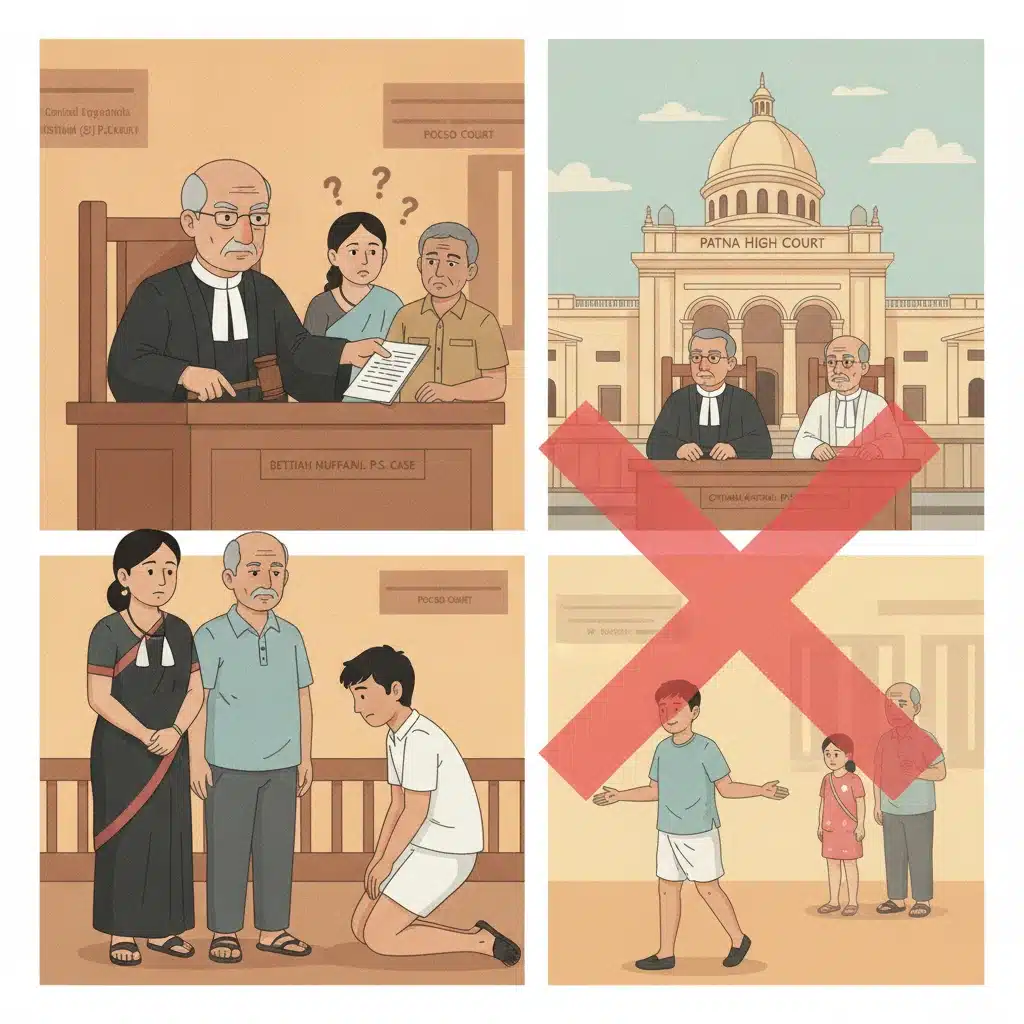
Case Background
The case arose from Bettiah Muffasil P.S. Case No. 626 of 2013 in West Champaran district. The criminal case was tried by the 1st Additional Sessions Judge-cum-Special Judge, West Champaran, Bettiah, treating it as a POCSO matter.
As per the First Information Report, the informant was a girl described as about 12 years old. She alleged that on 28.09.2013 at about 8:00 PM she had gone to the fields to ease herself. Near the field of one Nand Kishore Prasad, the appellant allegedly caught hold of her, dragged her into the paddy crop, removed her lower garments and committed rape.
She stated that after the act, the appellant threatened her not to disclose the incident to anyone and ran away. Out of fear, she did not immediately speak about it at home. However, her family members sensed that some incident had taken place and took her to the police station, where the FIR was lodged.
The police investigated and submitted a charge sheet against the appellant for offences under Section 376 of the Indian Penal Code and Section 4 of the Protection of Children from Sexual Offences Act, 2012 (POCSO Act). The case was committed to the Special Court and the appellant faced trial.
By judgment dated 07.01.2020, the trial court convicted the appellant under Section 376 IPC and Section 4 POCSO Act. On 28.01.2020, the court sentenced him to ten years’ rigorous imprisonment with a fine of Rs. 15,000 under each head, with two years’ rigorous imprisonment in default of payment, the sentences to run concurrently.
The appellant challenged this conviction and sentence before the Patna High Court in Criminal Appeal (SJ) No. 749 of 2020. The appeal was heard by Hon’ble Mr. Justice Birendra Kumar, who delivered a CAV judgment on 20.12.2021.
What the Court Examined and Decided
The Patna High Court closely examined the evidence recorded during trial and the reasons given by the trial judge to support the conviction.
The prosecution had examined five witnesses. PW 1 and PW 2 were co-villagers. Both stated that they knew nothing about the occurrence and were declared hostile. PW 3 was the father of the prosecutrix. He deposed that he was not present in the village at the time of the alleged incident. After his return, the prosecutrix disclosed only that the appellant had caught her arm. His evidence went no further.
PW 4 was the prosecutrix herself. In her examination-in-chief, she broadly supported the version given in the FIR about being dragged into the paddy field and ravished. However, in cross-examination her testimony significantly changed.
She stated that neither she nor her father had given any written report to the police. According to her, the written report was penned by “Darogaji”, whose name she did not know, and the report was not read over to her. She further stated that due to darkness and absence of light at the place of occurrence, she could not identify anyone by face.
She also deposed that she had not named the appellant in the first written report. Instead, villagers who accompanied her to the police station had written his name. She affirmed that she had never had any complaint against the appellant and that the appellant treated her as a sister. She added that since the appellant was her “brother”, she identified him in court.
PW 5 was Dr. Rashmi Nand Kuliyar, who medically examined the prosecutrix on 30.09.2013. She stated that secondary sex characters were developed, both breasts were developed, and auxiliary and pubic hair were present. There was no injury on the private parts. The hymen was old ruptured. On the basis of radiological report, she opined that the girl was around 15 years of age. Pathological examination did not detect any spermatozoa.
The trial court, while convicting the appellant, relied on several factors. First, it accepted the medical opinion that the girl was about 15 years old, and treated her as a minor, noting that no defence suggestion was made that she was major. It observed that rural poor people seldom produce documents to prove date of birth.
Second, the trial court considered that the victim had allegedly supported her FIR version in a statement under Section 164 of the Code of Criminal Procedure before a Magistrate, and felt that under Section 80 of the Evidence Act the court could rely on that statement even though it was “not brought on the record”.
Third, the trial court held that the cross-examination of the victim did not weaken her examination-in-chief, which was consistent with the FIR and alleged Section 164 statement. Fourth, it viewed the non-examination of the Investigating Officer as not causing any prejudice to the defence. Finally, it applied the statutory presumptions under Sections 29 and 30 of the POCSO Act and held that the accused had failed to rebut these presumptions.
Before the High Court, counsel for the appellant attacked these findings. He argued that criminal law requires the prosecution to prove guilt beyond reasonable doubt and that the initial burden cannot be shifted onto the accused. He stressed that the prosecutrix herself had disowned giving any written report and said that villagers had inserted the appellant’s name, and that there was no evidence on record of a statement under Section 164 CrPC. In such circumstances, examination of the Investigating Officer was vital to prove the genuineness of the FIR and any statement under Section 164 CrPC, and non-examination caused serious prejudice.
He further argued that the cross-examination showed the prosecutrix was not a “sterling witness”. The contradiction between her version and that of her father, who spoke only of the appellant catching her arm, went to the root of the prosecution story. On age, he submitted that prosecution must prove exact age through proper documents and that a mere approximate medical age could not sustain a POCSO conviction.
The Additional Public Prosecutor, defending the conviction, emphasized the settled principle that the solitary testimony of the prosecutrix can be sufficient for conviction, as sexual offences typically occur in secluded circumstances with no eyewitnesses.
The High Court then recorded its findings. It noted first that neither PW 3 nor PW 4 had deposed who actually wrote the first written information to the police. Both only identified their signatures. None of the witnesses, including the prosecutrix, said anything about giving a statement under Section 164 CrPC before a Magistrate. The court observed that such gaps could not be filled by conjectures or assumptions. It therefore treated non-examination of the Investigating Officer as a serious lapse on the part of the prosecution.
Next, the Court examined the credibility of PW 4. It held that she did not appear to be a “sterling witness”. In cross-examination she clearly said that in the darkness she could not identify the miscreant, that she had not named the appellant in the first report, that villagers had named him, and that she had never had any complaint against him and considered him as a brother.
The Court stressed that a witness’s statement must be read as a whole, not selectively. The father’s testimony that she only alleged that the appellant had caught her hand was not challenged, and he was not declared hostile. Relying on the Supreme Court decision in Raja Ram v. State of Rajasthan, (2005) 5 SCC 272, the Court observed that if a prosecution witness is not declared hostile, the defence can rely on his evidence and it becomes binding on the prosecution. The conflict between the versions of the prosecutrix and her father therefore created serious doubt about the trustworthiness of the prosecution case.
On the issue of age, the Court relied on Supreme Court authorities. In Sunil v. State of Haryana, AIR 2010 SC 392, and State of Madhya Pradesh v. Munna @ Shambhoo Nath, (2016) 1 SCC 696, the Supreme Court held that conviction cannot rest on approximate age alone. The High Court noted that PW 5 did not herself conduct the radiological examination and no radiological report or expert was produced. Therefore her opinion about the girl being around 15 years old could not reliably determine exact age.
The Court further relied on Jarnail Singh v. State of Haryana, 2013 Cri LJ 3976, where the Supreme Court directed that age of a rape victim should be determined in the manner laid down in Rule 12 of the Juvenile Justice (Care and Protection of Children) Rules, 2007. Under this rule, preference is given to school records and other official documents; only in their absence can medical opinion be considered. The Court pointed out that the prosecutrix was literate, had signed everywhere, and there was no case that she never attended school, yet no school document or birth certificate was produced.
Given this legal framework, the Court held that it was the bounden duty of the prosecution to prove the exact age of the prosecutrix through proper evidence, which it failed to do. In absence of school records or a proper medical board report, the mere approximate age given by PW 5 was “worthless” for proving age.
Turning to the POCSO presumptions, the Court reproduced Sections 29 and 30 of the Act and underscored that these are rebuttable presumptions that arise only after the prosecution first proves the foundational facts of the offence. In this case, because the sole testimony of the prosecutrix was not wholly reliable and her age was not proved in the manner mandated by law, the initial burden was not discharged. Therefore, the trial court was wrong in invoking Sections 29 and 30 against the accused.
The Court also criticized the trial court for relying on a supposed Section 164 CrPC statement that was not even brought on record, and for treating it as corroboration under Section 80 of the Evidence Act. Since the victim herself did not speak of such a statement and the Investigating Officer was not examined, the High Court held that the trial court had stretched its reasoning beyond the evidence.
Considering all these infirmities, particularly the doubtful identity of the offender, contradictions between father and daughter, absence of reliable age proof, and serious procedural gaps, the High Court concluded that it was not a fit case for conviction. It held that the trial judge had erred in law as well as in appreciation of facts, contrary to settled principles of criminal jurisprudence.
Accordingly, the High Court set aside the impugned judgment of conviction and the order of sentence. The appeal was allowed and the Court directed that the appellant be set free at once.
Why This Judgment Matters
This judgment from the Patna High Court underlines that even in sensitive cases of sexual assault and POCSO offences, conviction cannot rest on weak or incomplete evidence. Courts must still insist on proof beyond reasonable doubt.
For complainants, it highlights the importance of giving clear, consistent statements and of supporting them with proper documents, particularly regarding age. For police and prosecutors, it stresses that investigation must be complete: they must secure school or birth records, properly record and produce Section 164 CrPC statements, and examine the Investigating Officer in court.
For accused persons, the decision reaffirms that statutory presumptions under the POCSO Act do not relieve the prosecution of its basic duty to first establish the core facts of the offence. Only then can the burden shift to the defence.
More broadly, the judgment reminds trial courts that they cannot fill evidentiary gaps through assumptions or by relying on documents not formally proved. Statements of key witnesses, including relatives, must be read as a whole, and unexplained contradictions that go to the heart of the case cannot be ignored.
Legal Issues and Answers
- Issue: Could the conviction for rape and POCSO offences be upheld when the prosecutrix’s testimony contained serious contradictions and her age was proved only by approximate medical opinion?
Answer: No. The Patna High Court held that the prosecutrix was not a sterling witness, her evidence conflicted with her father’s, and exact age was not proved as required by law. Therefore the conviction could not be sustained. - Issue: Was the trial court justified in invoking presumptions under Sections 29 and 30 of the POCSO Act without firm foundational evidence?
Answer: No. The Court held that these presumptions arise only after the prosecution first discharges its initial burden. Since this did not happen, the presumptions could not be used against the appellant. - Issue: Did non-examination of the Investigating Officer and absence of a proved Section 164 CrPC statement materially affect the case?
Answer: Yes. The Court found that in view of the prosecutrix disowning the written report and no witness speaking of a Section 164 CrPC statement, failure to examine the Investigating Officer was a serious lapse that created doubt about the prosecution version.
Cases Cited by the Court
- Raja Ram v. State of Rajasthan, (2005) 5 SCC 272
- Sunil v. State of Haryana, AIR 2010 SC 392
- State of Madhya Pradesh v. Munna @ Shambhoo Nath, (2016) 1 SCC 696
- Jarnail Singh v. State of Haryana, 2013 Cri. L.J. 3976
Case Details
Case Number: Criminal Appeal (SJ) No. 749 of 2020; arising out of Bettiah Muffasil P.S. Case No. 626 of 2013, CIS No. 10914 of 2014
Case Title: Sikandar Patel v. The State of Bihar
Citation: 2022 (4) PLJR 83
Court: High Court of Judicature at Patna
Coram: Hon’ble Mr. Justice Birendra Kumar
Date of High Court Judgment: 20.12.2021
Trial Court Judgment: Judgment of conviction dated 07.01.2020 and sentence dated 28.01.2020 by 1st Additional Sessions Judge-cum-Special Judge, West Champaran, Bettiah
Advocates: Mr. Umesh Chandra Verma, Advocate for the appellant; Mr. Syed Ashfaque Ahmad, Additional Public Prosecutor for the State
Nature of Case: Criminal appeal (against conviction under Section 376 IPC and Section 4 of the POCSO Act)
Final Outcome: Appeal allowed; conviction and sentence set aside; appellant directed to be released.
Link to Judgment: Click here to read the full Patna High Court judgment
If you found this explanation helpful and wish to stay informed about
how legal developments may affect your rights in Bihar,
you may consider following Samvida Law Associates for more updates.




