

Case Background
The criminal revision arose from Baheri P.S. Case No. 268 of 2020 from District Darbhanga. The FIR mentioned offences under Sections 341, 323, 324, 307, 427, 302, 504/34 of the Indian Penal Code.
During the proceedings, the accused claimed that he was a juvenile on the date of the alleged occurrence, i.e., 19.11.2020. His claim was first examined by the Juvenile Justice Board (JJB), Darbhanga in J.J.B. Case No. 482 of 2021.
On 19.03.2021, the JJB declared him a major. The accused challenged this finding before the 1st Additional Sessions Judge-cum-Children Court, Darbhanga in Criminal Appeal No. 06 of 2021. On 08.07.2021, the appellate court affirmed the JJB’s order.
Still dissatisfied, the accused, through his mother, filed Criminal Revision No. 8 of 2022 before the Patna High Court. He sought interference with the concurrent findings of the JJB and the Children’s Court regarding his age.
What the Court Examined and Decided
The single point in this revision before the Patna High Court was whether the accused was a juvenile on 19.11.2020. Everything turned on which date of birth should be accepted.
The petitioner relied on his CBSE matriculation documents. In these documents, his date of birth was recorded as 30.06.2003. If this date were correct, he would have been under 18 years of age on 19.11.2020, and therefore entitled to protection as a child in conflict with law under the Juvenile Justice (Care and Protection of Children) Act, 2015.
The petitioner argued that once a matriculation certificate issued by CBSE records a date of birth, that date must be treated as conclusive proof of age. He attacked the reliance placed by the JJB and the appellate court on the admission register of the school from which he had passed matriculation.
He also relied on the Supreme Court judgment in Jabar Singh vs. Dinesh and Anr., (2010) 3 SCC 757. According to him, the school admission register did not meet the conditions of Section 35 of the Indian Evidence Act because it was not a public or official register prepared by a public servant in discharge of official duty.
Initially, his counsel tried to support the juvenility claim even on the basis of the medical examination report. The medical board had assessed his age as between 20–22 years. Counsel attempted to argue that two years should be reduced from the lower limit (20 years) and then another one year under Rule 12(3)(b) of the Juvenile Justice Rules, 2007, which in his view would bring the age down into the juvenile bracket.
However, on reading the Supreme Court judgment in Darga Ram @ Gunga vs. State of Rajasthan, (2015) 2 SCC 775, counsel realised that the benefit of “plus minus two years” was considered from the upper extreme limit of a medical assessment, not from the lower limit. This medical-age argument was therefore abandoned at the very outset.
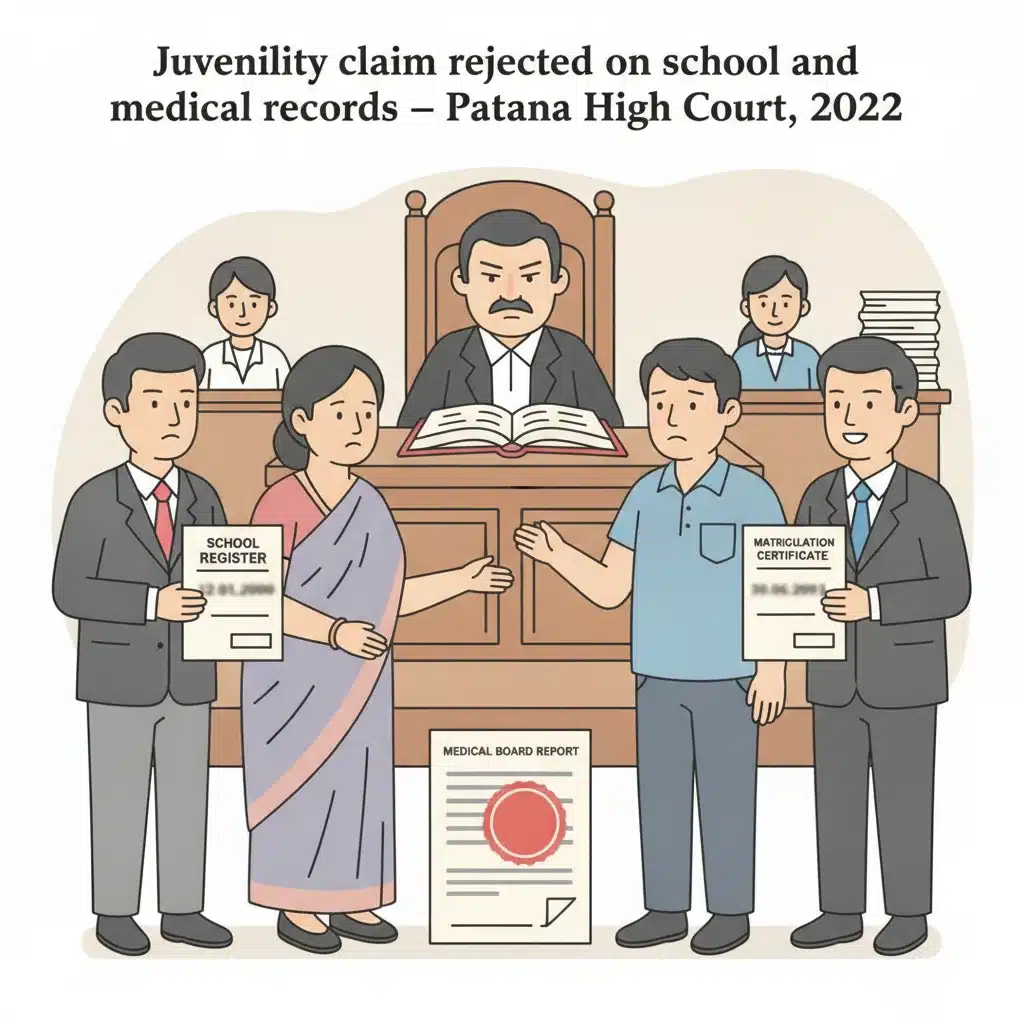
The State, through the learned APP, opposed the revision. It was pointed out that the petitioner was admitted to Don Bosco School, Darbhanga. In the school admission register, his date of birth was entered as 12.01.2000.
The problem arose when the registration card for the same class and school later showed his date of birth as 30.06.2003. This later date was then carried into the registration card, marksheet and admit card of the 10th class examination.
The State submitted that the petitioner had concealed his earlier recorded date of birth and, by changing it to 30.06.2003, tried to gain the benefit of a lower age, particularly at the stage of the matriculation examination. Given that the alleged occurrence took place on 19.11.2020, if the original school entry of 12.01.2000 was correct, he would clearly be more than 20 years old on that date.
Because of this serious discrepancy, the JJB did not accept the CBSE date blindly. On 23.01.2021, after hearing both sides, the Board passed a detailed and reasoned order. It called for the admission register of Class 9 from Don Bosco School and recorded the statement of a teacher on 11.01.2021. The teacher, on oath, confirmed that the petitioner’s date of birth in the school admission register was 12.01.2000, recorded at serial no. 65 at page 7 of the register.
The Board also constituted a medical board for age determination. The medical board assessed the age of the petitioner between 20 and 22 years. This assessment supported the date of birth recorded in the school admission register. The order dated 23.01.2021 directing constitution of the medical board was never challenged by the petitioner.
Before the High Court, the State argued that under Section 94 of the Juvenile Justice Act, 2015, documents like date of birth certificates from schools or matriculation certificates from examination boards are to be considered in age determination. However, when there is doubt, and especially when there is reliable school admission data corroborated by medical evidence, the court can prefer that material.
The APP further contended that the Supreme Court itself had doubted the narrow reading of Section 35 of the Evidence Act adopted in Jabar Singh. In Ashwani Kumar Saxena vs. State of Madhya Pradesh, (2012) 9 SCC 750, the Supreme Court had expressed reservations about that earlier view. The Patna High Court quoted paragraphs 20 and 21 of Ashwani Kumar Saxena, noting how the Supreme Court questioned the conclusion that school records could not be treated as relevant under Section 35.
The High Court then turned to the more recent and detailed judgment in Rishipal Singh Solanki vs. State of Uttar Pradesh and Ors., AIR 2022 SC 630. Paragraph 29 of that judgment summarised the entire legal position regarding claims of juvenility, including how age should be determined and what documents should be preferred.
The Court highlighted, in particular, sub-paragraphs (iii), (iv), (ix), (x) and (xi) of paragraph 29. These explained that:
- documents under Section 94(2) of the Juvenile Justice Act, 2015 can create a presumption of juvenility, but that presumption is rebuttable;
- age determination based on school records must be considered in light of Section 35 of the Evidence Act, which gives higher credibility to public or official documents maintained in discharge of official duty;
- matriculation certificates may be accepted if they are in line with credible public records; and
- medical or ossification tests are not conclusive, but can be important guiding factors when documentary evidence is doubtful.
Applying these principles, the Patna High Court noted that the petitioner himself did not dispute admission in Don Bosco School in Class 9. Nor was there any material to show that the school had admitted any clerical error in the admission register. The only explanation from the petitioner’s side was a bare assertion that the wrong date had been written by mistake, which the school had not accepted.
The Court also observed that the petitioner had chosen not to challenge the JJB’s order dated 23.01.2021 at the time. Instead, he waited for the medical board’s assessment, which ultimately supported the original school record.
In these circumstances, the High Court held that there was no reason to discard the school admission register, especially when it was supported by the medical assessment of age between 20–22 years. On this material, the JJB and the appellate court were justified in finding that the petitioner was not a juvenile on the date of occurrence.
Considering the limited scope of interference in revisional jurisdiction, particularly with concurrent findings of the JJB and the Children’s Court, the High Court held that there was no illegality, infirmity or perversity in their orders. It also found no error in the application of law.
Accordingly, the Patna High Court dismissed Criminal Revision No. 8 of 2022. The declaration that the petitioner was a major stood confirmed.
Why This Judgment Matters
This judgment is important for families and accused persons who seek to claim juvenility in serious criminal cases.
First, it shows that courts will closely examine contradictions between different date-of-birth documents. If a person has changed their date of birth at a later stage, the earlier school records and independent evidence like medical reports may carry more weight.
Second, the decision explains how the Patna High Court applies recent Supreme Court law on age determination. It confirms that documents like school admission registers are not automatically discarded. They can be relied on if they appear genuine and are supported by other evidence.
Third, the judgment cautions against misuse of the Juvenile Justice Act, 2015. While the law is meant to protect genuine children in conflict with law, it cannot be used by persons who were in fact adults at the time of offence but try to reduce their age by altering records later.
Finally, it underscores that revisional courts will not interfere with concurrent factual findings of lower authorities unless clear legal or factual error is shown.
Legal Issues and Answers
Issue: Whether the petitioner was a juvenile on the date of the alleged occurrence (19.11.2020), in light of conflicting dates of birth in school and CBSE records.
Answer: No. The Patna High Court held that the original school admission register showing date of birth as 12.01.2000, corroborated by a medical board assessment of age 20–22 years, outweighed the later CBSE records showing 30.06.2003. The concurrent findings declaring him a major were upheld.
Issue: Whether the Juvenile Justice Board and appellate court erred in relying on the school admission register and medical report instead of treating the CBSE matriculation certificate as conclusive proof of age.
Answer: No. Relying on Supreme Court decisions, the High Court held that school records considered under Section 35 of the Evidence Act, together with medical opinion, provided a sound basis for age determination. There was no illegality or perversity in their approach.
Cases Cited by the Court
- Jabar Singh vs. Dinesh and Anr., (2010) 3 SCC 757
- Ashwani Kumar Saxena vs. State of Madhya Pradesh, (2012) 9 SCC 750
- Darga Ram @ Gunga vs. State of Rajasthan, (2015) 2 SCC 775
- Daya Nand vs. State of Haryana, (2011) 2 SCC 224
- Rishipal Singh Solanki vs. State of Uttar Pradesh and Ors., AIR 2022 SC 630
Case Details
Case Number: Criminal Revision No. 8 of 2022
Arising out of: Baheri P.S. Case No. 268 of 2020, District Darbhanga
Case Title: Prabhu Sankar Ray @ Prabhu Sankar @ Golu vs. The State of Bihar & Anr.
Coram: Hon’ble Mr. Justice Rajeev Ranjan Prasad
Citation: 2022 (4) PLJR 793
Advocates:
- For the Petitioner: Mr. Kedar Jha, Advocate
- For the State (Respondent No. 1): Mr. Akhileshwar Dayal, APP
Nature of the Case: Criminal revision challenging concurrent orders on age determination and juvenility passed by the Juvenile Justice Board and Children’s Court.
Date of Patna High Court Judgment: 23.06.2022
Offence Sections Involved (in FIR): Sections 341, 323, 324, 307, 427, 302, 504/34 of the Indian Penal Code
Link to Judgment: Click here to read the full judgment of the Patna High Court
If you found this explanation helpful and wish to stay informed about
how legal developments may affect your rights in Bihar,
you may consider following Samvida Law Associates for more updates.




