

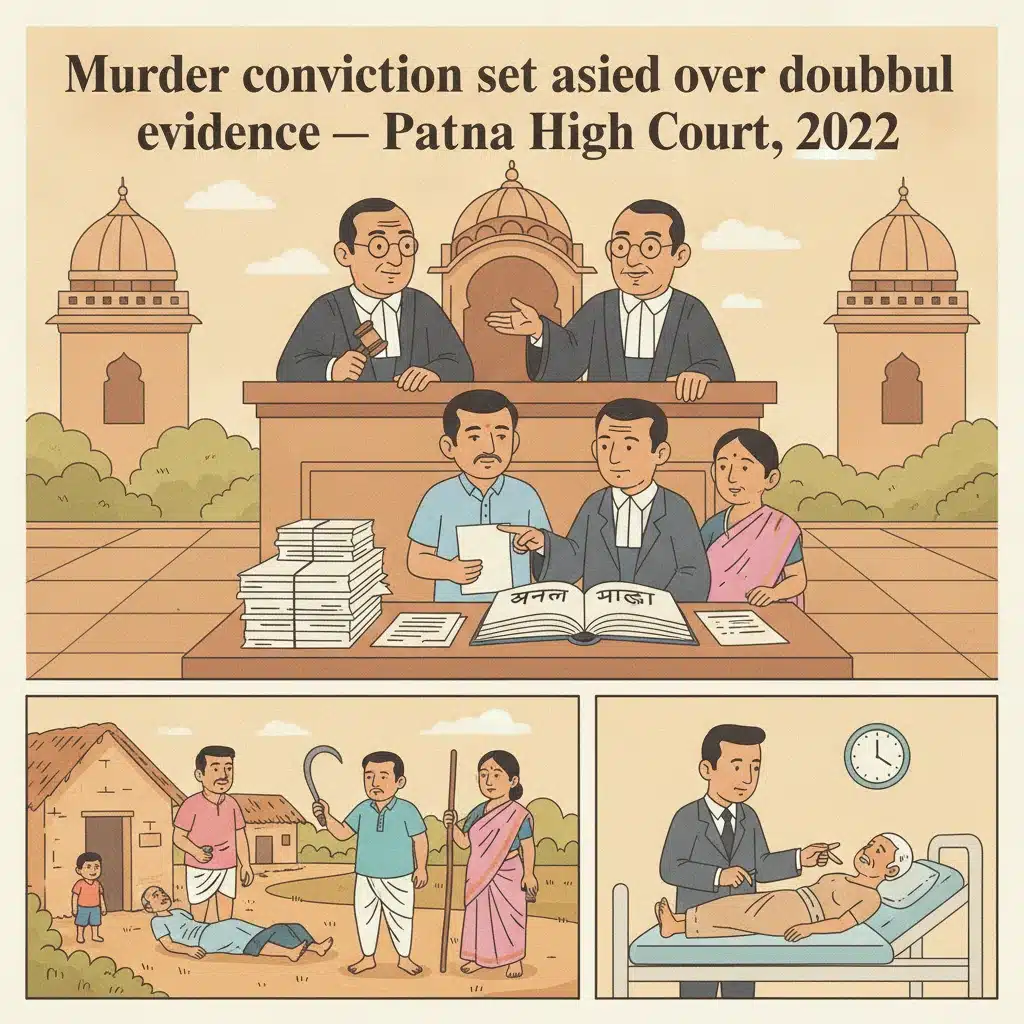
Case Background
The case arose from a family land dispute in village Manohar Chak, P.S. Mohanpur (Barachatty), District Gaya. According to the prosecution, the informant and his brother’s family were quarrelling over partition of land, even after the matter had allegedly been decided with the help of village panchayat members.
On 31.10.1987, the informant, examined in trial as P.W.1, gave his fardbeyan. He alleged that his nephews, named as appellant nos. 1 and 2, used to threaten him over the land issue. Their maternal uncles were said to have called them and some others, planned to kill the informant, and then allegedly sent appellant nos. 1 and 2 to the village to execute that plan.
The informant stated that on 30.10.1987, while he was washing his mouth at his darwaja, appellant no.1 caught hold of him and appellant no.2 began to assault him with a chapda, asking that his head be cut. Soon thereafter, appellant no.3, the mother of appellant nos. 1 and 2, allegedly came with a garasa and lathi, handed the garasa to appellant no.1 and kept the lathi herself, and all three were said to have assaulted the informant.
On his cries, the informant’s wife, later deceased Rampati Devi, allegedly came and fell on his body in an attempt to protect him. The assailants were said not to spare her, and to have continued assaulting both of them with garasa, lathi and chapda even after they had fallen down.
The informant further claimed that he and his wife shouted for help, but villagers did not initially come out due to fear as the assailants threatened to kill anyone who tried to intervene. Their son, P.W.9, was said to have taken shelter inside the house and shut the door, before raising further hue and cry. On that, some villagers, including P.Ws. 4, 5 and 6, were said to have reached and rescued them.
The informant stated that he saw three persons in front of him until he remained conscious, and then he and his wife fell unconscious. He said he did not know when he was taken to Mohanpur Government Hospital. On the basis of this fardbeyan, Barachatty P.S. Case No. 122/87 was registered under Sections 324, 307, 323/34 and 120B of the Indian Penal Code.
During treatment, the informant’s wife Rampati Devi died. Section 302/34 IPC was then added. After investigation, the police submitted charge-sheet and cognizance was taken by the jurisdictional Magistrate. The case was committed to the Court of Sessions and registered as Sessions Trial No. 612/90. By judgment dated 12.12.1994, the Sessions Judge, Gaya convicted all three appellants under Section 302 IPC and sentenced them to life imprisonment.
Against that conviction and sentence, the appellants filed Criminal Appeal (DB) No. 16 of 1995 before the Patna High Court. The appeal remained pending for about 27 years before being finally decided on 11.11.2022.
What the Court Examined and Decided
The Division Bench of the Patna High Court, speaking through Hon’ble Mr. Justice Sudhir Singh, framed three main questions:
First, whether the cause of death of the deceased was directly associated with the act of the appellants. Second, whether the prosecution had proved the place of occurrence beyond reasonable doubt. Third, whether the death was due to primary haemorrhage directly from the injuries or secondary haemorrhage arising later from complications and infection.
On behalf of the appellants, it was argued that the trial court had not properly appreciated the evidence. Counsel submitted that the fardbeyan did not contain specific allegations about which of the three appellants caused which particular injury to the deceased. According to the defence, later depositions by witnesses had been improved to fill this gap, making the prosecution story unreliable.
The appellants’ counsel also argued that the conviction under Section 302 IPC could not stand without taking the aid of Section 34 IPC, especially in the absence of proof that any one accused individually caused an injury sufficient in the ordinary course of nature to cause death. A further submission was that the deceased died about 20 days after the incident, due to secondary haemorrhage, so Section 302 IPC was not attracted. Lastly, it was contended that the prosecution had failed to establish the exact place of occurrence.
The State, through the Additional Public Prosecutor, supported the trial court’s judgment, claiming that the prosecution had proved its case beyond reasonable doubt and that there was no infirmity in the conviction and sentence.
While examining the first issue, the Patna High Court compared the original fardbeyan with the later oral evidence. In the fardbeyan, the deceased was said to have been assaulted by all three appellants, but there was no clear, specific allegation fixing the exact act of each one on the deceased. During trial, in paragraph 5 of his cross-examination, P.W.1 and in paragraphs 1 and 2 of P.W.9’s deposition, specific roles were assigned: appellant no.1 allegedly inflicting a garasa injury on the head, and appellant no.2 a chapda blow on the abdomen.
P.W.3 also tried to give a detailed account of specific assaults by appellant nos. 1 and 2. However, the Court noted that in the fardbeyan itself, the informant had said nothing about P.W.3 being present as an eye-witness. Because of this silence in the earliest version, the Court found it unsafe to rely on P.W.3’s later claim about witnessing the assault.
Looking at the evidence as a whole, the Bench found that the prosecution witnesses were not consistent and that the story had been materially improved during trial. The Court held that there were glaring infirmities in the prosecution case, especially regarding the alleged individual acts of each accused.
The Court then applied the principles laid down by the Hon’ble Supreme Court in Dhaneswar Mahakud and others v. State of Orissa, (2006) 9 SCC 307. There the Supreme Court held that for a conviction under Section 302 IPC simpliciter, the court must be satisfied that the injuries inflicted by each individual, taken in isolation, were sufficient in the ordinary course of nature to cause death. If such a conclusion is not possible, guilt under Section 302 IPC cannot be fastened on each accused individually without taking recourse to Section 34 IPC regarding common intention.
In the present case, there was no specific allegation at all against appellant no.3 regarding any injury on the deceased. For appellant no.2, a specific allegation about an abdominal injury appeared only in improved trial testimony. The post mortem report (Ext. 2) showed that death was due to toxemia, shock, sepsis and pressure over a vital part of the brain. The Court observed that the injury attributed to appellant no.2 could not be treated as a fatal or clearly homicidal injury in itself.
Consequently, the Bench held that the prosecution had failed to prove an independent charge under Section 302 IPC simpliciter against each appellant. It emphasised that there was no sufficient material for the trial court to find that each injury allegedly caused by each accused was, on its own, sufficient to cause death in the ordinary course of nature. The trial court had therefore erred in convicting each appellant under Section 302 IPC without taking the aid of Section 34 IPC.
On the second issue, regarding the place of occurrence, the Court again found major inconsistencies. In the fardbeyan, there was mention of only one place of occurrence: the informant’s darwaja, where he and his wife were allegedly assaulted with lathi, garasa and chapda. However, in his examination-in-chief, P.W.1 spoke of two places of occurrence. He first said the attack began at his darwaja while he was washing his mouth and, after his wife intervened, she went to the angan where she was again assaulted.
In cross-examination, P.W.1 further stated that he became unconscious after seeing blood spilled in the angan. On the other hand, P.W.9, their son, claimed that he was at the darwaja of the house, while his father was at the darwaja of a dalan about 20 feet away, and that the initial fight occurred there. According to him, the informant and the deceased later came to the angan, where the entire assault actually took place.
The Investigating Officer, P.W.10, added another twist. In examination-in-chief he mentioned a pagdandi as the first place of occurrence, east of which was the informant’s darwaja where he found a lot of blood. In cross-examination, he identified the angan as the second place but categorically stated that he did not find any blood there.
The Court noted that when such clear contradictions arose concerning whether the assault happened at the darwaja, the angan, the pagdandi, or some combination, the informant did not explain why his version changed from the first statement to his evidence in court. Relying on the Supreme Court’s judgment in Pohlu v. State of Haryana (MANU/SC/1148/2004), the Bench held that where the prosecution shifts the place of occurrence and witnesses improve their version without proper explanation, their evidence becomes unreliable.
In light of these conflicting statements from P.W.1, P.W.9 and P.W.10, the Patna High Court concluded that the prosecution had “miserably failed” to prove the place of occurrence beyond the shadow of reasonable doubt.
On the third issue, the Court examined the cause of death with the help of standard medical texts. It referred to definitions of haemorrhage, primary haemorrhage and secondary haemorrhage from Butterworths Medical Dictionary, Modi’s Medical Jurisprudence and Toxicology, Parikh’s Textbook of Medical Jurisprudence and Toxicology, and Lyon’s Medical Jurisprudence for India. These authorities explain that primary haemorrhage occurs immediately after injury, while secondary haemorrhage and related complications may arise days later due to infection and other factors.
The post mortem report recorded two main injuries: an infected wound over the vertex of the scalp with subdural haematoma, and abdominal findings including a healed surgical scar, sanguineous fluid, gangrenous large intestine, adhesions, lacerated liver and stomach partly filled with bloody fluid. The doctor (P.W.2) opined that death was due to toxemia, shock, sepsis and pressure over a vital part of the brain.
The Court paid particular attention to the fact that the deceased died about 20 days after the alleged assault and that the wounds had become infected, leading to sepsis and gangrene. In cross-examination, the doctor stated that life could have been saved with proper treatment, as there was sufficient time.
Drawing support from the Supreme Court’s decision in B.N. Kavatakar and others v. State of Karnataka, 1994 SCC (Cri) 579, where death occurred after five days due to septicaemia secondary to injuries and peritonitis and the offence was held to fall under Section 326 read with Section 34 IPC, the Patna High Court observed that in the present case also the death appeared more probably due to secondary haemorrhage and post-injury infection rather than directly and exclusively from the initial injuries.
On this reasoning, the Court held that the cause of death of the deceased was not directly associated with the acts allegedly committed by the appellants. Even if at best an offence under Section 326 IPC could be considered, the failure of the prosecution to prove the place of occurrence beyond reasonable doubt made it unsafe to uphold even that lesser charge.
Ultimately, in view of all three issues decided against the prosecution, the Patna High Court concluded that the prosecution had failed to prove the charge framed against the appellants. The conviction and life sentence under Section 302 IPC were therefore set aside. Since the appellants were already on bail, they were discharged from the liabilities of their bail bonds.
Why This Judgment Matters
This judgment of the Patna High Court is significant for criminal cases arising from village disputes, especially where family members are involved. It shows that even in serious offences like alleged murder, courts will not accept doubtful or improved versions given later if the earliest statements are vague.
The Court stressed that when witnesses change their story about where and how an incident happened, and the prosecution cannot clearly show the place of occurrence, the entire case becomes weak. For victims and accused persons alike, this underlines the importance of truthful, consistent statements right from the start.
The decision also highlights that if a person dies after a long gap due to infection and medical complications, the law may treat it differently from an immediate death caused directly by the injury. Where negligence in treatment or secondary infection plays a big role, the strict charge of murder under Section 302 IPC may not automatically apply.
For those facing false implication in village enmity or land disputes, the case demonstrates that higher courts can and do carefully re-examine the evidence, medical reports and investigation to protect against wrongful conviction.
Legal Issues and Answers
-
Issue: Was the death of the deceased directly linked to the specific acts of the appellants so as to sustain a conviction under Section 302 IPC individually against each of them?
Answer: No. The Court held that the prosecution failed to prove which injury by which appellant, taken alone, was sufficient in the ordinary course of nature to cause death, and that death appeared more connected with secondary haemorrhage and infection. -
Issue: Did the prosecution prove the place of occurrence beyond reasonable doubt?
Answer: No. The Court found material contradictions between the fardbeyan, witness testimonies and the Investigating Officer’s evidence on whether the assault occurred at the darwaja, angan or pagdandi, and held that the place of occurrence was not proved. -
Issue: Could any lesser offence, such as under Section 326 IPC, still be sustained on the evidence?
Answer: No. Although the medical evidence suggested that, at best, Section 326 IPC might be attracted, the failure to prove the place of occurrence and the overall inconsistencies in the prosecution case meant even that lesser charge could not stand.
Cases Cited by the Court
- Dhaneswar Mahakud and others v. State of Orissa, (2006) 9 SCC 307
- Pohlu v. State of Haryana, MANU/SC/1148/2004
- B.N. Kavatakar and others v. State of Karnataka, 1994 SCC (Cri) 579
Case Details
Case Number: Criminal Appeal (DB) No. 16 of 1995
Case Title: Kuleshwar Yadav & Ors. v. State of Bihar
Citation: 2022 (4) PLJR 863
Court: High Court of Judicature at Patna
Coram: Hon’ble Mr. Justice Sudhir Singh; Hon’ble Mr. Justice Shailendra Singh
Date of Judgment: 11.11.2022
Advocates: Mr. Ashok Kr. Choudhary, Senior Advocate for the appellants; Mr. Bipin Kumar, APP for the State
Originating Case: Sessions Trial No. 612/90 arising out of Barachatty P.S. Case No. 122/87, G.R. Case No. 2778/87
Nature of Case: Criminal appeal (Division Bench) against conviction and sentence under Section 302 IPC
Final Outcome: Appeal allowed; conviction and sentence set aside; appellants discharged from bail bond liabilities.
Link to Judgment: Click here to read the full Patna High Court judgment
If you found this explanation helpful and wish to stay informed about
how legal developments may affect your rights in Bihar,
you may consider following Samvida Law Associates for more updates.




