

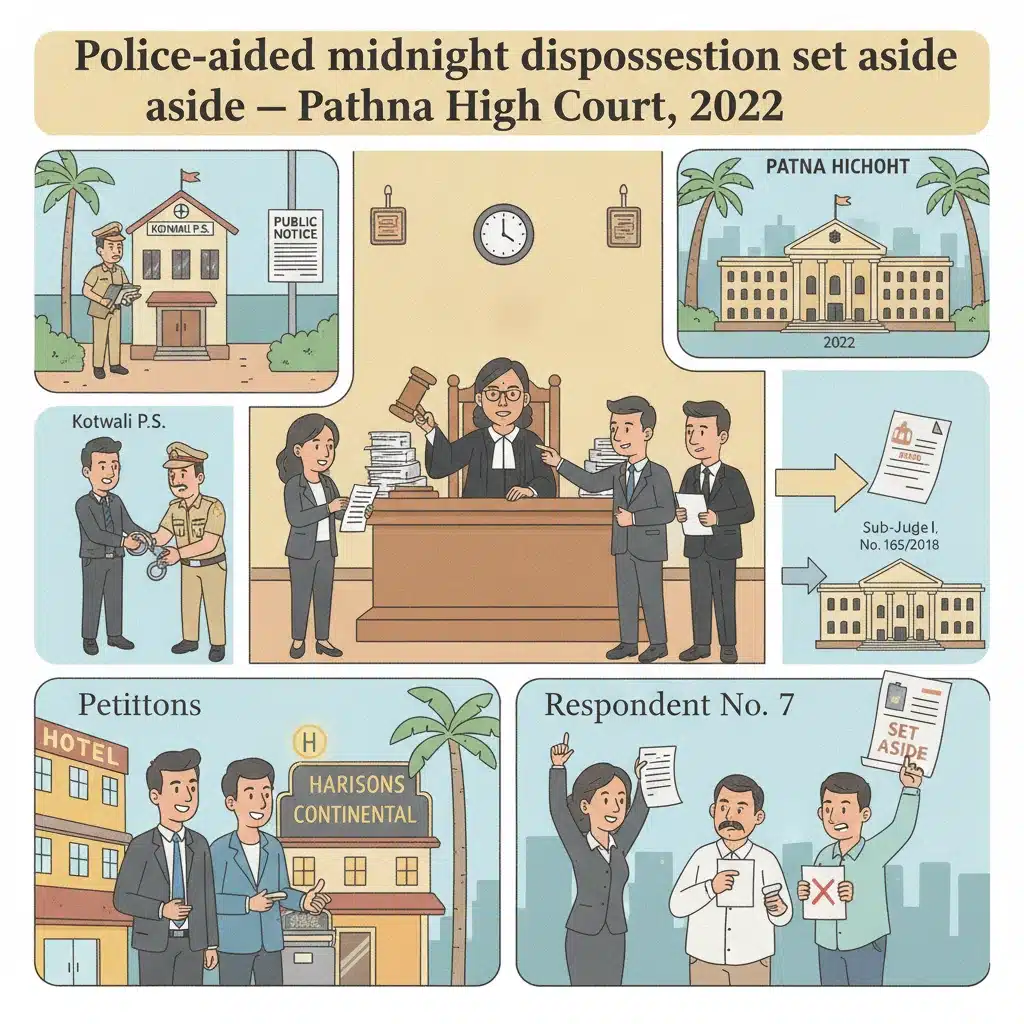
Case Background
The dispute concerns premises on Frazer Road, Patna, originally leased by a public limited company, Jai Mangal Limited, which owned and managed a building there. During company winding up proceedings in Company Petition No.10 of 1996, the Ex-management of the company entered into a memorandum of understanding dated 08.11.2006 with the director of petitioner no.2, a private advertising company. Funds were arranged to pay all dues to the company’s creditors.
By December 2009, petitioner no.2 claims to have paid Rs.1,41,49,000/-. This was followed by an agreement for sale dated 17.03.2010 between the Managing Director, Jagdish Prasad, and petitioner no.2, fixing consideration at Rs.2.53 crores and acknowledging the amount already received. The sale deed was to be executed within four months of discharge of liabilities on the property.
Because disposal of the company winding up case was delayed, a registered lease deed was executed on 06.08.2011 by Jai Mangal Limited in favour of petitioner no.2. Petitioner no.2 then executed a sub-lease on 15.03.2012 in favour of petitioner no.1, a hotel company, to run a hotel named Harisons Continental in the leased area.
On 18.12.2014 the Patna High Court closed the winding up proceedings. By then, petitioner no.2 states it had paid Rs.2,24,45,035/- to the company. According to the petitioners, despite repeated efforts to get the sale deed executed on payment of the remaining Rs.28,54,965/-, Jagdish Prasad avoided execution and appeared to be trying to sell the property elsewhere. Petitioner no.2 published a public notice in Dainik Bhaskar on 06.05.2017 warning about its agreement for sale.
Petitioner no.2 lodged Kotwali P.S. Case No.320/2017 on 01.07.2017 against Jagdish Prasad alleging offences under Sections 406, 409, 419, 420, 467, 468, 471 and 120B of the Indian Penal Code. Police submitted a charge-sheet after investigation.
On 24.04.2018, petitioner no.2 filed Title Suit No.165/2018 before the Sub-Judge I, Patna, seeking specific performance of the 17.03.2010 sale agreement. It then learnt that Jagdish Prasad had executed a sale deed dated 21.03.2018 in favour of respondent no.7, Kraft Outdoor Media Pvt. Ltd., which also covered the leased premises. Respondent no.7 was added to the suit and the plaint was amended to seek a declaration that the 21.03.2018 sale deed is illegal, null and void and to direct respondent no.7 to join in executing the sale deed in favour of petitioner no.2. Jagdish Prasad died around 24.08.2018 and his legal heirs were substituted. Respondent no.7 has appeared in that suit and filed a written statement.
Separately, respondent no.7 filed Eviction Suit No.72/2018 on 25.08.2018 against both petitioners under Sections 11(1)(c) and 14 of the Bihar Buildings (Lease, Rent and Eviction) Control Act, 1947, pleading personal necessity. In that eviction suit, respondent no.7 admits that the petitioners were in possession of the leased area.
Thus, by early 2022, two civil suits were pending: a title suit for specific performance in which respondent no.7 is a party, and an eviction suit by respondent no.7 against the petitioners. Meanwhile, petitioner no.1 continued to run Hotel Harisons in the leased portion, as shown by electricity bills, bank accounts, telephone bills, GST returns and PF challans for January–February 2022.
What the Court Examined and Decided
The core grievance in the criminal writ was that, during the night of 24/25 February 2022, respondent no.7, aided by police, forcibly dispossessed petitioner no.1 from the hotel premises by locking the main gate and refusing to lodge an FIR, despite information about cognizable offences.
According to the petitioners, around midnight the director of respondent no.7, Manish Kumar, his brothers and about 50 others came to the hotel reception, assaulted staff, kidnapped three staff members at gunpoint, took their phones and IDs, removed documents, a computer system and Rs.55,000 in cash, and then, with the help of Kotwali police, locked the premises. The petitioners say the police refused to register any case, and photographs were filed showing police personnel locking the premises.
When Kotwali police did not act, the petitioners emailed the Superintendent of Police, Patna at 2.50 AM on 25.02.2022 and again at 11.26 PM that day with a written complaint and photographs, asking that an FIR be registered against respondent no.7. Instead, the police submitted a report leading to preventive proceedings under Section 107 Cr.P.C. The hotel remained locked, causing serious financial loss to petitioner no.1.
The official respondents (Superintendent of Police, Dy.S.P., SHO, and others) filed a counter affidavit. They said that around 2.15 AM on 24/25.02.2022 Kotwali police received information through “PIR” that a robbery was occurring at Hotel Harisons. The SHO and other officials went to the hotel and found the outer gate locked with some people, including Manish Kumar and his associate, standing outside. After unlocking the gate, they went inside, found no robbery, and then “the people standing there again locked the gate.” Later, an ASI, Parmatma Dubey, reportedly heard a voice from inside the hotel, opened the lock with respondent no.7’s key, freed one Santosh Kumar, and then respondent no.7 again locked the door and kept the key.
The police claimed they only took preventive action and denied locking the premises themselves. They did not, however, deny that emails with specific allegations had been sent to the S.P., Patna, nor did they explain why no FIR was registered on 25.02.2022 despite allegations of cognizable offences.
During the writ hearing, the Court asked the Dy.S.P. to analyse CCTV footage from the police station on the relevant night. His report showed that around 2.09 AM, two persons from the petitioners’ side arrived at the police station on a scooter. At 2.12 AM, SI Parmatma Dubey went into the “Sirista” room with members from both sides. At 2.18 AM, a member of the second party (linked to respondent no.7) handed a key to SI Dubey, who then gave it to the officer on duty. At 2.40 AM, the duty officer handed the key back to Dubey, who left the police station with it at 2.42 AM. Members of the second party then left at 2.52 AM, and members of the first party at 2.59 PM. The report also recorded that the key of Hotel Harison “was handed over to the second party,” but was silent on who ordered this and in what manner the duty officer gave the key to respondent no.7.
The Dy.S.P. further noted that there was no available CCTV footage at the hotel site or the Dakbunglow crossing. But when questioned, SI Dubey admitted that he went to the hotel on a wireless message from Budha Smriti Park, found a lock on the hotel gate, and both parties quarreling. According to him, the key was first deposited at the police station, given to the officer on duty, then taken by him again to open the hotel shutter to release a tea vendor, Sanjay Kumar, and then allegedly returned to the duty officer. Yet the Dy.S.P.’s time-stamped CCTV analysis showed Dubey leaving the police station with the key and never being seen returning it.
Respondent no.7’s own counter affidavit played a crucial role. He did not deny that petitioner no.1 was running Hotel Harisons in the leased area or that an eviction suit was pending. In fact, in paragraph 17 he expressly stated that the petitioners “can claim possession of the hotel area as per the terms of the lease deed,” while asserting that other portions were in his occupation. He admitted that on the night in question, he and his brother, who work nearby, went to the property around 10.30 PM, found it “abandoned” and locked the outer gate. He further admitted that he opened the lock at the request of the PCR van, allowed police to inspect the hotel, then re-locked it. Later, after an altercation with Gaurav Kumar and others from the petitioners’ side, both parties were taken to the police station, and he again accompanied police back to the hotel, opened the lock to release a person inside, and then “relocked the gate and returned to Kotwali Police Station with key in his possession.”
Thus, even on respondent no.7’s own showing, he had unilaterally locked the hotel premises in the middle of the night, despite admitting that the petitioners were the current occupants of the hotel area, and despite an ongoing eviction suit where his right to recover possession was sub judice.
The Court stressed that in this writ it was not deciding who ultimately owns the property or whether the petitioners have an “existing executable right” to continue as tenants. Those issues were left to the civil court in the title suit and eviction suit. The narrow question was whether a tenant in settled possession can be forcibly ousted through “midnight locking” with police support instead of through due legal process.
Relying on a line of decisions, including its own earlier ruling in Anand Kishore Prasad Sinha v. State of Bihar (2021 (2) PLJR 445), upheld by the Supreme Court, and Supreme Court cases like Krishna Ram Mahale v. Shobha Venkat Rao, Bishan Das v. State of Punjab, and Samir Sobhan Sanyal v. Tracks Trade Pvt. Ltd., the Court reiterated the principle that even an owner cannot dispossess a person in settled possession, even a tenant whose lease has expired, except by following law. Forcible dispossession, particularly with the help of police, is impermissible.
The Court distinguished Supreme Court judgments cited by respondent no.7, such as Mohan Pandey v. Usha Rani Rajgaria and Roshina T. v. Abdul Azeez K.T., noting that those were not cases where the admitted occupant was illegally ousted with police collusion; there, the dispute was more in the nature of competing claims without admitted current possession.
On the conduct of the police, the Court found that Kotwali police had clearly violated the Constitution Bench judgment in Lalita Kumari v. State of Uttar Pradesh (2014) 2 SCC 1 by failing to register an FIR despite detailed emails describing cognizable offences. It viewed the handling of the key—as shown in the Dy.S.P.’s CCTV analysis—as strong prima facie evidence that police officials had sided with respondent no.7, enabled the unlawful locking, and later handed the key to the second party instead of protecting the existing possessor.
The Court characterised the incident as akin to “property grabbing” or “illegal house grabbing,” where a mob or powerful party ousts existing occupants through force, often with help or silence from law-enforcement. In such situations, the Court said, a constitutional court cannot shut its eyes or relegate the dispossessed party to a long civil suit while leaving him on the street. Doing so would, in the words of the Supreme Court in Samir Sobhan Sanyal, destroy respect for rule of law and give a “field day” to lawless elements.
Therefore, exercising its extraordinary jurisdiction under Article 226, the Patna High Court allowed the writ petition. It directed the Superintendent of Police, Patna, and the Officer-in-charge, Kotwali Police Station, to immediately recover the key from respondent no.7, remove the lock on the hotel’s main gate, and hand over possession of the premises to the petitioners. If respondent no.7 did not cooperate, they were authorised to break open the “unauthorised lock.”
At the same time, the Court was careful to limit its ruling. It clarified that it was not deciding any issue pending in the civil suits, and that its observations about unlawful dispossession would not prejudice any party in those proceedings or in the complaint case no.3323(c)/2022 filed by the petitioners about the February incident. Those matters would proceed independently on their own merits.
Why This Judgment Matters
This decision is important for tenants, licensees and small businesses in Bihar who are in lawful possession but face threats from powerful landlords or purchasers. The Patna High Court made it clear that no one, not even a new owner, can throw out an existing occupant by using private musclemen or by misusing police support.
The judgment also sends a strong message to the police. When citizens complain about midnight attacks, beatings, kidnapping, robbery or illegal locking of premises, the police cannot simply refuse to register an FIR or hide behind “preventive action.” Failing to act and then helping one side keep the keys can amount to collusion, which the Court will not tolerate.
For ordinary people, this ruling shows that approaching the High Court in a writ petition is possible when dispossession is clearly unlawful and linked to police failure, even if there are civil suits pending about title or eviction. The Court can order restoration of possession to undo the illegal act, while leaving all civil disputes to proper trial.
Legal Issues and Answers
-
Issue: Can a person in admitted, settled possession of leased premises be dispossessed at midnight by the purchaser-landlord with police support, instead of through pending civil and eviction suits?
Answer: No. The Patna High Court held that such dispossession is unlawful “property grabbing.” The landlord must seek eviction through legal process; forcible ouster, especially with police collusion, violates rule of law and can be corrected in writ jurisdiction by restoring possession. -
Issue: Does the existence of alternative civil remedies or disputes about final rights bar the High Court from granting relief under Article 226 in such a case?
Answer: No. Where the fact of possession and the act of unlawful dispossession are clear and admitted, and police have failed in their duty, the Court can intervene under Article 226 to restore possession, without deciding title or tenancy rights which remain for civil courts. -
Issue: What is the duty of police when informed of cognizable offences like assault, robbery and illegal dispossession, especially through written complaints and emails?
Answer: Police must register an FIR and act in terms of the Constitution Bench ruling in Lalita Kumari. Ignoring such complaints, failing to record an FIR, and instead helping one side retain control over the premises amounts to serious dereliction, justifying judicial directions.
Cases Cited by the Court
- Anand Kishore Prasad Sinha v. State of Bihar and others, 2021 (2) PLJR 445; SLP (Crl.) Nos.3239/2021 dismissed on 05.04.2021.
- Lalita Kumari v. Government of Uttar Pradesh and others, (2014) 2 SCC 1.
- Miheer H. Mafatlal v. Mafatlal Industries Ltd., (1997) 1 SCC 579.
- Midnapur Zamindary, 51 Ind App 243 (PC).
- Bishan Das and others v. State of Punjab and others, AIR 1961 SC 1570.
- Samir Sobhan Sanyal v. Tracks Trade Pvt. Ltd. and others, 1996 AIR SCW 2539.
- Ram Prasad Narayan Sahi and another v. State of Bihar and others, AIR 1953 SC 215.
- Hindustan Petroleum Corporation Ltd. v. State of Bihar and others, 1996 SCC Online Pat 378 = AIR 1996 Pat 163.
- Yar Mohammad v. Lakshi Das, AIR 1956 All 1 (FB), approved in Lallu Yeshwant Singh and others v. Rao Jagdish Singh and others, AIR 1968 SC 620.
- Krishna Ram Mahale v. Shobha Venkat Rao, AIR 1989 SC 2097.
- State of U.P. v. Maharaja Dharmander Prasad Singh v. Maharani Raj Laxmi Kumari Devi and others, AIR 1989 SC 997.
- Anju Devi v. Commissioner of Police, 1994 SCC Online Del 327.
- Vijay Khanna and another v. Union of India, 1998 SCC Online Del 846.
- Waf Alalaulad and another v. Sundardas Daulatram and Sons and others, 1996 SCC Online All 176 = AIR 1996 All 355.
- Charan Lal Sahu v. Union of India, AIR 1990 SC 1480.
- Jai Prakash Vashisht v. Additional District Magistrate, 1995 (26) All LR 46.
- Mohan Pandey and others v. Usha Rani Rajgaria, 1992 (4) SCC 61.
- Roshina T. v. Abdul Azeez K.T. and others, 2019 (1) PLJR 230 (SC) = (2019) 2 SCC 329.
Case Details
Case Number: Criminal Writ Jurisdiction Case No.346 of 2022
Case Title: Harisons Continental Private Limited & Anr. v. The State of Bihar & Ors.
Coram: Hon’ble Mr. Justice Rajeev Ranjan Prasad
Citation: 2022 (4) PLJR 643
Advocates:
- For the petitioners: Mr. P.N. Shahi, Sr. Adv.; Mr. Suraj Samdarshi, Adv.; Mr. Avinash Shekhar, Adv.; Mr. Vijay Shankar Tiwary, Adv.
- For respondent no.7: Mr. Sanjay Singh, Sr. Adv.; Mr. Sangeet Deokuliar, Adv.
- For the State: Mr. Saroj Kumar Sharma, AC to AAG-3.
Nature of the case: Criminal writ petition under Article 226 of the Constitution seeking protection of possession and action against illegal dispossession and police inaction.
Date of Judgment: 12.10.2022
Link to Judgment: Patna High Court Judgment in Cr. WJC No.346 of 2022
If you found this explanation helpful and wish to stay informed about
how legal developments may affect your rights in Bihar,
you may consider following Samvida Law Associates for more updates.




