
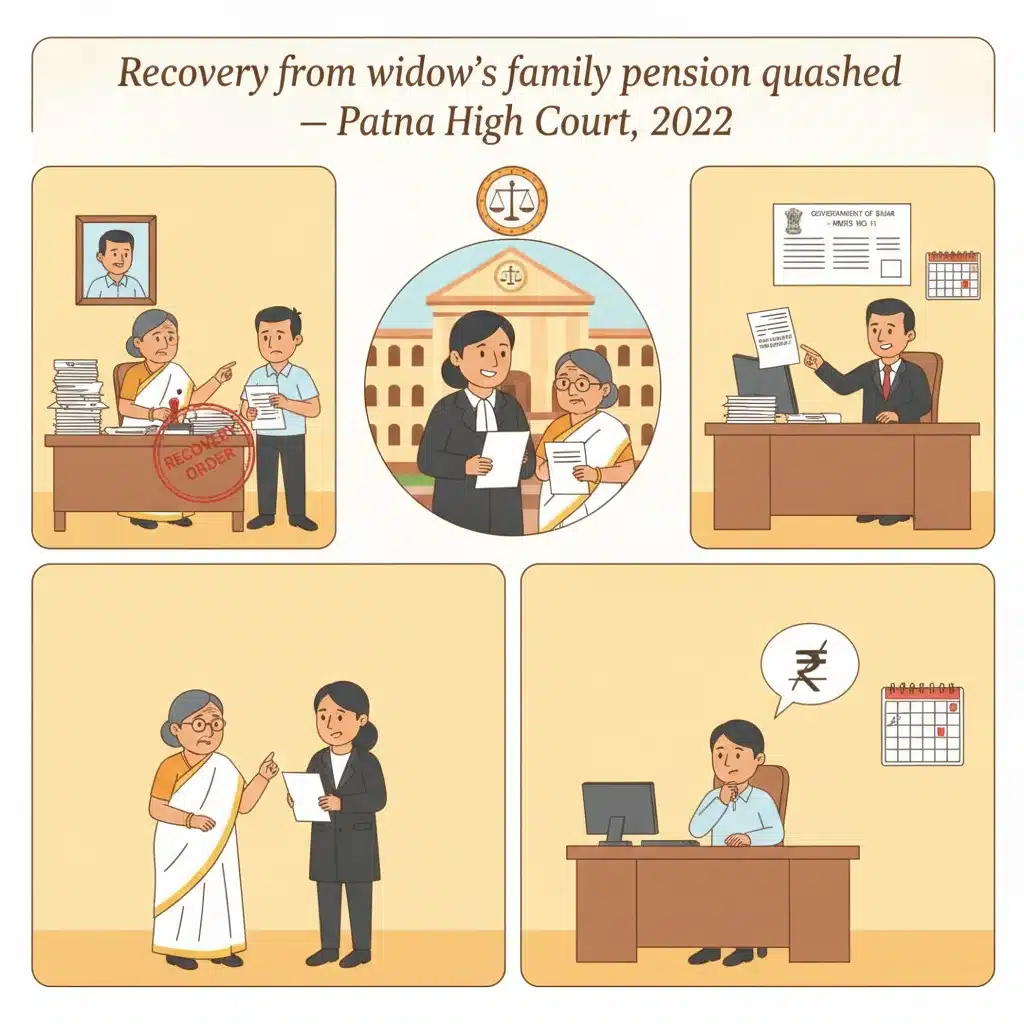
Case Background
The petitioner is the widow of a teacher of Sarvjit Sanskrit Upshastri College, Lahta, in Darbhanga district. The college is a deficit grant affiliated college under Kameshwar Singh Darbhanga Sanskrit University, Darbhanga.
Her husband was appointed as a teacher on 03.02.1977 by the Managing Committee of the college. His appointment was against a vacant sanctioned post approved by the Registrar of the University through Memo No. 2205 dated 22.09.1981, effective from 01.01.1980.
After serving for nearly four decades, he superannuated from service on 31.01.2019. During service, his pay was revised from time to time by a Pay Fixation Committee constituted by the University. No objection was raised by any authority regarding his pay scale till his retirement.
In 2016, the University issued a notification (Memo No. 311 dated 07.02.2016) stating that the Triple Benefit Scheme had been implemented for deficit affiliated colleges with effect from 31.08.2010. According to the petitioner, her husband, being a teacher of such a college, was entitled to this scheme, but the benefit was not extended to him till his death on 12.06.2019.
Despite several attempts, the petitioner did not receive full death-cum-retiral benefits such as pension, gratuity, provident fund, earned leave encashment and 7th Pay salary differences. She therefore approached the Patna High Court by filing Civil Writ Jurisdiction Case No. 14696 of 2021 seeking directions for payment of all retiral dues with interest at 10% per annum and for parity with similarly placed employees.
What the Court Examined and Decided
Justice Harish Kumar heard the writ petition on 09.11.2022. The Court first noted the main relief sought: payment of all retiral dues of the deceased employee, including pension, gratuity and other benefits, along with interest, and a declaration that similarly situated employees cannot be discriminated against.
During pendency of the writ case, an important development took place. The Government of Bihar issued Memo No. 11 dated 21.05.2021 directing that regular pension be paid only after verification of salary by the Pay Verification Cell. Acting on this decision, the Pay Verification Cell examined the salary of the petitioner’s late husband.
On the basis of this verification, it was concluded that an excess amount of Rs. 6,93,188/- had been wrongly calculated and paid to him. Treating this as overpayment, the Registrar of the University issued Office Order Memo No. 985 dated 22.08.2022 ordering deduction of Rs. 6,93,188/- from the pension and gratuity payable to the petitioner.
The widow, aggrieved by this fresh deduction order, challenged it through an interlocutory application in the same writ case. She argued that her husband’s pay had been fixed by a duly constituted Pay Fixation Committee, and for over a decade no irregularity had been pointed out. His pay had last been fixed in 2012 and he had retired on 31.01.2019 without any objection.
The petitioner stressed that the verification by the Pay Verification Cell happened after more than ten years of pay fixation and after her husband’s death on 12.06.2019. According to her, recovery from family pension and gratuity, especially after the death of the employee, was not legally permissible.
Her counsel relied on two major Supreme Court decisions. First, Syed Abdul Qadir and others vs. State of Bihar and others, (2009) 3 SCC 475, where the Supreme Court held that excess payment cannot be recovered if it was not due to any misrepresentation or fraud by the employee and was instead due to a bona fide mistake or wrong interpretation by the employer. Second, State of Punjab and others vs. Rafiq Masih (White Washer), (2015) 4 SCC 334, where the Supreme Court laid down categories of cases in which recovery by employers would be impermissible as it would be harsh and inequitable.
On the other side, senior counsel for the University submitted that the calculation of death-cum-retiral benefits was made strictly in pursuance of Government Memo No. 11 dated 21.05.2021, mandating payment of pension only after salary verification by the Pay Verification Cell. He argued that after proper calculation, the outstanding dues payable to the petitioner had been paid and the Branch Manager, State Bank of India, K.S.D.S.U. branch had issued a certificate to that effect.
The University further contended that the deduction from pension and family pension was made on the basis of the Pay Verification Cell’s recommendation. The Director, Higher Education Department, Government of Bihar, through Letter No. 15M1-110/202/2849 dated 24.12.2021, had directed all universities to get pay points of all teaching and non-teaching staff of Upshastri Colleges verified by the Pay Verification Cell. The University, being largely funded by the State Government for payment of salary, pension and retiral dues, was bound to implement these directions.
The central question that the Patna High Court framed for decision was: Could the University lawfully recover the alleged excess amount of Rs. 6,93,188/- from the petitioner’s family pension and gratuity, particularly when the deceased teacher had already superannuated on 31.01.2019 and had died much before the deduction order dated 22.08.2022?
The Court examined the record and noted that the husband of the petitioner was entitled to the Triple Benefit Scheme effective from 31.08.2010, which had been extended to all employees of deficit affiliated colleges. It also recorded that his pay scale, along with that of other employees, had been fixed by the University’s Pay Fixation Committee in 2012, and no objection was raised until his retirement in 2019.
The Court found that the case of the respondents was not based on any allegation of misrepresentation or fraud by the deceased teacher. There was no suggestion that he knew that he was being paid more than his entitlement. Even if excess payment was made, it was due to improper fixation by the Pay Fixation Committee acting under the direction of the Department of Higher Education, not due to any act of the employee.
To test the legality of the recovery, the Court carefully considered paragraphs 27 and 28 of the Supreme Court’s judgment in Syed Abdul Qadir. Those paragraphs, reproduced in the High Court judgment, explain that:
(a) Courts have repeatedly restrained recovery of excess payments where the excess was not due to misrepresentation or fraud by the employee; and (b) the overpayment arose because the employer applied a wrong principle or misinterpreted rules. In such situations, recovery is barred on equitable grounds to avoid hardship, especially where the employees had no knowledge of the error and had in good faith received the higher amounts for a long period.
The Patna High Court also relied on Rafiq Masih, where the Supreme Court held that in choosing between the employer’s right to recover and the employee’s interest, especially when the employee is the weaker party and the employer is a welfare State, equity and justice may bar recovery. Paragraph 18 of that judgment, quoted by the High Court, lists specific situations where recovery is impermissible, including:
(i) recovery from Class III and IV (Group C and D) employees; (ii) recovery from retired employees or those due to retire within a year; (iii) recovery of excess payments made for more than five years before the order of recovery; (iv) recovery where an employee had been made to discharge higher duties; and (v) any case where recovery would be so harsh and inequitable that it outweighs the employer’s right.
The High Court extracted the principle that, where excess payment has been made for more than five years and was not caused by any fault of the employee, recovery is generally not permissible. In the present case, the alleged excess payment was tied to pay fixation done in 2012, and the order of recovery came in 2022—well beyond five years.
A further aspect that weighed heavily with the Court was that the impugned recovery order was passed behind the back of the deceased employee. He had died in 2019, well before the issuance of Memo No. 985 dated 22.08.2022. He had no opportunity to defend his pay fixation or explain his entitlement. Throughout his service, neither the State nor the University had raised any objection to his pay scale; he was allowed to retire unblemished.
Considering these facts and the Supreme Court precedents, the Court concluded that the University was not entitled to recover the alleged excess amount from the petitioner’s family pension or gratuity. The deduction order was held to be unsustainable in law as well as on facts.
Consequently, the Patna High Court quashed Registrar’s Memo No. 985 dated 22.08.2022. The University was directed to refund forthwith the entire amount deducted from the petitioner’s family pension and gratuity, along with statutory interest. The writ application was allowed.
The Court added that if any other outstanding amounts were still due to the petitioner from the University, those too should be paid as early as possible, preferably within four weeks from the date of receipt or production of a copy of the Court’s order.
Why This Judgment Matters
This decision is significant for retired employees and their families, especially those in aided or affiliated colleges in Bihar. It sends a clear message that government departments and universities cannot, years later, cut pensions or gratuity on the ground that the Pay Verification Cell has now found an “excess payment”.
Where salary was fixed by the authorities themselves, and there is no fraud or misrepresentation by the employee, recovery from pension or family pension is treated as harsh and illegal. The Patna High Court has followed the Supreme Court line that equity and fairness must protect vulnerable retirees and widows from such shocks.
Practically, this judgment helps widows and other dependents whose family pension has been reduced due to retrospective audit objections. It also reminds universities and departments to act carefully during pay fixation rather than burdening families many years later.
Legal Issues and Answers
-
Issue: Can the University recover an alleged excess amount of Rs. 6,93,188/- from the family pension and gratuity of a deceased teacher, years after his pay was fixed and after his retirement and death, when there is no allegation of fraud or misrepresentation?
Answer: No. The Patna High Court held that such recovery is impermissible in law and on facts, relying on Supreme Court precedents. The deduction order (Memo No. 985 dated 22.08.2022) was quashed and the University was directed to refund the recovered amount with statutory interest.
Cases Cited by the Court
- Syed Abdul Qadir and others vs. The State of Bihar and others, (2009) 3 SCC 475.
- State of Punjab and others vs. Rafiq Masih (White Washer), (2015) 4 SCC 334.
Case Details
Case Number: Civil Writ Jurisdiction Case No. 14696 of 2021
Case Title: Mosmat Laxmi Devi vs. The State of Bihar & Ors.
Coram: Hon’ble Mr. Justice Harish Kumar
Date of Judgment: 09.11.2022
Citation: 2022(4) PLJR 712
Advocates:
For the petitioner: Mr. Kripa Nand Jha, Advocate
For the State (respondents): Mr. Madhaw Prasad Yadav, GP-23; Mr. Arvind Kumar, AC to GP-23
For the University: Mr. Tej Bahadur Singh, Senior Advocate; Mr. Nagendra Kumar Singh, Advocate
Nature of the Case: Writ petition under civil writ jurisdiction challenging non-payment and recovery from death-cum-retiral benefits (pension, family pension, gratuity and related dues).
Link to the Judgment: Click here to read the full Patna High Court judgment
If you found this explanation helpful and wish to stay informed about
how legal developments may affect your rights in Bihar,
you may consider following Samvida Law Associates for more updates.




