

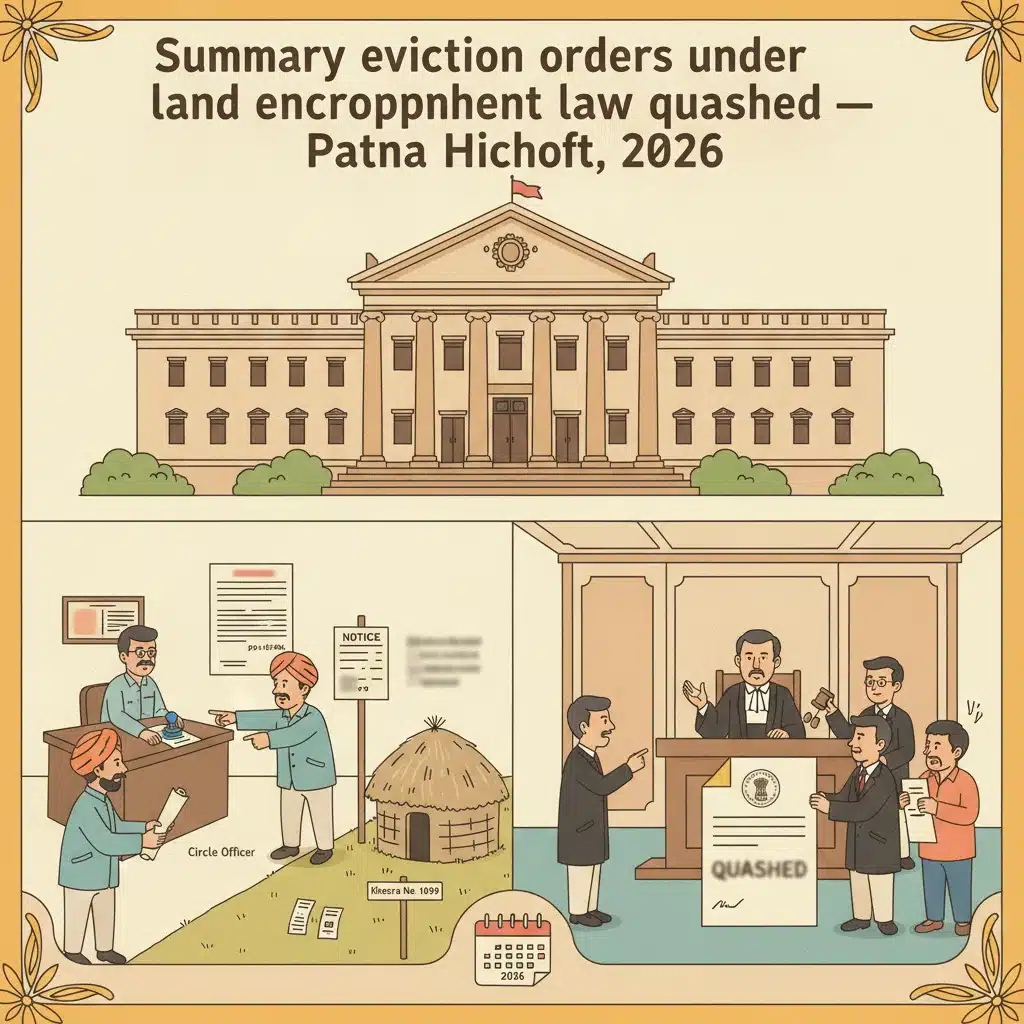
Case Background
The case concerns a small piece of land, 6 dhurs in area, situated on Plot/Khesra No. 1099, Village Amarpura, P.S. Lokahi, District Madhubani.
The petitioner claimed that a larger area of 3 katthas under Khesra No. 1099, Khata No. 275, was settled in favour of his grandfather, Babu Lal Gope, by the then Maharaja of Darbhanga on 20.07.1926, before the abolition of zamindari. According to him, a jamabandi was created in his grandfather’s name, later reflected as Jamabandi No. 258 carved out of Jamabandi No. 275, and rent was regularly paid to the State up to 2013‑14.
The petitioner stated that his family has been living peacefully on their dwelling house built on this raiyati land.
On 11.09.2013, respondent no. 6, a neighbouring resident, complained to the Sub‑Divisional Officer, Phulparas, alleging that there was encroachment over public land. The S.D.O. directed the Circle Officer to enquire and proceed.
Respondent no. 6 also filed CWJC No. 3050 of 2014 before the Patna High Court, seeking removal of the encroachment. On 07.02.2014, a Co‑ordinate Bench directed the authorities to ensure removal of encroachment within three months after hearing the parties.
In pursuance of that order, the Circle Officer, Lokahi, initiated Encroachment Case No. 21/2013‑14 on 19.04.2014 under the Bihar Public Land Encroachment Act, 1956. Notice under Section 3(1) of the Act was issued to the petitioner, asking him to appear on 05.05.2014 and file show cause.
The petitioner appeared on 05.05.2014, filed his written show cause setting out his title and long possession, and asserted that he was not an encroacher. However, on that very same date, the Circle Officer passed a final order directing him to remove the alleged encroachment from “public land” within 15 days.
The petitioner then moved CWJC No. 9357 of 2014 before the Patna High Court challenging the Circle Officer’s order. On 27.05.2014, the writ was disposed of with liberty to file an appeal under Section 11 of the Bihar Public Land Encroachment Act, 1956.
Accordingly, the petitioner filed Encroachment Appeal No. 10/2014‑15 before the Collector, Madhubani, annexing the 1926 settlement deed and other revenue documents, and reiterated that Khesra No. 1099, measuring 3 katthas out of gairmazarua aam khata, had been settled with his ancestor and that Khata No. 352 had subsequently been created in his grandfather’s name.
The Collector rejected the appeal by order dated 18.11.2014. Relying upon a report of the Circle Inspector and revenue staff, the Collector held that Khesra No. 1099 stood recorded as gairmazarua aam rasta (public road) in the survey khatiyan of kism dagar, over which the petitioner had constructed a thatched hut. The Collector concluded that the petitioner had failed to prove his title because he did not produce “relevant documents” of ownership or settlement.
Aggrieved, the petitioner filed the present writ petition, CWJC No. 526 of 2015, before the Patna High Court challenging both the Circle Officer’s final order dated 05.05.2014 and the Collector’s appellate order dated 18.11.2014. A Co‑ordinate Bench granted an interim stay on 20.02.2015. The matter has now been finally decided by the Patna High Court by oral judgment dated 10.08.2026.
What the Court Examined and Decided
The Patna High Court first noted that notices had been issued to respondent no. 6, the complainant, but she chose not to appear. The Court then heard counsel for the petitioner and the State.
On behalf of the petitioner, it was argued that:
• The land had been settled in 1926 in favour of his grandfather by the Maharaja of Darbhanga.
• Jamabandi was created in his grandfather’s name and rent was paid till 2013‑14, showing continuous recognition by the State.
• Such long‑standing raiyati land and jamabandi cannot be disturbed through a summary encroachment proceeding under the Bihar Public Land Encroachment Act, 1956.
• Even if the State disputed the jamabandi, it was bound to approach a competent civil court for cancellation; until then, the jamabandi stands.
• The Circle Officer passed the final order on the very same day the show cause was filed, which itself showed that there was no real enquiry or evidence-taking as required under Sections 3, 4, 5 and 10 of the Act.
• Under Section 10, the authorities have powers similar to a civil court—calling for records, summoning witnesses, admitting evidence and conducting enquiry. These powers must be properly used to form a prima facie opinion whether the land is actually “public land” as defined in Section 2(3). This was not done.
On behalf of the State, it was argued that:
• Adequate opportunity had been given to the petitioner to defend his case.
• The petitioner failed to produce necessary documents before the appellate authority in support of the alleged 1926 settlement.
• As per paragraph 7 of the counter‑affidavit and revenue records, 6 dhurs of Khesra No. 1099 were recorded as gairmazarua aam rasta in the cadastral survey khatiyan and had been encroached upon by a thatched hut.
• The small portion of 6 dhurs did not fall within the 1926 settlement.
The petitioner, in reply, firmly asserted that the 6 dhurs formed part of the settled land and that the State’s stand was incorrect.
The Court closely examined the orders of the Circle Officer and the Collector.
Regarding the Circle Officer’s order dated 05.05.2014, the Court found that:
• The petitioner filed his show cause on 05.05.2014 pursuant to a notice dated 19.04.2014.
• On the same date, without any further enquiry, without summoning revenue records, and without giving a proper hearing, the Circle Officer passed the final order directing removal of encroachment within 15 days.
The Court held that this procedure was contrary to the Bihar Public Land Encroachment Act, 1956. Sections 3, 4, 5 and 10 require the authority to:
• Issue notice and grant reasonable time to respond.
• Hear the concerned persons.
• Take evidence, if any.
• Conduct such enquiry as may be necessary by calling for records.
None of this was done in a meaningful way, as everything happened on the same day the show cause was filed. Thus, the Court concluded that there was no real opportunity of hearing and no evidence was considered before branding the petitioner an encroacher.
Regarding the Collector’s appellate order dated 18.11.2014, the Court noted that the Collector had referred to some inspection reports but had not given a clear and definite finding on the vital issue of jamabandi and long‑standing settlement in favour of the petitioner’s ancestors. The Collector rejected the appeal mainly saying that the petitioner failed to prove his title and that survey records showed the land as gairmazarua aam rasta. However, the Collector did not properly deal with the 1926 settlement deed or the admitted long‑running jamabandi.
The High Court then referred to earlier decisions on the scope of the Bihar Public Land Encroachment Act, 1956.
In Uma Devi v. State of Bihar, CWJC No. 9773 of 2000 (decided on 05.03.2001), this Court held that where there is a question of title, proceedings under the land encroachment Act are not the proper remedy. Rights, title or interest must be decided by a competent civil court, and until that is done, authorities cannot use the encroachment Act to dislodge occupants.
Similarly, in Bipin Bihari Verma v. State of Bihar, CWJC No. 4876 of 2021 (judgment dated 21.05.2026), a Co‑ordinate Bench reiterated that long‑standing jamabandis cannot be cancelled in a summary proceeding. If the State wants to challenge such old settlements, particularly those prior to 01.01.1946, its remedy is to approach a competent civil court for cancellation of the settlement first and then the jamabandi. Paragraph 33 of that judgment was quoted in detail.
The same principle was followed in Sunita Rani Sah v. State of Bihar, CWJC No. 15484 of 2022, decided on 18.06.2026, where it was again held that long‑standing jamabandi cannot be cancelled in summary proceedings and the State must file a civil suit for appropriate declaration.
Applying these principles, the High Court in the present case held that:
• The Bihar Public Land Encroachment Act, 1956, applies only to public land.
• Proceedings under this Act cannot be initiated over raiyati land of private persons, particularly where they are in possession for almost 100 years on the strength of an old settlement and jamabandi.
• The issue of jamabandi and ancestral settlement in favour of the petitioner had not been properly considered by the authorities.
• The State’s argument that a “wrong jamabandi” was created could not assist it, because the jamabandi in favour of the petitioner’s ancestors still exists and has never been challenged before any forum.
The Court therefore held that the proceedings initiated under the Bihar Public Land Encroachment Act, 1956 against the petitioner were vitiated.
The Court then went further and issued wider guidelines for authorities under the Act. It observed that many cases under the Bihar Public Land Encroachment Act, 1956 involve disputes over raiyati lands and long‑standing titles, leading to unnecessary litigation and harassment. The Court emphasised that proceedings under the Act cannot be used against raiyati land and that frivolous complaints must be curtailed.
The Court summarised the statutory scheme of Sections 3, 4, 5, and 6 of the Act, explaining the step‑by‑step process that the Collector or Circle Officer must follow—from forming a prima facie view, issuing notice, hearing parties, taking evidence, to passing an order under Section 6(1) either dropping proceedings, granting settlement, claiming damages, or directing removal with forfeiture.
Crucially, the Court directed that when an authority forms a prima facie view under Section 3, it must use its Section 10 powers to call for records like jamabandi, khatiyan, Register‑II entries, decrees of title/partition suits, and documents of various types of settlements. The authority must then record a clear finding whether there is a bona fide dispute regarding the nature of the land.
If such a bona fide dispute exists, the case should not be pursued under the Bihar Public Land Encroachment Act, 1956 but should be addressed as follows:
• If the dispute relates to a recently created jamabandi, the State may apply under Section 9 of the Bihar Land Mutation Act, 2011 for cancellation before the Additional Collector.
• If the dispute relates to a long‑standing jamabandi backed by substantial documents, it is a bona fide dispute, and the onus shifts to the State to file a civil suit for cancellation of the settlement/jamabandi.
• If the person claiming title produces no supporting documents, the burden lies on him to approach a civil court for declaration of his rights.
The Court also highlighted Section 4(g) and (h) of the Bihar Land Reforms Act, 1950, clarifying that the Collector cannot annul transfers or settlements made before 01.01.1946. Settlements prior to that date must be challenged only through civil court.
Further, the Court directed that if, on receiving a complaint under Section 3(1), the authority finds it to be motivated or aimed at some improper gain, reasons should be recorded and action may be taken against the complainant under Section 248 of the Bharatiya Nyaya Sanhita, 2023.
The Court discouraged writ petitions challenging mere show cause notices under Section 3(1) or final orders under Section 6(1) without exhausting remedies of appeal under Section 11 and review under Section 13, except where there is violation of natural justice, patent illegality, error on the face of record, or issue of long‑standing settlements justifying exercise of writ jurisdiction.
Finally, the Court underscored that right to shelter is part of Article 21 of the Constitution, and Article 300A protects property. Demolition or removal from khatiyani land without due process and valid notice can attract liability on the State to pay compensation. The amount and mode of compensation will depend on facts of each case.
On these findings, the Court allowed the writ petition, quashed the Collector’s order dated 18.11.2014 in Encroachment Appeal No. 10/2014‑15 and the Circle Officer’s order dated 05.05.2014 in Encroachment Case No. 21/2013‑14.
The matter was remanded to the Circle Officer, Madhubani (respondent no. 5) to reconsider the petitioner’s case in light of paragraphs 28 to 30 of the judgment. The Circle Officer must minutely examine the grounds based on settlement and jamabandi, record a prima facie satisfaction after hearing all parties, and complete the exercise within four months from the date of judgment. Till then, status quo as on the date of the judgment is to be maintained between the parties.
Why This Judgment Matters
This judgment is significant for residents of Bihar, especially villagers living on ancestral homestead or agricultural lands recorded in jamabandi.
First, the Patna High Court has clearly held that proceedings under the Bihar Public Land Encroachment Act, 1956 cannot be used to evict people from raiyati land, particularly where their settlement and jamabandi are decades old and unchallenged.
Second, it protects ordinary citizens from sudden eviction orders passed in a hurry. Authorities must now call for revenue records, hear both sides properly, and record clear findings before treating someone as an encroacher.
Third, the Court has laid down detailed guidelines for Circle Officers and Collectors, telling them when to drop encroachment proceedings and instead direct cases towards civil courts or mutation authorities. This can significantly reduce harassment caused by misuse of encroachment law.
Fourth, the judgment reminds authorities that right to shelter and property are constitutionally protected and that illegal demolitions or removals may expose the State to compensation claims.
For people in Bihar facing similar allegations of “encroachment” on lands they have possessed for generations, this Patna High Court decision offers a strong basis to insist that their jamabandi and old settlements be respected and that disputes of title be taken to civil courts, not decided in fast‑track administrative proceedings.
Legal Issues and Answers
- Issue: Can long‑standing raiyati land held under an old settlement and jamabandi be treated as “public land” and dealt with under the Bihar Public Land Encroachment Act, 1956, through summary proceedings?
Answer: No. The Court held that the Bihar Public Land Encroachment Act, 1956 applies only to public land and cannot be invoked against raiyati land settled long back. Long‑standing jamabandis cannot be cancelled in summary encroachment proceedings; the State must approach a civil court if it disputes such settlements. - Issue: Were the orders of the Circle Officer and the Collector valid when passed without proper enquiry, without examining jamabandi and settlement records, and without giving effective hearing to the petitioner?
Answer: No. The Court found that the Circle Officer failed to comply with mandatory procedures under Sections 3, 4, 5 and 10 of the Act and that the Collector did not give a clear finding on the jamabandi and long‑standing settlement. Both orders were held contrary to law and were quashed. - Issue: What procedure must authorities follow in future while dealing with complaints under the Bihar Public Land Encroachment Act, 1956, especially where disputes of title and jamabandi arise?
Answer: The Court issued detailed guidelines requiring authorities to call for jamabandi, khatiyan, Register‑II and other records, determine if a bona fide title dispute exists, and, depending on whether jamabandi is recent or long‑standing and what documents are produced, either proceed under the Act or direct the parties/State to appropriate civil or mutation proceedings.
Cases Cited by the Court
- Uma Devi v. State of Bihar, CWJC No. 9773 of 2000, judgment dated 05.03.2001 – holding that when a question of title is involved, proceedings under the land encroachment Act are not the proper remedy.
- Bipin Bihari Verma v. State of Bihar, CWJC No. 4876 of 2021, judgment dated 21.05.2026 – reiterating that long‑standing jamabandis, especially based on pre‑1946 settlements, cannot be cancelled in summary proceedings and must be challenged in civil court.
- Sunita Rani Sah v. State of Bihar, CWJC No. 15484 of 2022, judgment dated 18.06.2026 – reaffirming that long‑standing jamabandi cannot be cancelled and that the State must file a civil suit for declaration.
Case Details
Case Number: Civil Writ Jurisdiction Case No. 526 of 2015
Case Title: Asharfi Yadav v. The State of Bihar and Others
Citation: 2026 (5) PLJR 211
Court: High Court of Judicature at Patna
Coram: Hon’ble Mr. Justice Raj Kumar
Date of Judgment: 10.08.2026
Advocates: Mr. Gajendra Kumar Jha, Advocate and Mr. Sushil Kumar Jha, Advocate for the petitioner; Mr. Santosh Chandra Bhaskar, AC to GP‑11 for the State. Appearance of respondent no. 6: notice served, but no appearance.
Nature of Case: Writ petition under Article 226 of the Constitution challenging orders passed under the Bihar Public Land Encroachment Act, 1956 (encroachment proceedings and encroachment appeal).
Impugned Orders: Final order dated 05.05.2014 passed by the Circle Officer, Lokahi, in Encroachment Case No. 21/2013‑14; Appellate order dated 18.11.2014 passed by the Collector, Madhubani, in Encroachment Appeal No. 10/2014‑15.
Final Outcome: Writ petition allowed; both impugned orders quashed; matter remanded to Circle Officer, Madhubani, for fresh consideration in accordance with law and in terms of paragraphs 28 to 30 of the judgment, to be completed within four months; status quo directed till then.
Link: https://patnahighcourt.gov.in/viewjudgment/MTUjNTI2IzIwMTUjMSNO—ak1–T1a8pvSwiU=
If you found this explanation helpful and wish to stay informed about how legal developments may affect your rights in Bihar, you may consider following Samvida Law Associates for more updates.




