

Case Background
The matter came before the Patna High Court in a writ petition registered as Civil Writ Jurisdiction Case No. 19064 of 2018.
The petitioner is the registered owner of a car bearing Registration No. BR06AD2443. This vehicle was seized in connection with Muffasil P.S. Case No. 475 of 2018.
The criminal case was registered for offences punishable under Section 30(a) of the Bihar Prohibition and Excise Act. As per the seizure list, 86.4 litres of Indian Made Foreign Liquor (I.M.F.L.) was recovered in connection with this case.
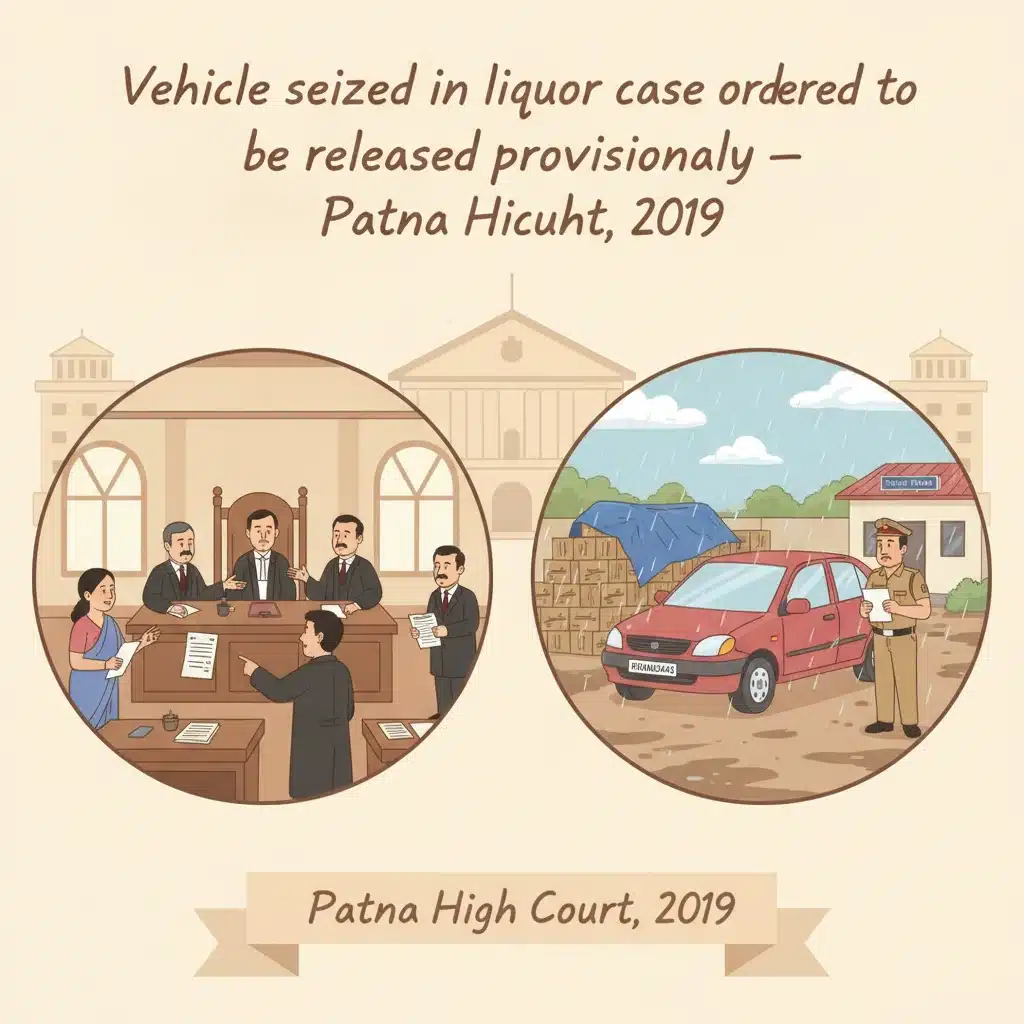
After the seizure, the vehicle remained parked in the police station, exposed to the open sky, and the confiscation proceeding under the Bihar Prohibition and Excise Act had not yet been initiated.
In these circumstances, the petitioner approached the Patna High Court seeking provisional release of the seized vehicle.
What the Court Examined and Decided
The Division Bench of the Patna High Court, comprising Hon’ble Mr. Justice Jyoti Saran and Hon’ble Mr. Justice Arvind Srivastava, heard the case on 01-04-2019.
The Court heard learned counsel for the petitioner as well as learned counsel for the State. The main relief sought was provisional release of the car that had been seized in the prohibition case.
The key facts before the Court were:
First, the vehicle bearing Registration No. BR06AD2443 had been seized in Muffasil P.S. Case No. 475 of 2018 under Section 30(a) of the Bihar Prohibition and Excise Act.
Second, the seizure list showed that 86.4 litres of I.M.F.L. were seized in the case.
Third, the confiscation proceeding in respect of the vehicle had not yet been started by the competent authority under the Bihar Prohibition and Excise Act.
Fourth, the vehicle was lying in the police station in the open, subject to weather and possible deterioration.
The Court considered these factors together. It particularly noted the “nature of seizure made” and the fact that the confiscation proceeding was “yet to be initiated.”
In many prohibition-related seizures, vehicles are kept unused for long periods. When such vehicles remain parked in the open without proper care, they often suffer damage, lose value, and become almost unusable by the time legal proceedings are completed.
Balancing the interests of the State and the rights of the vehicle owner, the Patna High Court chose a middle path: allowing provisional release but with strict safeguards to ensure that the vehicle would remain available for confiscation, if ordered later.
The Court therefore directed that the vehicle be released provisionally in favour of the petitioner, subject to the petitioner establishing ownership and complying with certain conditions.
First, for release, the petitioner must produce the ownership and registration documents showing that the vehicle stands in his name. These are to be produced before the designated Court below.
Second, the petitioner must furnish one surety along with either a Bank Guarantee or original title deed of immovable property situated within the district. The value covered by the Bank Guarantee or property must be equal to the value of the vehicle as indicated in the insurance document.
This requirement protects the financial interest of the State. If later the confiscation authority orders confiscation, the State will have security in place equivalent to the vehicle’s value.
Third, while submitting the surety and Bank Guarantee or title deed, the petitioner must also furnish certain affidavits and undertakings, as directed by the Court.
The first undertaking is that the vehicle has never been involved in any similar offence in the past and shall not be used for a similar offence in future.
The second undertaking is that the petitioner will not create any third-party right or interest in respect of the vehicle while confiscation proceedings are pending. He will not alienate or transfer the vehicle during this period. This ensures that the vehicle remains under the effective control of the legal process.
The third undertaking is that the petitioner will produce the vehicle before the confiscating authority whenever required. This is crucial to make sure the vehicle can be presented before the authority or court at later stages.
The fourth condition relates to evidence. Before the vehicle is released, the designated Court below will prepare a Panchanama. During this process, photographs of the vehicle will be taken, and these photographs will be certified by the petitioner. The Panchanama and photographs will be kept on record.
This Panchanama will serve as secondary evidence in the future, if required. For example, if there is a dispute over the identity or condition of the vehicle at the time of seizure, these records can help the Court. The petitioner must also undertake that he will not challenge the Panchanama during trial.
The High Court also fixed a time frame for compliance. It directed that the release of the vehicle should be allowed within 14 days from the date the petitioner produces the ownership and registration papers, surety, Bank Guarantee or title deed, and all required undertakings before the designated Court below.
However, the Court made it very clear that this release is provisional. It will always remain subject to the initiation and finalisation of confiscation proceedings under the Bihar Prohibition and Excise Act.
If the confiscation authority later decides to confiscate the vehicle, that order will prevail, and the security provided by the petitioner (Bank Guarantee or title deed) will remain in the safe custody of the Court below until final decision in the confiscation proceedings.
Thus, the State’s powers under the Prohibition law are preserved, while the vehicle owner is protected from unnecessary damage and loss due to long-term seizure.
After giving these directions and setting these safeguards, the Patna High Court allowed the writ petition.
Why This Judgment Matters
This judgment is important for vehicle owners whose vehicles are seized in liquor-related cases under the Bihar Prohibition and Excise Act.
Many people, including drivers and small owners, suffer when their vehicles remain parked in police stations for months or years, even when confiscation proceedings are not yet started. The value of the vehicle falls, and some vehicles become junk by the time cases finish.
By directing provisional release with conditions, the Patna High Court shows that the courts can protect property from damage while still safeguarding the State’s right to confiscate, if the law requires.
The decision clarifies that when confiscation proceedings have not even begun, and the vehicle is lying idle, the Court can step in and order conditional release. The owner must, however, be ready to give security and strong undertakings.
For ordinary citizens, this judgment highlights that they can approach the High Court for relief if their vehicle is seized and kept for long periods without confiscation proceedings, especially in prohibition-related matters.
Legal Issues and Answers
Issue: Can a seized vehicle, involved in a case under Section 30(a) of the Bihar Prohibition and Excise Act, be released provisionally when confiscation proceedings have not yet been initiated?
Answer: Yes. The Patna High Court directed provisional release of the vehicle to its owner, subject to production of ownership documents, furnishing of surety and Bank Guarantee or immovable property title deed equal to the vehicle’s value, and filing of specific undertakings, while making clear that such release will remain subject to future confiscation proceedings.
Cases Cited by the Court
- The judgment text does not mention or rely on any other decided case. No prior case law is cited.
Case Details
Case Number: Civil Writ Jurisdiction Case No. 19064 of 2018
Case Title: Vivek Kumar v. The State of Bihar and Others
Coram: Hon’ble Mr. Justice Jyoti Saran; Hon’ble Mr. Justice Arvind Srivastava
Citation: 2022 (4) PLJR 619
Advocates: For the petitioner – Mr. Umesh Chandra Verma; For the respondents/State – Mr. Anil Kr. Sinha, GA 1
Nature of the Case: Writ petition seeking provisional release of vehicle seized in a criminal case under Section 30(a) of the Bihar Prohibition and Excise Act
Date of Judgment: 01-04-2019
Link to Judgment: https://patnahighcourt.gov.in/viewjudgment/MTUjMTkwNjQjMjAxOCMxI04=-fM8TD8TLVcw=
If you found this explanation helpful and wish to stay informed about
how legal developments may affect your rights in Bihar,
you may consider following Samvida Law Associates for more updates.




