

Case Background
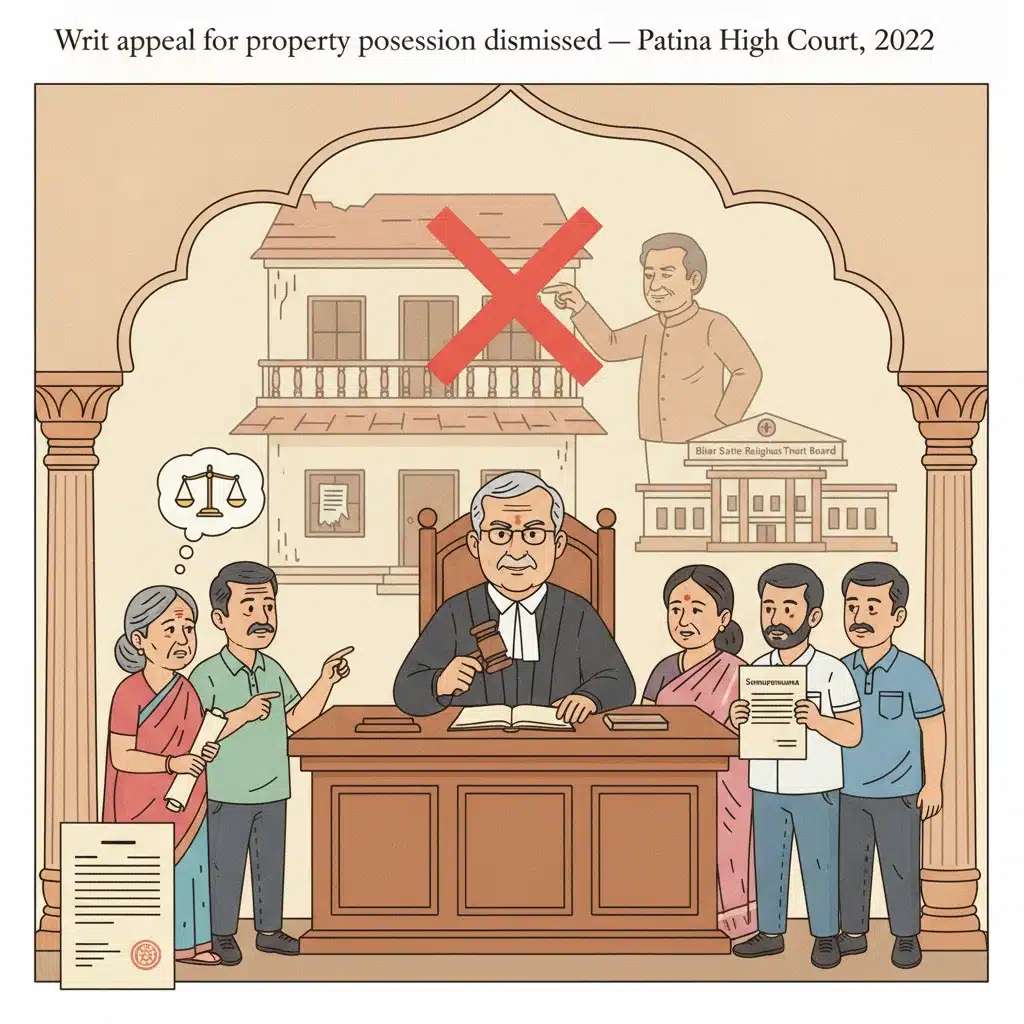
The dispute concerns a two-storey building standing over several plots in East Champaran district. The appellants claim that this property is their personal property and that they have full right, title and interest over it.
Their claim is based on registered sale deeds said to have been executed in favour of the grandmother of the first appellant in the year 1944. On this basis, they asserted private ownership over the building and the underlying plots.
However, some people from the locality took a different stand. They relied on a document described as “Samarpannama” dated 08.04.1952. Based on this document, they sought a declaration that the same property is a public or religious trust property, and not a private asset.
Because of this conflict, civil and quasi-judicial proceedings started. A Title Suit bearing T.S. No. 176 of 2020 was filed seeking a declaration that the premises is a public trust. The present appellants were made defendants in that civil suit.
Separately, persons named Deepak Agarwal and Anil Agarwal approached the Bihar State Religious Trust Board. They sought a declaration from that statutory body that the property is a religious trust property and not a private property. Those proceedings are still pending final adjudication.
The appellants claim that, during this period of dispute, they were forcibly evicted from the premises. According to them, a local politician interfered and they lost possession of the building, even though a proceeding under Section 144 of the Code of Criminal Procedure relating to the property had been dropped midway.
Aggrieved, the appellants moved the Patna High Court by way of Civil Writ Jurisdiction Case No. 8844 of 2020. They asked for directions to restore their possession over the building and to restrain the District Magistrate, East Champaran at Motihari, from interfering with the property.
The learned Single Judge, by order dated 10.03.2021, refused to issue any such directions. The judge noted the pendency of the title suit and other proceedings and declined to exercise writ jurisdiction for restoring possession.
The appellants then filed the present Letters Patent Appeal No. 291 of 2021 before a Division Bench of the Patna High Court challenging that order.
What the Court Examined and Decided
The Division Bench, comprising Hon’ble Mr. Justice Ashutosh Kumar and Hon’ble Mr. Justice Jitendra Kumar, heard the appeal. The main grievance of the appellants was that the learned Single Judge had failed to protect their possession over their alleged private property.
On behalf of the appellants, it was argued that they had a clear chain of title based on registered sale deeds of 1944 in favour of the grandmother of the first appellant. They claimed that, in spite of this, they had been forcibly dispossessed with the help of a local politician.
The appellants’ counsel, Ms. Mahasweta Chatterjee, challenged the approach of the learned Single Judge. She pointed out that the judge had heavily relied on the pendency of Title Suit No. 176 of 2020, in which the question is whether the premises is a public trust property. She submitted that mere pendency of that suit should not have prevented the Court from directing restoration of possession to the appellants.
She also highlighted that Deepak Agarwal and Anil Agarwal had simultaneously approached the Bihar State Religious Trust Board seeking a declaration that the property is a religious trust. Those proceedings too were pending and had not yet resulted in any final decision.
In simple terms, the appellants’ side wanted the High Court, in its writ jurisdiction under Article 226 of the Constitution of India, to decide, at least for the purpose of possession, in their favour while the civil and trust proceedings were still going on.
The Division Bench examined the situation carefully. It noted that there were serious and basic disputes of fact regarding the nature of the property: whether it was purely private, as the appellants claimed, or whether it had been dedicated as a public or religious trust, as the other side claimed on the basis of the “Samarpannama” of 1952.
These competing claims were already the subject matter of the pending title suit in the civil court, where the appellants were defendants, and of proceedings before the Bihar State Religious Trust Board. Both forums are competent to examine documents, hear witnesses and take evidence.
The Division Bench observed that in such a situation, it was not proper for the High Court to use its writ powers to decide the issue of possession, because that would indirectly involve deciding the underlying ownership and trust questions. These questions are complex and require detailed examination of facts and law.
The Court relied on several judgments of the Hon’ble Supreme Court on this point. It referred to Union of India and others v. Ghaus Mohammad, AIR 1961 SC 1526; D.L.F. Housing Construction (P) Limited v. Delhi Municipal Corporation and others, AIR 1976 SC 386; State of Rajasthan v. Bhawani Singh and others, 1993 Supp. (1) SCC 306; and State of Bihar and others v. Chandrabanshi Singh, 2015 SCC OnLine Pat 10048.
These decisions lay down a clear principle: where basic facts are in serious dispute and the rights of parties depend on complicated questions of law and fact requiring evidence, the High Court should not try to resolve them in a writ petition. Instead, the proper course is to leave those issues to the civil court or other competent forum and to dismiss the writ petition at the threshold, without going into the merits.
The Supreme Court has also cautioned that if High Courts try to decide such fact-heavy disputes in writ proceedings, it can lead to “perilous and hazardous” results. Important issues of rights might become very difficult to prove later, and the normal process of evidence could be undermined.
Applying this guidance, the Division Bench held that the learned Single Judge was correct. In the interregnum, that is, while the title suit and Religious Trust Board proceedings are pending, no direction could have been issued under Article 226 for restoration of possession to the appellants.
The Bench found no “fault-line” in the Single Judge’s order. It agreed that writ jurisdiction was not the proper remedy for the appellants in this type of property dispute involving rival claims of private ownership versus public or religious trust.
The Court also observed that the learned Single Judge had kept in mind all the relevant principles from the Supreme Court judgments when rejecting the appellants’ request. After hearing the submissions of Ms. Chatterjee, the Division Bench remained unconvinced that any interference was required.
Ultimately, the Letters Patent Appeal was dismissed. However, the Court clarified an important point. It expressly stated that the appellants are at liberty to have their claims and rights vindicated by approaching the appropriate forum, a right to which they are entitled.
This means the appellants can continue to contest the title suit and the proceedings before the Bihar State Religious Trust Board. There, they can lead evidence, rely on the 1944 sale deeds, challenge the “Samarpannama” of 1952 and argue that the property is private. Those forums will then decide the matter on merits.
The Division Bench thus kept the door open for the appellants to fight their case, but made it clear that the High Court’s writ jurisdiction is not a shortcut to bypass the regular civil process when facts are seriously disputed.
Why This Judgment Matters
This judgment is significant for people involved in property disputes, especially where there is a claim that private property has become a public or religious trust. The Patna High Court has underlined that such questions cannot be settled through writ petitions when factual disputes are deep and complex.
For ordinary citizens, the message is that if your property rights are challenged and others claim it is trust property, you must primarily fight your case in the civil court or before the designated statutory authority. The High Court, under Article 226, will not normally restore possession or decide ownership when the basic facts are hotly contested.
The decision also protects the integrity of civil trials. It ensures that evidence is taken and tested in the usual way, rather than through brief affidavits and arguments in writ proceedings. This reduces the risk of hurried or incomplete fact-finding in sensitive property and trust matters.
Finally, the judgment reassures litigants that dismissal of a writ petition in such circumstances does not shut the door on their claims. They still have the right to pursue appropriate remedies before proper forums, where their rights can be fully adjudicated.
Legal Issues and Answers
Issue: Can the Patna High Court, in writ jurisdiction under Article 226, direct restoration of possession of a disputed property to the appellants when there are serious factual disputes and pending proceedings on whether the property is private or a public/religious trust?
Answer: No. The Court held that where basic facts are disputed and complicated questions of law and fact require evidence, and where a title suit and Religious Trust Board proceedings are already pending, no such direction can be issued in writ proceedings. The proper course is to seek relief before the appropriate forums.
Cases Cited by the Court
- Union of India and others v. Ghaus Mohammad, AIR 1961 SC 1526
- D.L.F. Housing Construction (P) Limited v. Delhi Municipal Corporation and others, AIR 1976 SC 386
- State of Rajasthan v. Bhawani Singh and others, 1993 Supp. (1) SCC 306
- State of Bihar and others v. Chandrabanshi Singh, 2015 SCC OnLine Pat 10048
Case Details
Case Number: Letters Patent Appeal No. 291 of 2021 in Civil Writ Jurisdiction Case No. 8844 of 2020
Case Title: Nawal Kishor Sureka and others v. The State of Bihar and others
Coram: Hon’ble Mr. Justice Ashutosh Kumar and Hon’ble Mr. Justice Jitendra Kumar
Citation: 2022 (4) PLJR 791
Advocates: Ms. Mahasweta Chatterjee, Advocate for the appellants; Mr. Saroj Kumar, Advocate for the State/respondents
Date of Judgment: 23-06-2022
Nature of the Case: Letters Patent Appeal against dismissal of a writ petition seeking restoration of possession of disputed property and restraint on interference by district authorities
Link to Judgment: https://patnahighcourt.gov.in/viewjudgment/MyMyOTEjMjAyMSMxI04=-U9Jmm1iTACI=
If you found this explanation helpful and wish to stay informed about
how legal developments may affect your rights in Bihar,
you may consider following Samvida Law Associates for more updates.




