

Case Background
The case arose from the election to the post of Chairman of Kanahauli Vishanparsi Primary Agriculture Co-operative Society (PACS), Block Mahua, District Vaishali.
The earlier Chairman had died on 02.01.2020, creating a vacancy to the post of Chairman of the PACS. To fill this vacancy, the election process was started, and nomination papers for the post of Chairman had already been filed by the time the matter came before the Patna High Court.
Two petitioners approached the Court. Petitioner no. 1 was the working Chairman of the PACS. Petitioner no. 2 was the PACS itself, represented through its working Chairman. They filed the writ petition in a representative capacity, claiming that a large section of genuine members of the PACS had been left out of the voter list and many ineligible names had been included.
The grievance of the petitioners revolved entirely around the correctness of the voter list prepared for the PACS election. Despite their representations and objections, they alleged that the authorities at the district and block levels did not act on their complaints. When the election process continued without rectifying the voter list, they moved the High Court under its writ jurisdiction.
What the Court Examined and Decided
The petitioners asked the Patna High Court to issue a writ of mandamus directing the authorities to correct the voter list of the Kanahauli Vishanparsi PACS.
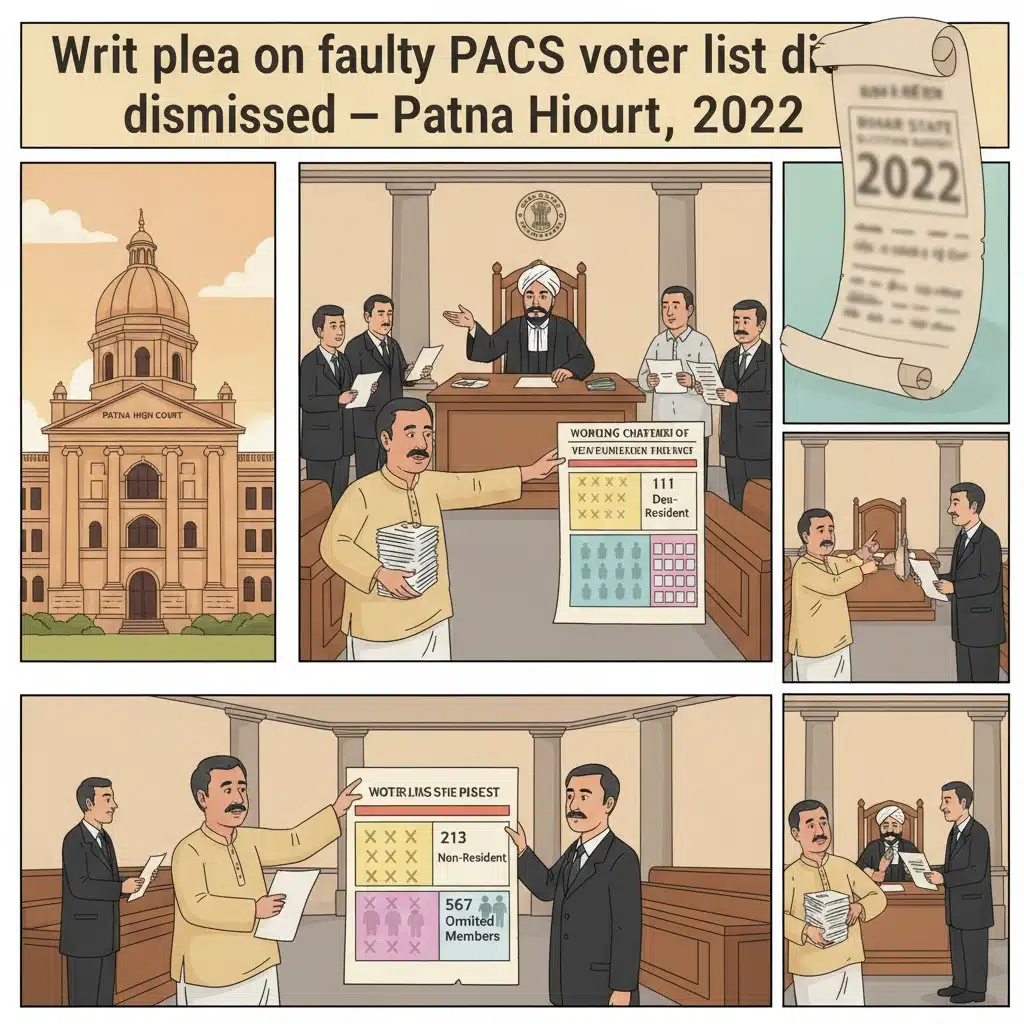
They specifically requested deletion of the names of 111 persons who, according to them, had died, and 213 persons who, according to them, were not residents of the concerned Panchayat where the PACS is located. They also sought inclusion of the names of 567 persons stated to be members of the PACS whose names were missing from the final voter list.
The petitioners claimed that the final voter list had been published without considering their claims and those of other aggrieved persons, which they said was clear from materials annexed to the writ petition. On this basis, they argued that the election process itself was tainted.
Besides correction of the voter list, they asked the Court to direct the authorities to issue a revised voter list or corrigendum, and to allow only valid members of the PACS to contest the election and vote. They wanted the election process for the post of Chairman of the PACS to be stayed until the voter list was corrected.
The petitioners also prayed for a direction restraining the authorities from proceeding with the election for the post of Chairman until objections were considered and necessary corrections carried out. They asserted that, despite directions from a superior authority referred to as respondent no. 11 in the pleadings, the district and block level authorities had not complied. Yet, the State Election Authority was allegedly proceeding with the election knowing these directions were not implemented.
Further, they sought a declaration that any order passed by the concerned authorities in violation of the prescribed rules and procedure and without considering their claim was illegal and unsustainable. They additionally asked the Court to hold that the very initiation of the PACS election process was illegal as being contrary to Section 14(a) of the Bihar Co-operative Society Act, 1935. They also prayed for any other appropriate relief.
In response, the Court focused on one central aspect: whether such grievances could be raised through a writ petition once the election process had already started.
The Bench noted that the Bihar State Election Authority Act, 2008, governs elections relating to co-operative societies, including PACS. Section 10 of this Act clearly provides that the election to any office of a co-operative society shall not be called in question except by way of an election petition as prescribed. A similar mandate appears in Rule 11 of the Bihar State Election Authority Rules, 2008.
The Court observed that, in view of these provisions, there exists a specific and exclusive remedy for challenging PACS elections, including issues about voter lists. This remedy is an election petition to be filed after the election process is over, not a writ petition under Article 226 of the Constitution while the election is ongoing.
The Bench then turned to the settled legal position of the Supreme Court on interference with elections during the election process. It pointed out that, right from the beginning, the Supreme Court has consistently held that courts should not interfere with an election once the process has started.
The Patna High Court referred in detail to the landmark case of N.P. Ponnuswami v. Returning Officer, Namakkal Constituency, AIR 1952 SC 64. In that case, a candidate’s nomination for an Assembly election had been rejected by the Returning Officer. The candidate filed a writ petition before the High Court, which was dismissed on the ground of lack of jurisdiction in view of Article 329(b) of the Constitution of India. Article 329(b) says that no election to Parliament or State Legislature shall be called in question except by an election petition presented in the manner laid down by the appropriate law.
The Supreme Court, in Ponnuswami, held that the law of elections in India does not contemplate two separate challenges: one during the election process by invoking writ jurisdiction and another after completion by way of an election petition. It stressed that any matter that could vitiate an election should be raised at the appropriate stage in the proper manner before a special tribunal through an election petition, and not before any court at an intermediate stage.
Relying on this reasoning, the Patna High Court restated that election disputes should not be taken up in writ jurisdiction while the process is still underway.
The Bench also cited Supreme Court Bar Association v. B.D. Kaushik, (2011) 13 SCC 774, where the Supreme Court reiterated that, ever since 1952, it has been firmly held that once the election process has commenced, courts should not ordinarily interfere by granting injunctions.
Further, the Court referred to Shaji K. Joseph v. V. Viswanath, AIR 2016 SC 1094, which dealt with an election to the Dental Council of India under Section 3(a) of the Dentists Act, 1948. In that case, the Supreme Court observed that even if, on a prima facie view, a candidate appears to be eligible, the High Court should not interfere after the election process has commenced. The Supreme Court emphasised that such issues too must be raised in the proper election dispute mechanism.
Taking these authorities together, the Patna High Court concluded that the challenge raised by the petitioners related purely to an election dispute. The main complaint about non-inclusion and wrongful inclusion of names in the voter list, and the request to stay the election, directly attacked the ongoing election process.
Given that the election process for the PACS had already started and nomination papers had been filed, and considering the express bar created by Section 10 of the Bihar State Election Authority Act, 2008 read with Rule 11 of the 2008 Rules, the Court held that it was not inclined to entertain the writ petition.
The Bench, therefore, dismissed the writ petition. However, it did not shut the door entirely on the petitioners. It granted them liberty to file an election petition after the election is over, in accordance with law. Through that route, they can raise all their grievances about alleged illegalities in the voter list and other aspects of the election.
Why This Judgment Matters
This judgment is important for members and office-bearers of co-operative societies, including PACS, across Bihar.
It clarifies that if someone believes the voter list is wrong, or that ineligible voters are being allowed to vote, they cannot usually use a writ petition in the High Court to stop the election once the process has started. Even serious allegations, like names of dead persons being included or genuine members being left out, must be taken up in an election petition after the election.
For practical purposes, this means that people involved in PACS elections must be alert at the stage when draft voter lists are prepared and objections are invited. If their objections are not properly addressed and the election still goes ahead, their remedy lies in challenging the election through the statutory election petition process, not by rushing to the High Court in the middle of the polls.
The judgment also reinforces that special laws governing elections, such as the Bihar State Election Authority Act, 2008, create exclusive channels for resolving election disputes. High Courts will normally respect those channels and avoid parallel scrutiny under writ jurisdiction when elections are underway.
Legal Issues and Answers
- Issue: Can the Patna High Court, in a writ petition, interfere with a PACS election by ordering correction of the voter list and staying the election after the election process has commenced?
Answer: No. In view of Section 10 of the Bihar State Election Authority Act, 2008, Rule 11 of the 2008 Rules, and settled Supreme Court law, such election disputes must be raised only through an election petition after the election is over. - Issue: Are allegations of wrongful inclusion of dead or non-resident persons and exclusion of genuine members in the voter list sufficient grounds to halt an ongoing PACS election through writ jurisdiction?
Answer: No. Even such allegations, though serious, go to the validity of the election and should be addressed in an election petition before the competent tribunal, not in a writ petition during the election process.
Cases Cited by the Court
- N.P. Ponnuswami v. Returning Officer, Namakkal Constituency, AIR 1952 SC 64.
- Supreme Court Bar Assn. v. B.D. Kaushik, (2011) 13 SCC 774.
- Shaji K. Joseph v. V. Viswanath, AIR 2016 SC 1094.
Case Details
Case Number: Civil Writ Jurisdiction Case No. 8792 of 2022
Case Title: Rajendra Singh @ Rajendra Prasad & Anr. v. The State of Bihar & Ors.
Coram: Hon’ble Mr. Justice Ashwani Kumar Singh and Hon’ble Mr. Justice Shailendra Singh
Date of Judgment: 27-09-2022
Citation: 2022(4) PLJR 721
Advocates:
For the petitioners: Mr. Krishna Kant Singh, Advocate
For the respondent-State: Mr. Uday Shankar Sharan Singh, GP-19; Mr. Uday Bhan Singh, AC to GP-19
For respondent no. 9 (Bihar State Election Authority): Mr. Mukesh Kumar, Advocate
Nature of the case: Writ petition (civil) challenging voter list and seeking to stall PACS election; dismissed with liberty to file election petition.
Link to the judgment: Click here to read the full judgment of the Patna High Court
If you found this explanation helpful and wish to stay informed about how legal developments may affect your rights in Bihar, you may consider following Samvida Law Associates for more updates.




