

Case Background
The case arose from a dispute over homestead land in village Subhai South Tola, P.S. Hajipur Sadar, District Vaishali. The petitioners claimed ownership over land described as Khata No. 453, Khesra No. 1513.
According to the petitioners, their forefather had purchased this land on 17.08.1974. After the purchase, the land was mutated in the forefather’s name. Following the death of the petitioners’ father, the land was again mutated in the petitioners’ own names.
The petitioners stated that they were regularly paying rent and that revenue receipts were being issued in their names. They treated the land as their homestead land.
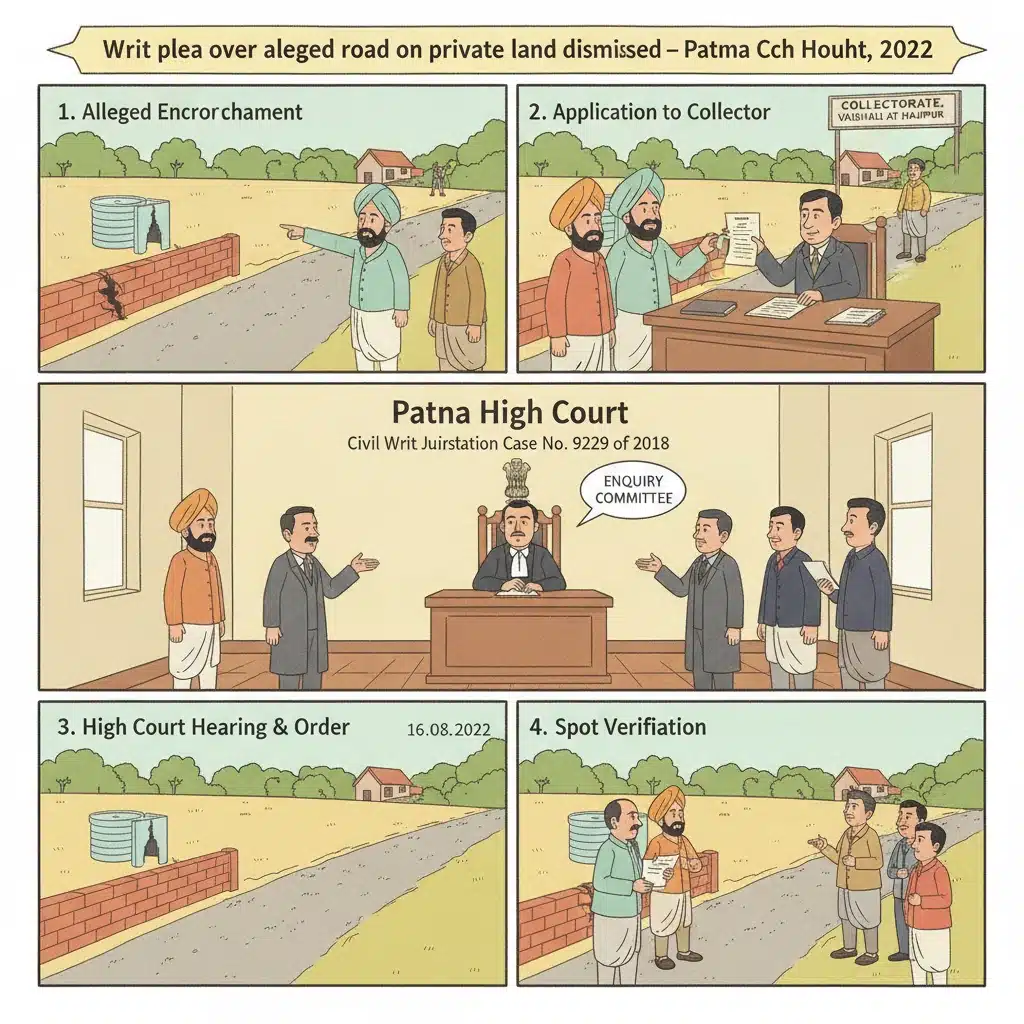
After a family partition, the land was measured on 16.03.2018. During this measurement, the petitioners claimed that they discovered an alleged encroachment on a portion of their land.
They asserted that land measuring about 10 dhur in the said khata and khesra had been forcibly encroached upon by the local Mukhiya. A road had allegedly been constructed over that part of their homestead land.
The petitioners objected to this construction. However, they alleged that work on the road did not stop. They therefore approached the district administration.
On 17.03.2018, they filed an application before the Collector, Vaishali at Hajipur, seeking removal of the alleged road made over their private land. According to them, no action was taken on this complaint.
They further alleged that, instead of protecting their land, the boundary wall, bathroom and septic tank of their house were destroyed and demolished. Feeling aggrieved, they approached the Patna High Court under its civil writ jurisdiction.
In the writ petition, they sought directions to the State authorities to stop the alleged illegal construction of the road over their homestead land and to remove the road already constructed over it.
What the Court Examined and Decided
The matter was heard by Hon’ble Mr. Justice Mohit Kumar Shah of the Patna High Court. The petitioners were represented by counsel, and the State of Bihar and its officials were represented by Government Pleader-18.
The key question before the Court was whether a road had in fact been constructed over the petitioners’ homestead land and, if so, whether the High Court should grant relief in writ jurisdiction.
On 16.08.2022, the Court directed the District Magistrate, Vaishali at Hajipur, to enquire into the matter. He was asked to ascertain the actual facts and file a counter affidavit before the Court.
In compliance with this order, the District Magistrate conducted an enquiry. By letter dated 20.08.2022, he constituted an Enquiry Committee. This committee carried out a spot verification.
The spot verification was done in the presence of the petitioners. It was also carried out in the presence of the Anchal Amin and the Rajasva Karamchari. The officials examined the location of the road and its relation to the petitioners’ homestead land.
On the basis of this enquiry and verification, the authorities came to a clear conclusion. According to the Enquiry Committee, the road in question did not exist on the homestead land of the petitioners.
This conclusion was not only stated in the report of the Enquiry Committee but was also corroborated by the report of the Anchal Amin and the sketch map of the area. These documents were annexed as Annexures C/1 and C/2 to the counter affidavit filed by the District Magistrate.
The State’s counsel relied on these records and argued that the petitioners’ allegation of a road on their land was factually incorrect. The State further relied on a joint enquiry report dated 23.08.2022.
This joint report was prepared by the Circle Officer, Hajipur, the Deputy Collector Land Reforms, Hajipur, and the Sub-Divisional Magistrate, Hajipur. It also concluded that no road had been constructed over the land purchased by the petitioners.
Instead, according to the joint report, the brick soling road had been constructed over the land of one Sudama Devi. Her land was situated towards the north of the land of the petitioners.
Thus, both the earlier enquiry and the joint enquiry consistently stated that the road was not on the petitioners’ homestead land but on the land of another person to the north.
The Court noted that the petitioners’ counsel was unable to controvert these findings. There was no material shown to the Court which could dislodge or seriously question the reports of the District authorities.
Having regard to these facts, the Court held that the thorough enquiry conducted by the District Magistrate, along with spot verification in the petitioners’ presence, had clearly established that the road did not exist on the petitioners’ land. Therefore, the claim of the petitioners was belied by the factual record brought on file.
The Court then considered the legal position. It observed that, even if the petitioners wanted to dispute the findings of the District Magistrate and other officials, such a dispute would involve contested questions of fact.
Disputed questions of fact require detailed examination of evidence. This is normally done before a competent Civil Court, not in writ proceedings under Article 226.
The Court held that any challenge to the factual findings of the enquiry committee must be raised before the appropriate forum, namely the competent Civil Court having jurisdiction over the land dispute.
Because the case involved disputed facts about title and location of land, the High Court found that the writ petition itself was not maintainable.
To support this view, the Court referred to the judgment of the Hon’ble Supreme Court in Thansingh Nathmal & Ors. vs A. Mazid, Superintendent of Taxes, reported in A.I.R. 1964 SC 1419. This decision laid down principles on when the High Court should refuse to exercise writ jurisdiction, particularly when other adequate remedies exist or when complex fact disputes are involved.
The Court also relied on another Supreme Court judgment reported in (1969) 3 SCC 769, Smt. Gunwant Kaur & Ors. vs. Municipal Committee, Bhatinda & Ors. This case similarly dealt with limits on writ jurisdiction where disputed facts require civil trial.
Further, the Court cited the Supreme Court judgment reported in (2020) 6 SCC 256, Punjab National Bank & Others vs. Atamanand Singh & Others. That decision reiterated that writ jurisdiction is not suited for resolving complex factual disputes.
Taking note of these authorities and the factual record before it, the Patna High Court concluded that the case at hand was not fit for determination under its writ jurisdiction.
Accordingly, the Court held that the writ petition was not maintainable and dismissed it. No further directions were issued in favour of the petitioners regarding removal or stoppage of the road.
Why This Judgment Matters
This judgment is important for residents who feel that their private land has been taken over for roads or other public works. It explains what kind of proof is needed and which forum is proper.
Here, after an official enquiry and spot verification, the authorities found that the public road was not on the petitioners’ land. Once these facts came on record, the High Court declined to treat it as a writ matter.
The decision shows that when the main dispute is about facts—such as the exact location, measurement or ownership of land—the proper place to fight is usually the Civil Court. The Patna High Court will not normally act like a trial court in such disputes.
At the same time, the judgment reminds district officials of their duty to conduct fair enquiries with proper measurement and mapping, as their reports can strongly influence the outcome in higher courts.
Legal Issues and Answers
Issue: Whether a writ court can direct stoppage and removal of an allegedly illegal road on private homestead land when there is a dispute over the factual location of the road.
Answer: No. After official enquiry showed that the road was not on the petitioners’ land, and since any further challenge would involve disputed questions of fact, the Patna High Court held the writ petition not maintainable and dismissed it, leaving the petitioners to approach the competent Civil Court if so advised.
Cases Cited by the Court
- Thansingh Nathmal & Ors. vs A. Mazid, Superintendent of Taxes, A.I.R. 1964 SC 1419
- Smt. Gunwant Kaur & Ors. vs. Municipal Committee, Bhatinda & Ors., (1969) 3 SCC 769
- Punjab National Bank & Others vs. Atamanand Singh & Others, (2020) 6 SCC 256
Case Details
Case Number: Civil Writ Jurisdiction Case No. 9229 of 2018
Case Title: Rajendra Ray & Anr. vs The State of Bihar & Ors.
Coram: Hon’ble Mr. Justice Mohit Kumar Shah
Citation: 2022 (4) PLJR 605
Advocates: Mr. Sanjay Kumar Pandey, Advocate for the petitioners; Mr. Raj Kishore Roy, GP-18 for the respondents/State
Nature of the Case: Civil writ petition seeking directions to stop and remove alleged illegal road construction over petitioners’ homestead land
Date of Judgment: 30.08.2022
Link to Judgment: View full judgment on Patna High Court website
If you found this explanation helpful and wish to stay informed about
how legal developments may affect your rights in Bihar,
you may consider following Samvida Law Associates for more updates.




